

Fast-track special courts slow as backlog mounts; nearly 2.5 lakh cases pending | India News


BENGALURU: At a time when Centre has announced setting up of Fast-Track Courts (FTC) to ensure expeditious trials in paper leak cases in the wake of the 2026 NEET fiasco, the country’s Fast-Track Special Courts (FTSCs) — operating under the most recent scheme introduced in Oct 2019 — are buckling under mounting backlogs.Govt data analysed by TOI shows that annual disposals by FTSCs, created to deliver swift justice in some of the most sensitive criminal cases (rape and Pocso), dropped to 66,500 cases in 2025, down from a record 85,595 in 2024, a decline of more than 22%. At the same time, pending cases rose from a little more than 2 lakh at the end of 2024 to nearly 2.5 lakh by the close of 2025.The trend suggests that despite expanding judicial capacity, fresh cases continue to outnumber disposals. Since 2021, pendency has increased by nearly one-third, from around 1.8 lakh to nearly 2.5 lakh , even as annual disposals almost doubled between 2021 and 2024 before falling last year.
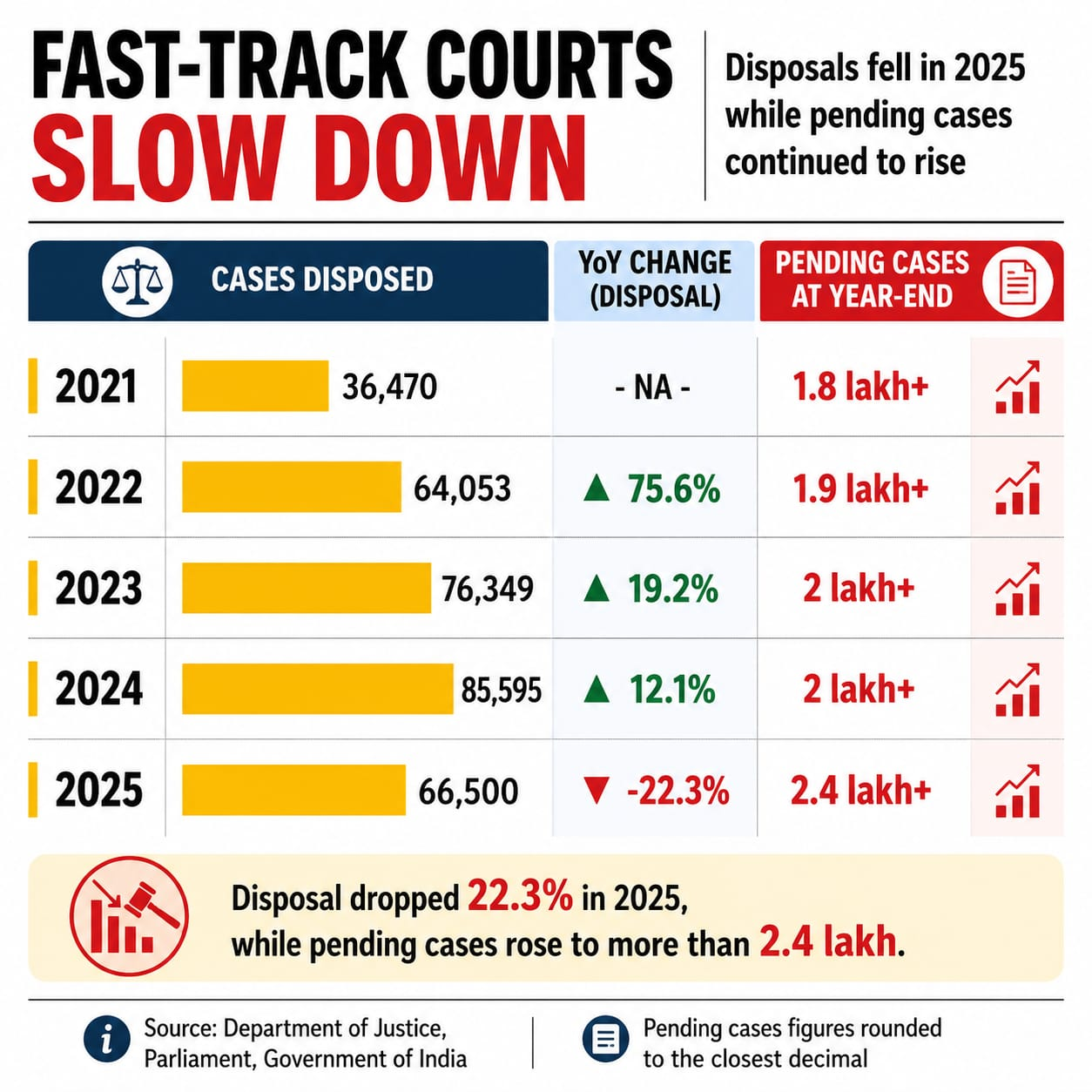
The figures point to a structural challenge rather than a temporary slowdown. Fast-track courts were conceived to shorten the time victims wait for justice, but rising case inflows, judicial vacancies, infrastructure constraints and limited courtroom capacity have continued to push pendency upwards. The result is that courts designed to accelerate trials are themselves carrying growing backlogs.As per the latest information from the govt, the FTSC scheme currently operates 775 courts, including 398 exclusive POCSO courts, across the country. This is against a target of at least 790 courts that should have been functional. The courts have disposed of nearly 3.9 lakh cases since inception. Yet with nearly 2.5 lakh cases still pending, the gains have not translated into a sustained reduction in backlog.The experience varies widely across States. While some States have managed comparatively low pendency per court, others continue to operate under far heavier workloads, indicating that the effectiveness of the scheme depends not only on the number of courts but also on staffing, infrastructure and the volume of new cases entering the system.The latest figures relate specifically to Fast Track Special Courts (FTSCs), which are a separate scheme launched by the Centre in Oct 2019 to hear rape and Protection of Children from Sexual Offences (POCSO) Act cases, which has since been extended up to Sept 30, 2026. These should not be confused with the original Fast Track Courts (FTCs), which were introduced nearly two decades earlier — 880 of which are functional currently.These courts had disposed of more than 13 lakh cases in 2025, up from 11.7 lakh in 2024, but lower than 15.2 lakh in 2023. However, year-wise pendency data on FTCs wasn’t immediately available. The department of justice’s dashboard, which was accessible as of July 23 night, was offline on Friday.History Of Fast-Track CourtsIndia’s first FTCs were established in 2000 following the recommendations of the 11th Finance Commission. The idea was to create additional courts on a temporary basis to clear long-pending sessions cases and reduce the number of undertrial prisoners.The Centre funded the scheme until March 31, 2011, after which States were expected to use their own resources. While several States retained or expanded FTCs, others allowed them to lapse, leading to wide variations across the country.The policy then evolved after the 2012 Nirbhaya case, as public pressure mounted for quicker trials in sexual offence cases. The 14th Finance Commission later supported the creation of 1,800 Fast Track Courts using the increased fiscal space available to States, though without dedicated central funding.And, in Oct 2019 the FTSCs scheme under the Nirbhaya Fund was launched. Since then, the ordinary FTCs remain the responsibility of state govts and high courts, while the Centre funds only the FTSC scheme.