
Rhode Island’s offshore wind turbines are attracting Jonah crabs, raising a bigger question about whether they are creating new marine habitat |

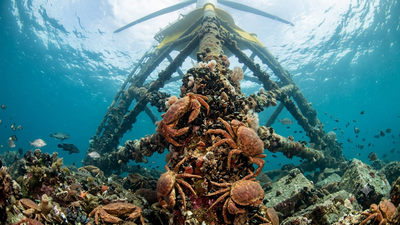
Far below the surface off the coast of Rhode Island, the bases of offshore wind turbines are becoming something more than supports for machines. Their hard foundations are providing places for marine organisms to settle, creating patches of habitat on an otherwise softer seafloor. Barnacles, mussels, algae and other small creatures can attach themselves to the structures, bringing feeding opportunities for animals higher up the food chain. Jonah crabs are among the species now being found around these installations. Their presence has raised a question that scientists are still working to answer: are the turbines producing new habitat that supports more crabs, or are they simply drawing existing animals into one place?
Why Jonah crabs are becoming more important to New England fishermen
Jonah crabs were once largely incidental catches in Southern New England’s lobster fishery. Fishermen looking for lobsters could find them in their traps, but the crab had nowhere near the same commercial importance and was often returned to the water.That situation has changed as conditions in the region’s lobster fishery have shifted. Warming ocean waters have affected where American lobsters are found, with the species increasingly moving towards cooler parts of the North Atlantic. As fishermen have adapted to those changes, Jonah crab has become a more important commercial species.The shift matters beyond the fishing industry. Jonah crabs occupy a useful position in the seafloor food web, acting as both predators and prey. Because much of their life is tied to benthic habitats, changes in where they feed and shelter can offer clues about how new structures are altering the marine environment.
Turbine foundations are becoming places to live
A turbine foundation creates a large area of hard surface in a marine environment where much of the surrounding seabed may not offer the same kind of attachment point. Once the structure is in place, organisms can begin settling on it.Small marine life arrives first. Barnacles and mussels can colonise the foundation, while algae and other organisms add further layers to the developing community. Those organisms can then become food or shelter for larger animals.For a crab, the structure is not necessarily important because it is a wind turbine. The result can resemble a small artificial reef. Fish may visit to feed, crabs can gather around the available food and shelter, and other species can use the structure in different ways. The community does not appear all at once. It develops as organisms settle and interact with one another.
Scientists investigate whether wind farms are supporting crab growth
As reported by Ocean State Media, this distinction sits at the centre of Emmanuel Oyewole’s research at the University of Rhode Island’s Graduate School of Oceanography.Oyewole has been making regular trips from Point Judith aboard commercial fishing vessels, working around the Revolution Wind and South Fork Wind areas. His fieldwork involves ventless traps placed at stations around the offshore wind sites, with trips taking place roughly twice a month.The catches have provided evidence of an increase in the number of Jonah crabs found around the turbines. But there is an important question behind those numbers. A structure that offers food and shelter can attract crabs that were already living elsewhere nearby. If that is what is happening, a larger concentration around the turbines would not necessarily mean the regional crab population has grown.The alternative is more significant from an ecological and fisheries perspective. If the structures are allowing crabs to feed, survive and eventually reproduce there, the turbines could be supporting additional production rather than simply concentrating animals that were already present.At this stage, Oyewole’s work has not established which of those explanations accounts for the increase.
Crab tissue could reveal whether the turbines are creating a lasting habitat
The unusual part of the investigation takes place after the boats return to shore. Crabs collected during the fieldwork are stored for laboratory analysis at URI. Oyewole is using stable isotope techniques to examine chemical signatures in different tissues, looking for evidence of where the animals have been feeding and living over different periods of their lives.The approach works because tissues do not all record an animal’s history in exactly the same way. Chemical signatures can provide information about the environments an animal has occupied, allowing researchers to reconstruct parts of its movements and feeding history.That gives Oyewole a way to approach the bigger question without simply counting crabs around the turbines. If the chemical evidence indicates that the animals have spent substantial periods feeding and living around the structures, it could support the idea that the new habitat is being used for more than temporary shelter or feeding stops. If the signatures instead point to crabs arriving from surrounding areas, the turbines may be functioning mainly as gathering places.
What the growing crab numbers could mean for local fisheries
As reported by The Nature Conservancy, the project is being carried out with the Commercial Fisheries Research Foundation, a nonprofit organisation established by local commercial fishermen. Oyewole has spent time on fishing boats and speaking with people who work these waters regularly, using their observations about species behaviour, fishing patterns and changing conditions alongside scientific sampling.The fieldwork also means his research is taking place within an active fishing environment rather than in isolation from it. The information gathered from the traps and the laboratory analysis is intended to contribute to a clearer understanding of how offshore wind sites interact with fisheries.A temporary concentration of crabs could have different implications from a habitat that supports growth and reproduction. Distinguishing between the two may eventually help scientists and fisheries managers understand how these newly created structures fit into the wider ecosystem.