


NEW DELHI/MUMBAI: A year after GST rationalisation, higher commodity prices have eroded a large part of the gains with prices of several products – from food to consumer goods and automobiles – slowly inching up.Within the multiple segments that saw rate reduction, with some of the slabs and cess on most goods being removed, automobiles have emerged as the clearest winner. Consumers initially paid less, demand accelerated and sales touched new highs.Automobile retail sales reached 29 million units during the 11 months ended Aug 2026, rising 20% from a year earlier, according to ICRA. Passenger vehicle registrations grew 22%, while two-wheelers rose 20%, commercial vehicles 19% and tractors 23%.“Assessed over the past 11-12 months since implementation, the GST rate rationalisation could be said to have delivered a notable consumption sentiment boost,” said Jitin Makkar, senior vice-president and group head, corporate ratings, ICRA.
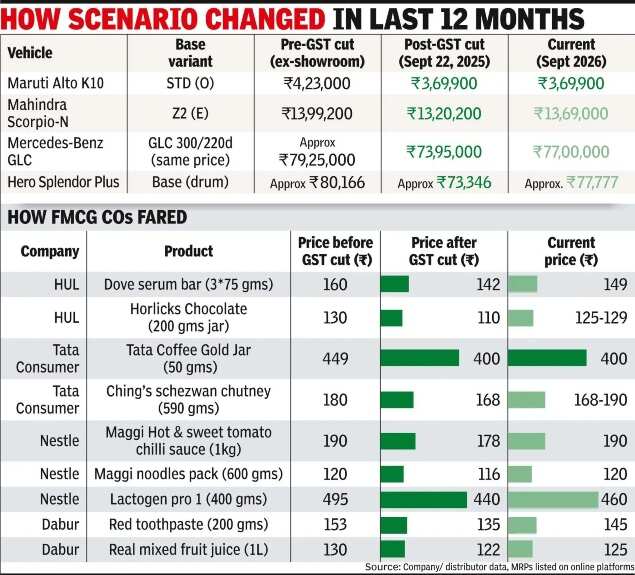
The changes in past 12 months
The momentum was visible in manufacturer dispatches, as per Siam data, over the last six months. “The broader demand environment remains fundamentally healthy,” Siam director general Rajesh Menon said in Aug. He, however, acknowledged that last month’s growth was also “supported by a lower base of previous year”.Vehicle prices illustrate both the original benefit and its subsequent dilution. The Maruti Alto K10 STD (O), which cost Rs 4.2 lakh before the rate reduction, fell to Rs 3.7 lakh after Sept 22, 2025 and remains at that level. The Mahindra Scorpio-N Z2 declined from Rs 13.9 lakh to Rs 13.2 lakh but now costs Rs 13.6 lakh (see graphic).The outcome has been more mixed in fast-moving consumer goods. GST on several essentials was reduced to 5% from 12% or 18%, initially prompting average price cuts of around 10%. Companies have since raised prices by 6-7% to manage higher raw-material, energy and logistics costs, including inflation linked to the West Asia conflict. “Consumers are still better off by 2-3%,” said Mayank Shah, chief marketing officer at Parle Products. He, however, cautioned that companies may need another round of price increases closer to Diwali if input-cost inflation persists.Nestle India said the GST reduction provided a “positive impetus to consumption”. But Ronak Shah, consumer-sector analyst at Equirus Securities, said it had delivered “more of an affordability boost than a direct demand surge” for FMCG companies.“The GST reduction has provided some cushion against cost inflation, rather than translating into a meaningful increase in category consumption,” he said. Premium and discretionary products saw some incremental demand, but subsequent mid-to-high-single-digit price increases diluted the gains.Apparel largely missed out. GST on clothing priced above Rs 2,500 rose from 12% to 18%, affecting festive and occasion wear. “The GST 2.0 reforms or reductions have not really impacted prices to a great degree,” said Rahul Mehta, chief mentor at the Clothing Manufacturers Association of India. Mehta expects apparel costs to rise 8-10% this festive season, although consumer prices may increase by a lower 5-7% as manufacturers, brands and retailers absorb part of the burden.Other unintended effects also emerged. Mid-market hotels moved from 12% GST with input-tax credit to 5% without it, squeezing margins because key inputs remained taxed at higher rates.