
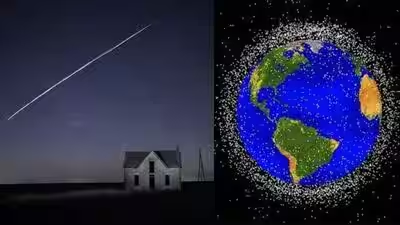

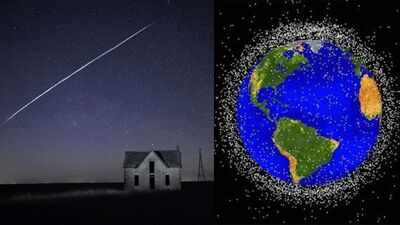
More than a metric tonne of space debris is falling back to Earth roughly every week as the rapid growth in rocket launches and satellite deployments increases the amount of junk orbiting the planet, according to a report.Space junk includes discarded rocket bodies, defunct satellites and fragments from spacecraft. There are about 36,000 pieces of debris larger than 10 centimetres and tens of millions of smaller fragments in orbit, with the total estimated weight reaching 13,486 tonnes.A recent incident in Kenya highlighted the growing problem. In December, a large metal ring from a rocket fell into farmland near Mukuku village, around three hours south of Nairobi, according to a report by New York Times.“People were thinking this is the end of the world,” John Mukunuu, a local resident told NYT.The object, which was taller than a person and heavier than a horse, was later identified as a rocket component. Kenya Space Agency said in early 2025 that it was “an isolated event”.However, experts cited in the report said falling debris is becoming more frequent. “The re-entries happen each and every day,” said Mariusz Slonina, who heads space situational awareness operations for the Polish Space Agency. He added that objects weighing a metric tonne or more return to Earth about once a week.The report said the United States Space Force issued alerts for nearly 820 objects entering Earth’s atmosphere last year, compared with 110 a decade earlier.More than 300 rockets were launched last year, nearly four times the number from a decade ago. The increase has added to concerns over uncontrolled re-entry of spent rocket parts and ageing satellites.Space junk also poses a threat in orbit. Debris in low Earth orbit travels at around 7 kilometres per second, and collisions can create more fragments in a chain reaction known as the Kessler syndrome.The International Space Station (ISS) already carries out manoeuvres to avoid debris. “The default solution is to let space junk get dragged into the atmosphere where it incinerates,” the report said.The expansion of commercial satellite networks has intensified the challenge. SpaceX, which operates more than 10,000 satellites, has applied to launch many more, while Blue Origin and Chinese satellite programmes have similar plans.A study for the United States Federal Aviation Administration found that by 2035, debris from SpaceX satellites alone could kill or injure someone every two years.The report stated that Starlink satellites will account for 85 per cent of the risk to people on the ground and aviation from reentering space junk by the middle of the next decade.SpaceX previously disputed the assessment but later said about 5 per cent of the mass of some satellites may not disintegrate during re-entry.Sean O’Keefe, a Syracuse University professor and former Nasa administrator, told NYT, “Humans have a lot of failure of imagination. We just can’t imagine that it will happen to us.”Experts said governments and companies may need stronger rules requiring spacecraft to use materials that fully burn up during re-entry. Current United Nations space debris guidelines are non-binding and were issued in 2007, when far fewer satellites were in orbit.The report noted that predicting landing locations remains difficult. According to the Aerospace Corporation, a nonprofit research group, a one-minute error in predicting re-entry can shift the possible impact zone by nearly 300 miles.