
Helicopters, influencers and nail art: The money trail of 2026 assembly elections | India News


From paying social-media influencers to allocating money for ‘nail art’, the BJP‘s expenditure statements reveal the range of campaign activities funded during its bid to win the West Bengal assembly election. A closer look at political parties’ filings with the Election Commission of India (ECI) makes for interesting reading, revealing how spending priorities varied according to the political stakes in different states. However, the TVK example is only a humbling reminder that in democracy, greater outreach may lead to greater eyeballs, but it is no guarantee for success.The BJP declared Rs 529.39 crore expense for this year’s assembly elections in West Bengal, Assam, Keralam, Tamil Nadu and Puducherry. Congress declared Rs 248.55 crore as spending, less than half that amount.A TOI analysis of the expenditure filings shows that Rs 178.78 crore of the Rs 280.84-crore difference, nearly two-thirds, came from advertisements and travel by star campaigners, the top leaders a party sends around a state to address rallies. Money given directly to candidates accounted for only Rs 16.27 crore of the gap. At least on paper, the BJP’s extensive advertising campaigns and deployment of senior leaders, many of them massive crowd pullers, distinguished its expenditure pattern from that of Congress.The BJP won 207 seats in West Bengal in the results declared on May 4 and later won the Falta repoll to take its tally to 208. It formed its first government in the state, ending the Trinamool Congress’s 15-year rule. TMC chief Mamata Banerjee lost her own seat, Bhabanipur, to the BJP’s Suvendu Adhikari. The BJP-led NDA won Assam for a third consecutive term, while the NDA led by the All India NR Congress retained Puducherry.In Keralam, the Congress-led UDF returned to power after 10 years. Congress won 63 of the 140 seats, the CPI(M)-led LDF 35 and the BJP three. In Tamil Nadu, film star Vijay’s TVK, contesting its first assembly election on the whistle symbol, won 108 of the 234 seats, ahead of the DMK with 59 and the AIADMK with 47. Subsequently, Vijay became chief minister.
What each party declared
The BJP, Congress and CPI(M) filed accounts covering all five elections, with the CPI(M) declaring only Rs 39.04 crore as expenditure. The DMK declared Rs 197.85 crore spending for Tamil Nadu and Puducherry, while the AIADMK reported Rs 112.40 crore expenses in a statement covering Tamil Nadu, Puducherry and Keralam.TVK reported Rs 19.81 crore for Tamil Nadu, according to TOI report. TMC’s full 2026 expenditure statement is not available on the ECI website.Political parties have no overall election expenditure ceiling, but individual candidates face spending limits. The accounts can also include expenditure authorised but not yet paid. The BJP’s Bengal return, for instance, recorded Rs 89.32 crore in outstanding general-campaign expenditure at the end of the election period.
State by state
More than half the BJP’s money, Rs 286.99 crore or 54.2 per cent, went to Bengal, followed by Rs 96.27 crore in Assam. Together, the two states accounted for Rs 383.26 crore, or 72.4 per cent of the party’s total. The BJP also declared Rs 82.67 crore in Keralam, Rs 51.56 crore in Tamil Nadu and Rs 11.90 crore in Puducherry.
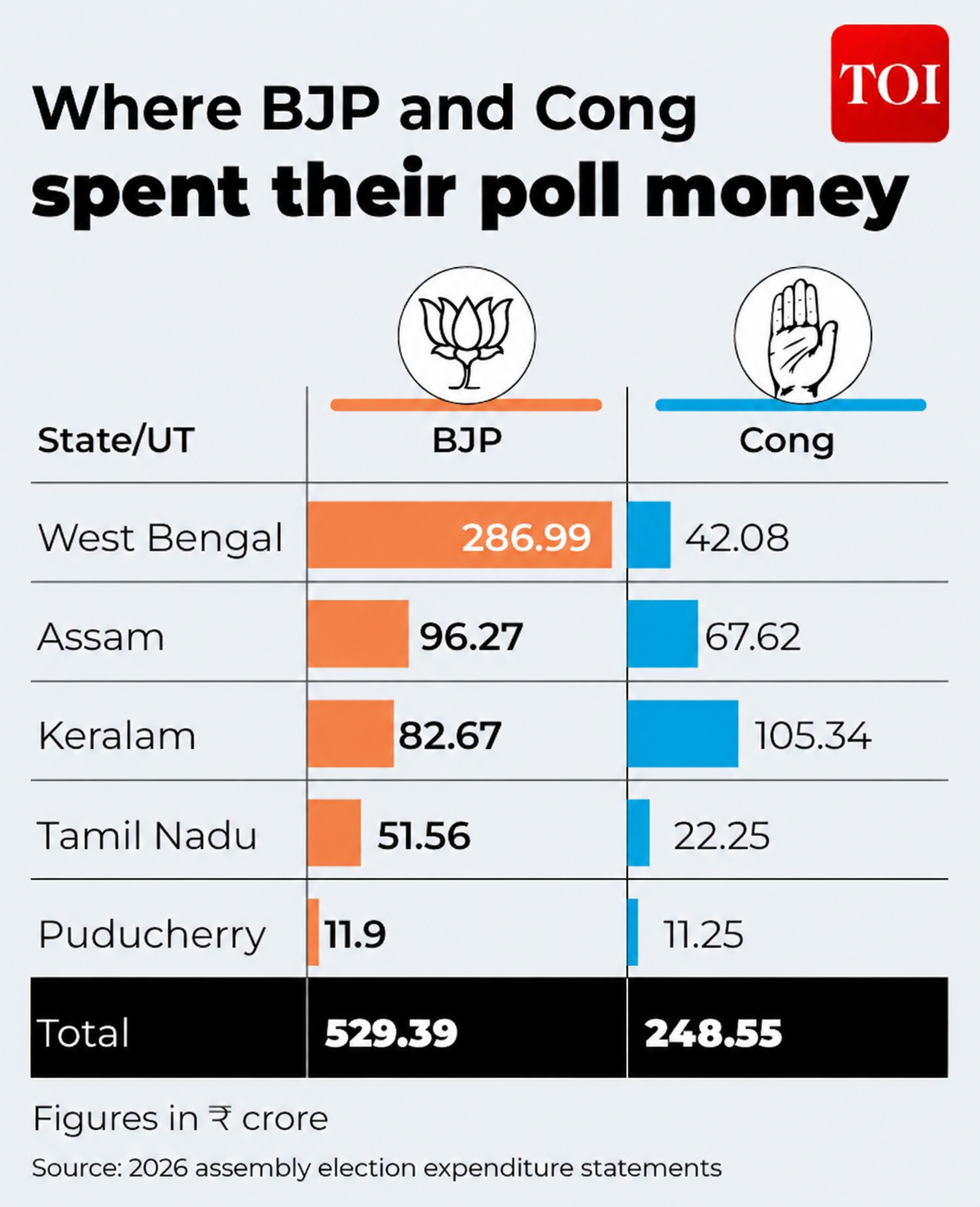
A statewise representation of poll expenditure by the BJP and Congress.
The spending pattern broadly reflected the different political stakes.The figure broadly aligns with what was at stake too. BJP was desperate to get power in Bengal after catapulting to second position in 2021 and sensing anti-incumbency was heavily weighing down on Mamata Banerjee. In Assam, it was looking to consolidate a strong position. The party had much less at stake in Tamil Nadu where it is still an emerging force. In Keralam, a much smaller state than Tamil Nadu, more amount was pumped in sensing an opportunity to break the binary nature of the state politics.For Congress, the situation was totally different. Its biggest chance for coming to power was in Keralam and it’s no surprise that the party spent the most in Keralam, Rs 105.34 crore or 42.4 per cent of its total, followed by Assam at Rs 67.62 crore, or 27.2 per cent. It declared Rs 42.08 crore in Bengal, Rs 22.25 crore in Tamil Nadu and Rs 11.25 crore in Puducherry.Bengal accounts for most of the gap between the two parties, perhaps unsurprisingly, although both parties were contesting almost the same number of seats in the state. The BJP declared Rs 244.91 crore more than Congress there, about 87 per cent of the total difference. Keralam was the only state where Congress declared more, by Rs 22.67 crore.
Where the gap came from
Party filings divide spending into different categories, and three of them help explain the BJP–Congress difference to an extent.The BJP declared Rs 187.54 crore on general-party media advertisements, which promote the party as a whole rather than individual candidates. Congress declared Rs 92.52 crore, a difference of Rs 95.02 crore.
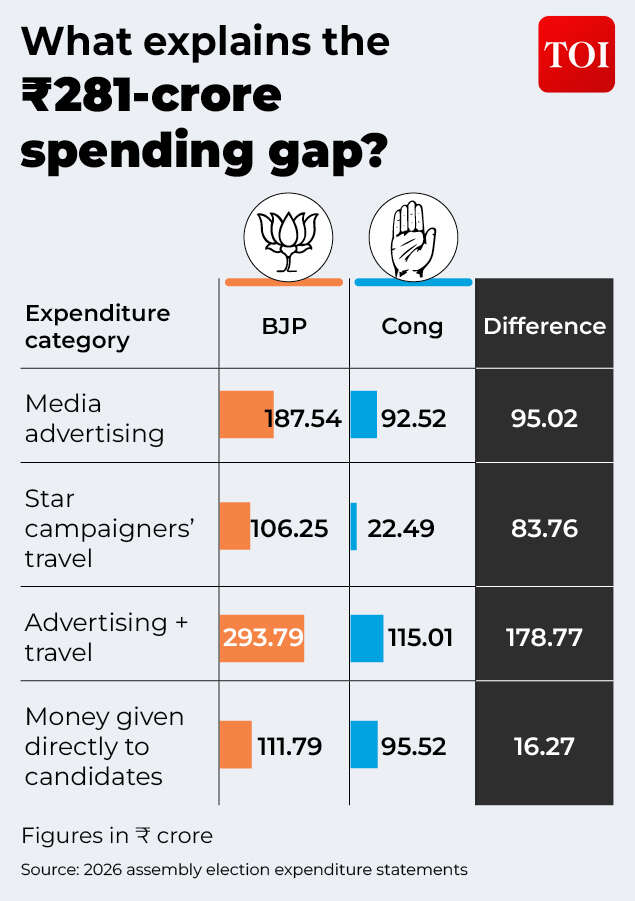
The funding gap between BJP and Congress, and where the money was spent.
Star-campaigner travel covers trips by a party’s senior leaders, and the BJP’s schedules list aircraft and helicopter travel for several of them. The BJP declared Rs 106.25 crore under this head against Congress’s Rs 22.49 crore, about 4.7 times as much and Rs 83.76 crore more.Direct grants, the money a party transfers to candidates, were much closer. The BJP declared Rs 111.79 crore and Congress Rs 95.52 crore, a difference of Rs 16.27 crore, with the BJP’s grants about 17 per cent higher. Congress spent slightly more on grants than on general-party media advertisements.In Bengal, the BJP recorded grants of Rs 20 lakh each to its 294 candidates, totalling Rs 58.80 crore. In the same state, it declared Rs 88.48 crore on general-party media advertisements and Rs 52.18 crore on star-campaigner travel.Grants, however, are only part of the support candidates receive, since parties also pay centrally for publicity, rallies and other campaign activities.
Who was paid
The filings name the people and firms that were paid, though they do not always specify what services were delivered.In Bengal, the BJP’s accounts include payments recorded against social-media influencers and content creators. TOI earlier reported that influencer Sayak Chakraborty acknowledged receiving Rs 2.5 lakh for two videos, The Bengal accounts also contain entries for nail art. Four entries of Rs 1 lakh each, marked “Nail Art”, appear under public meetings and rallies. Another Rs 9.65 lakh is recorded against Visionary Edge for a “Nail Art Prog” under media advertisements.Sayak was not the only influencer or content creator named in the accounts. Others have also acknowledged receiving payments. Yet the separate virtual-campaign schedules recorded no expenditure.Across the five elections, the BJP’s accounts list Rs 41.83 crore against Google India and Rs 15.65 crore against Facebook India Online Services, a total of Rs 57.48 crore, of which Rs 31.39 crore was attributed to Bengal. This amount is already included in the BJP’s advertising expenditure. Advertising purchased through agencies for social media may also appear under other names.The filings also point to the use of artificial intelligence in election outreach. Congress’s headquarters recorded Rs 3.72 crore against Neomarq Flare Solution LLP in Assam for a service described as “AI 2 Way Voice Calling”.In Tamil Nadu, the DMK’s Rs 197.85 crore included Rs 70.63 crore on general-party media advertisements and Rs 45.75 crore in grants to candidates. Five entries marked “Social media” added up to Rs 16.87 crore, naming Vipras Ads, Ravi Publicity Services, Glovy Trading and Populus Empowerment Network.Populus appeared four times in the accounts, for manpower and consultancy, campaign production, digital advertising (Rs 6.37 crore) and social media. Together, these entries totalled Rs 74.94 crore, about 37.9 per cent of the DMK’s expenditure.The AIADMK recorded Rs 103.99 crore of its Rs 112.40 crore, or 92.5 per cent, in a single entry for Pramanya Strategy Consulting, described as “Social Media Promotion, TV, Website”. Because the filing does not break down this amount, it cannot be compared directly with the DMK’s specifically labelled social-media entries.The CPI(M)’s Keralam unit accounted for Rs 28.60 crore of the party’s Rs 39.04 crore, and its Bengal unit Rs 8.23 crore. In Keralam, the party recorded Rs 19.53 crore on general-party media advertisements, of which Rs 18.77 crore, about 96 per cent, appeared in four entries naming Maitri Advertising for print, television and electronic media.These entries identify the companies named in the expenditure schedules, not necessarily the ultimate media outlets or platforms.
Spending and seats
The BJP won Bengal, the state where it declared its largest expenditure, while the Congress-led UDF won Keralam, where Congress spent the most.Tamil Nadu, however, presented a striking contrast.TVK reported expenditure of Rs 19.81 crore, including about Rs 6.3 crore on media advertisements, Rs 3.5 crore on Vijay’s air travel and Rs 2.1 crore on public meetings and roadshows, according to TOI’s September 26 report.The DMK declared Rs 197.85 crore across Tamil Nadu and Puducherry, while the AIADMK reported Rs 112.40 crore in a statement covering three jurisdictions. Although the reporting coverage differed, TVK’s declared expenditure was substantially smaller than that of either established Dravidian party.
Share your thoughts in the comments
Be respectful · TOI community guidelines
Yet TVK won 108 assembly seats, compared with the DMK’s 59 and the AIADMK’s 47.Vijay entered politics with a considerable advantage in public recognition, having spent decades as one of Tamil cinema’s biggest stars. His existing fan base and celebrity appeal may have given TVK organic visibility, yet the difference in spendings can’t be ignored.The filings offer a fascinating account of the financial machinery behind modern election campaigns, from helicopters and digital advertisements to influencers, consultants and AI-powered calls. They also expose the limits of pumping funds to win elections. Hence Tamil Nadu perhaps had the most important lesson for mainstream political parties.