
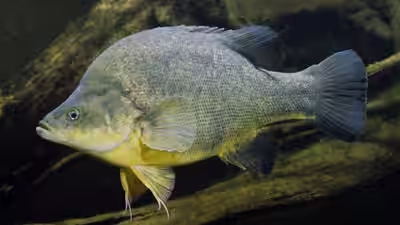
Researchers returned 4,450 pieces of timber to 110 km of Australia’s Murray River; over seven years, Murray cod abundance tripled and golden perch density doubled in the restored reach

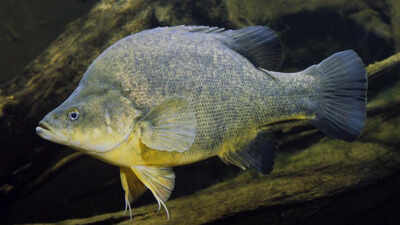
Restoring woody habitat in a degraded section of Australia’s Murray River has led to a major increase in the populations of two native fish species. In the research carried out over seven years, the number of Murray cod in the restored reach increased threefold, while the population of golden perch increased twofold. The aim of the study was to examine whether adding large pieces of coarse woody habitat could increase fish populations. The study was published in Ecological Applications in 2019.During the study, researchers put 4,450 pieces of coarse woody habitat back into about 110 km of the Murray River in south-eastern Australia. The timber was placed between 2007 and 2010 in four priority zones. Most of the pieces weighed more than one tonne and came from natural trees recovered from a large road project. Researchers then monitored fish populations over seven years, from 2007 to 2013.The work focused on Murray cod (Maccullochella peelii) and golden perch (Macquaria ambigua), two native freshwater fish that use woody structures for refuge, cover while hunting and spawning sites. Both species had declined in abundance and range since European settlement. To assess the changes, researchers compared the restored section, called the intervention reach, with three nearby control reaches where the structural restoration was not carried out.The study was designed to account for the fact that fish do not remain in one section of a river. Researchers used electrofishing, tagging, angler reports and radio telemetry to track fish, their movement and mortality. They also used a Bayesian state-space model to estimate population sizes while accounting for differences in capture rates and movement between the river reaches.
More habitat added
The intervention reach had previously lost much of its woody habitat. More than 25,000 large pieces of coarse woody habitat had been removed from the section between 1950 and 1980 to improve water conveyance. The reach was described as degraded, with poor riparian and instream habitats and an altered flow regime.Between 2007 and 2010, researchers reintroduced 4,450 large pieces of coarse woody habitat into the reach. The restored section extended for approximately 120 km from Lake Hume to the junction of Lake Mulwala, with the restoration concentrated in four 5,000-metre priority zones between 25 and 100 river kilometres downstream from Lake Hume.The researchers wanted to find out whether the new habitat would increase the overall fish population or simply cause fish already present in the reach to move into the newly restored areas. To test this, they sampled sites both inside and outside the resnagging zones. The monitoring continued for seven years, providing a longer record than many smaller river restoration studies.
Fish populations increased
During the study, researchers captured 7,312 Murray cod and 3,743 golden perch through electrofishing. They tagged 3,839 Murray cod and 3,316 golden perch with PIT and external tags. They also fitted 689 Murray cod and 466 golden perch with radio tags. Recreational anglers reported the capture of 1,338 tagged Murray cod and 275 tagged golden perch.The population model showed a clear increase in Murray cod in the restored reach. The estimated population of Murray cod larger than 200 mm increased between 2007 and 2013, while a comparable control reach experienced a 40% decrease over the same period. The researchers said the increase in the restored reach did not coincide with a decline in the nearby populations that could explain it simply as fish moving from those areas.Golden perch also increased in the intervention reach. The study sites held about 1,000 golden perch larger than 200 mm between 2007 and 2011, with the estimated number rising to around 2,000 over the course of the study.Also, more than six million records were collected from logging stations and reduced to 558 permanent location changes. More fish moved into the restored population than moved out, with many movements coming upstream from two neighbouring populations. The researchers found that these nearby populations acted as source populations, supplying adult fish to surrounding areas.
Role of connectivity
The researchers said the restoration worked in combination with connectivity between river populations. Fish could move between several of the study reaches, allowing individuals from source populations to reach the restored habitat. Most immigrants came from the closest neighbouring populations where there were no barriers to movement.This means adding habitat alone was not the only factor involved. The restored section was part of a larger connected system in which fish populations interacted. The researchers said transfers from source populations into the restored reach exceeded other movement rates and helped increase the number of adult Murray cod and golden perch there.The study also highlighted the importance of habitat heterogeneity, or having different types of habitat available within a river. Such variation can allow large predatory fish to complete different stages of their life histories and move between populations when conditions change. In the restored reach, the researchers found that the wider metapopulation could provide recruits through immigration, helping offset limited local recruitment.The researchers concluded that restoring coarse woody habitat can increase the population size of large-bodied fish in degraded rivers when the restored area remains connected to source populations. They also said restoration needs to be studied over spatial and time scales that match the species being targeted.