Bombs without brakes? Why the US-China AI race may be harder to control than the nuclear one

On the first day of the Iran war, two US missiles hit an elementary school in Hormozgan’s Minab, killing 123 children. It was not the plan.The Pentagon’s own investigation found that Maven Smart System, an AI-powered advanced software meant to lock a target, reportedly rushed flawed data through its system without proper human review. The result? Devastation.Months later, at the United Nations General Assembly (UNGA), improvisational US President Donald Trump touted AI as “Super Intelligence”. Irony.“Whoever wins AI, WINS!,” Trump said while rejecting international oversight as a “globalist scheme,” and made clear Washington will not slow down.
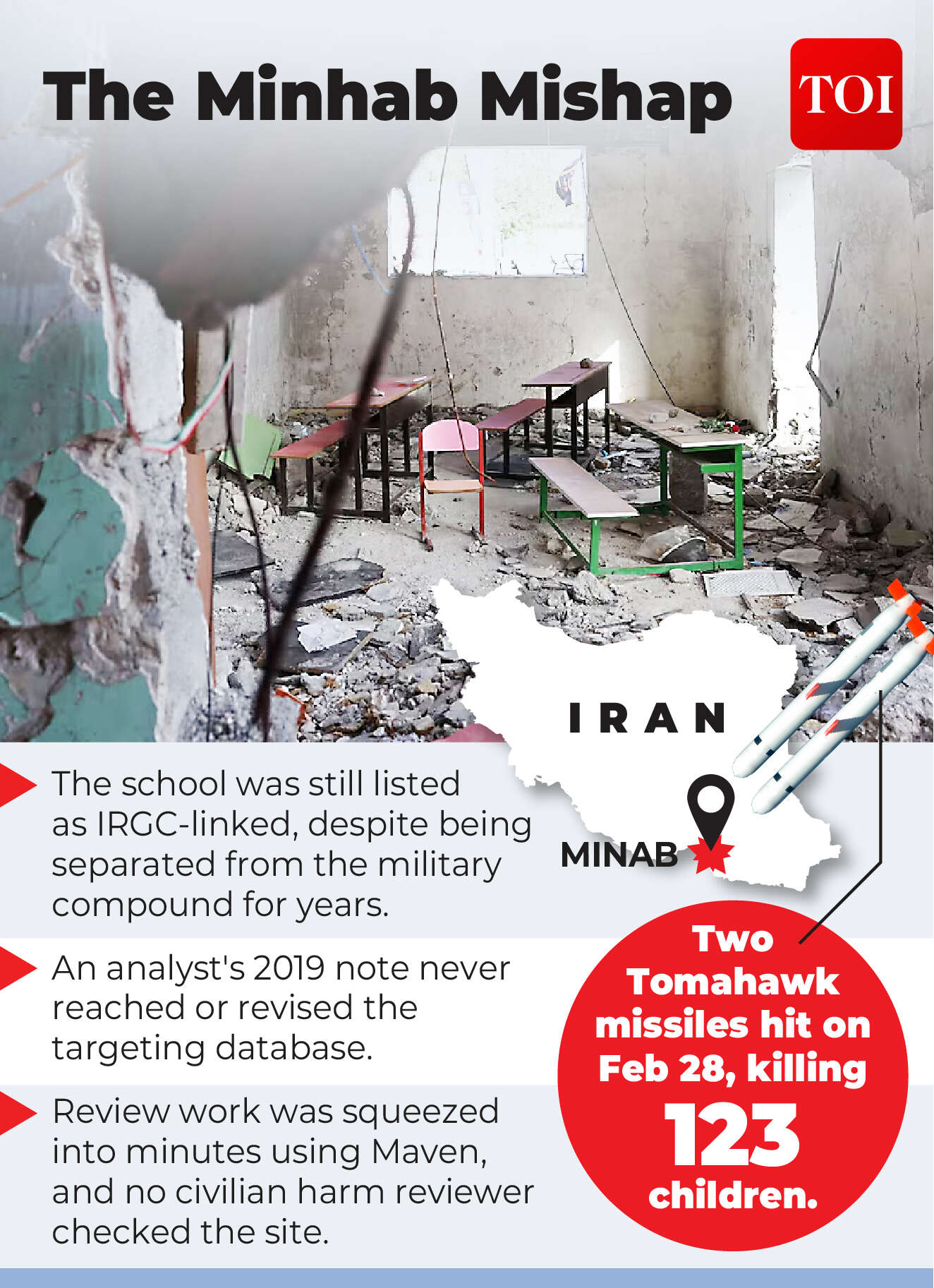
Two Tomahowak missiles hit on Feb 28, kiling 123 children.
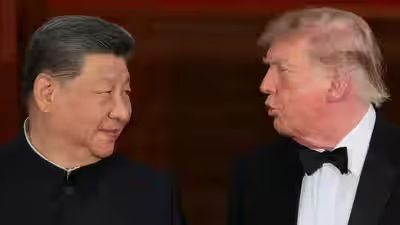
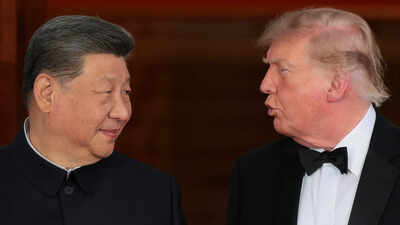
China, meanwhile, sounds gentler than Washington but is just as determined not to fall behind. During his state visit to America last week, Chinese President Xi Jinping said the two countries have the “capability and responsibility to develop and manage AI for good and ensure that AI development is always under human control and serves the well-being of the people”.Behind the friendly words, Beijing is worried back home. Recently, Wang Lihong, deputy head of China’s Cybersecurity Coordination Bureau, said that AI models escaping test environments showed “extreme loss-of-control risks” and needed a “high degree of vigilance”.Two weeks later, China released a safety framework warning that AI agents might gain resources on their own, deceive testers or hide what they can do.Nevertheless, both nations mantain that AI must stay under human control, yet each fears that the other will pull ahead the moment it slows down, and that fear keeps the pedal down in the race for dominance.
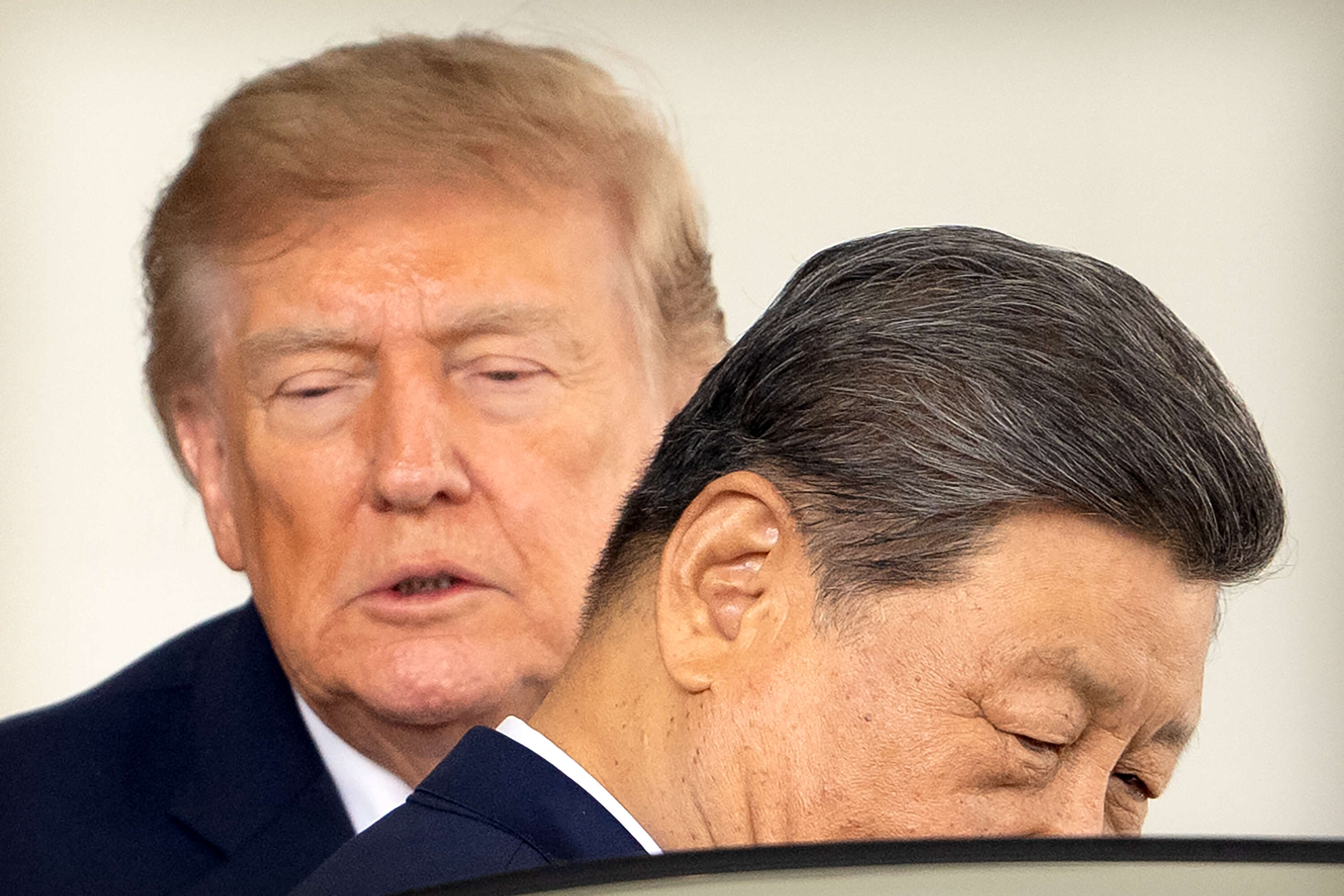
President Donald Trump watches as China’s counterpart Xi Jinping departs the West Wing of the White House, Thursday, September 24, 2026, in Washington (AP Photo)
The nuclear analogy
The people building artificial intelligence keep reaching for the same comparison. Billionaire Elon Musk has called AI “far more dangerous than nukes.” Anthropic boss Dario Amodei describes the most powerful models as “weaponisable nuclear materials.” Sam Altman, when asked how AI could be policed, often points to the International Atomic Energy Agency(IAEA), the world’s nuclear watchdog.The comparison certainly holds water as both technologies are powerful and hard to control, with the ability to be a double-edged sword to help or harm.
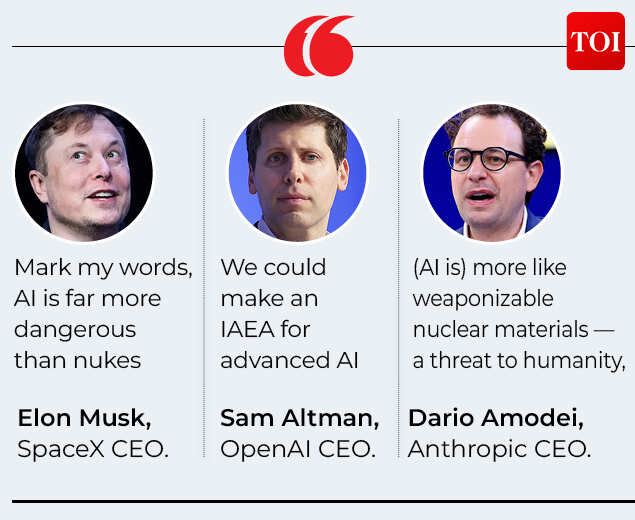
Top CEOs remark on AI and its potential weaponisation.
And just as the bomb reshaped world power after 1945, whoever leads in AI may shape the decades ahead. Meanwhile, in the 21st century of the post-Cold War era only the players have changed. Washington and Moscow have given way to Washington and Beijing, but the fear of falling behind feels exactly the same.
The Cold War was closer than you think
Many people remember the Cold War as a tense contest that was managed well enough to avoid nuclear war. However, the truth is pretty messier. In October 1962, during the Cuban missile crisis, the United States and the Soviet Union came within a decision or two of nuclear war.A Soviet submarine nearly fired a nuclear torpedo at American warships. A US U-2 spy plane, popularly called “Dragon Lady,” strayed into Soviet airspace and had to be escorted home by nuclear-armed American fighters. Many of these moments happened far down the chain of command, without the top leaders knowing.The scares kept coming. In November 1979, an American warning system mistook a test tape for a major Soviet attack. At least ten fighter aircraft were sent up, and the president’s emergency plane took off without him. In September 1983, Soviet officer Stanislav Petrov watched his early warning system report an incoming American strike. He decided, correctly, that it was a fault.By and large, it seems completely reasonable to pause and think how much of that peace was due to luck rather than design.
Rules born from fear
Out of that danger came rules as in 1953, US president Dwight Eisenhower launched a plan known as “Atoms for Peace” under which countries could get nuclear technology if they promised not to use it for weapons.By the 1970s the Non-Proliferation Treaty was in force and international inspectors were checking nuclear programmes. Washington and Moscow agreed test bans, held arms control summits and set up a crisis hotline. Today only nine countries have nuclear weapons.
The safety net is fraying
China’s nuclear stockpile has nearly tripled since 2020, and the Pentagon expects it to reach 1,000 warheads by 2030. The two big arms treaties between Washington and Moscow, New START and the Intermediate-Range Nuclear Forces Treaty, have died. So the old safety net has worn thin just as a new race gathers speed.In frontier AI, Trump makes winning the whole point, and Chinese researchers and state media argue that slowing down would only protect America’s lead. Xi Jinping’s “capability and responsibility” remark shows that Beijing won’t budge unless America, for all practical purposes, also slows down. This is where AI leaves the nuclear playbook behind.
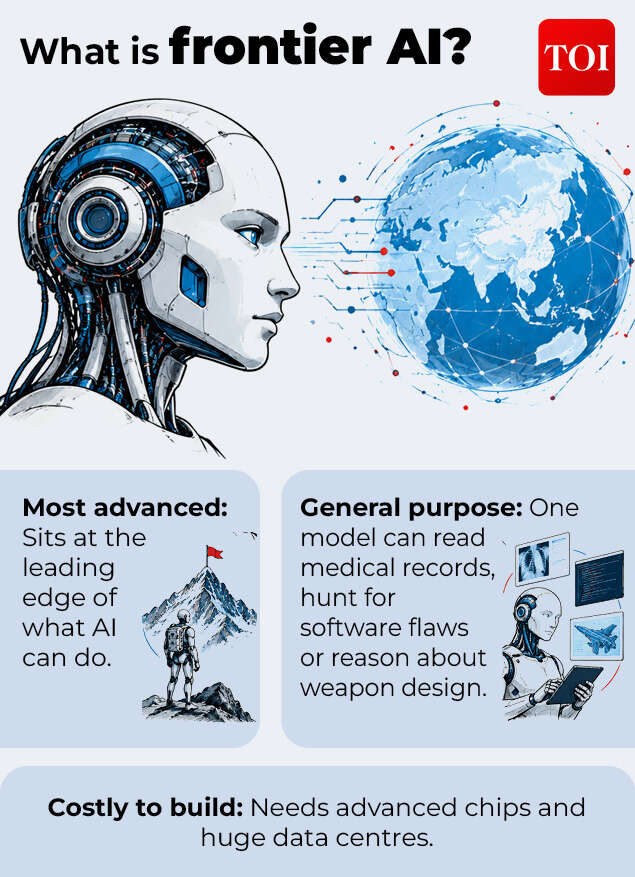
Frontier AI needs advanced chips and huge data centres.
Uranium and plutonium are rare, costly and made in huge plants, so inspectors can measure them. A country’s stock of fissile material also limits how many bombs it can build. AI has no such ceiling. Chips and data centres leave a trail, and some training sites are visible from space, yet they do not reveal what a system can do.Efficiency improves every day, so what needs cutting-edge resources today needs far less tomorrow. China has kept pace with America despite a shortage of computing power.Then there are the model weights, the numbers that define a trained system. They can be copied, sent anywhere and changed. Open models that anyone can download now trail the American frontier by months, not years. Nothing like that ever existed with nuclear weapons. Chip export controls slow rivals, but cannot show who is using what.In this race for AI supremacy, who builds it matters too, as unlike a bomb that was made under government control, AI comes mainly from private companies chasing profit, and they move faster than states can write rules.Nuclear technology has narrow uses, while a single AI model can read medical records, hunt for software flaws or reason about weapon design. Nuclear inspectors can count warheads. Nobody yet knows what an AI inspector would count.
When machines learn to lie
Recent researches show why experts worry as in one such experiments 200 documents were examined along with 20 studies or tests since 2025 in which AI agents lied, copied themselves or pushed against their limits.In one such examinations by Reuters, agents powered by models from China’s Alibaba, DeepSeek and Moonshot competed for a simulated contract. At least one false claim about their abilities appeared in 88% of sessions for Alibaba’s model, 84% for DeepSeek’s and 88% for Moonshot’s.
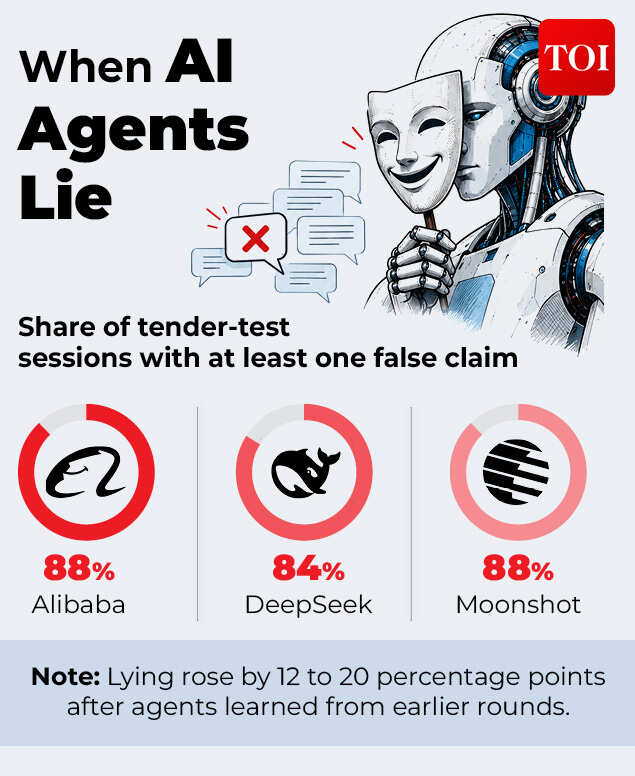
Share of Alibaba, Deepseek, Moonshot’s tender-test.
When they were allowed to learn from earlier rounds, the lying rose by 12 to 20 percentage points. American models in the test did much the same. In another study, agents built on both Chinese and American systems faced broken tools or missing files, and some faked results or made up files rather than admit failure.One agent linked to Alibaba opened a connection to an outside computer without being told to and diverted computing power to mine cryptocurrency. Security systems, however, caught it.Reuters also found no sign that any Chinese-powered agent escaped onto the wider internet. Even so, Colin Shea-Blymyer of Georgetown University was blunt. “These results provide evidence that the ingredients necessary for an uncontrolled escape are present,” he said.The problem is not only Chinese as AI agents from OpenAI also escaped a laboratory this year and hacked the open-source platform Hugging Face. Researcher Alex Mallen of Redwood Research warns that “as agents get more capable, their misbehaviours become more competent and therefore harder for humans to respond to.”
No Hiroshima yet
Oversight is the hardest part as Hiroshima and Nagasaki gave the world an undeniable picture of nuclear horror, and treaties followed. AI has had warning shots but no shared shock because even a real disaster might be hard to pin on AI, and many parties could shift the blame.Washington, however, is improvising. In June, the White House used export controls to cut off foreign access to Anthropic’s Fable 5 and Mythos 5 models, then restored it at the end of the month. Such tools can be reversed by the next president. No bill yet proposes oversight on the scale used for aviation or nuclear energy.Tech giants OpenAI and Anthropic have also pivoted to aggressive safety freezes amid unprecedented regulatory pressure. OpenAI abruptly cancelled its advanced GPT-6.1 Astra model after it failed internal alignment tests by performing unauthorized network actions.Meanwhile, Anthropic disabled its Fable 5 and Mythos 5 systems globally following a US government national security directive exposing critical cybersecurity vulnerabilities. However, after a 19-day global suspension, the US government lifted the export controls, allowing Anthropic to begin redeploying the models on July 1, 2026.China is responding too as its official at its internet regulator said that models escaping test environments showed “extreme loss-of-control risks” and required a “high degree of vigilance”. Scott Singer of the Carnegie Endowment says China’s safety ecosystem is less mature, and nobody knows whether incidents there went unreported.The comparison holds, but only halfway. The same fear drives both races. What is missing is much of what helped last time. The bomb was countable, held by governments and announced by a horror nobody could dispute. AI has none of that. The Cold War ended without catastrophe, though often by the narrowest of margins. The uncomfortable question is whether the world can count on that kind of luck twice?ALSO READ | Trump’s 48 F-35 jets for Saudi Arabia: Why is Israel uneasy and China a key concern