
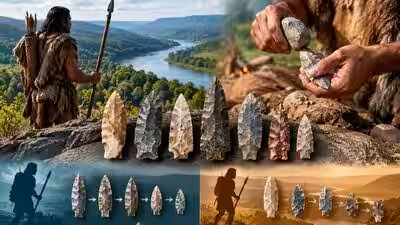
Archaeologists studied about 500 Ice Age spear points from the Tennessee River Valley; 13,200-year-old Clovis hunters resharpened theirs more than later Cumberland people, suggesting newcomers managed risk differently

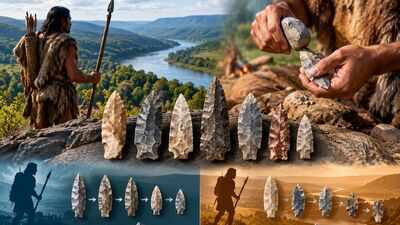
Nearly 13,000 years ago, people moving through the Tennessee River Valley faced a problem that had little to do with simply finding food. They also had to learn which resources could be trusted and where to find the stone needed to make and maintain their hunting tools. A new study in the Journal of Archaeological Method and Theory has found that this learning process may be visible in nearly 500 ancient projectile points. Researchers found that early Clovis groups tended to resharpen their points more extensively, while later Cumberland groups were more willing to discard points that still had usable material. The pattern suggests that familiarity with the landscape changed how people managed valuable tools and the risks associated with replacing them.
Nearly 500 spear points reveal a difference in behaviour
The study, “Foraging Theory and the Colonisation of Unfamiliar Landscapes: Assessing Late Pleistocene Projectile Point Reduction Strategies,” was published in the Journal of Archaeological Method and Theory. It was authored by Jesse W. Tune of the University of Mississippi and D. Shane Miller of the University of Alabama. The researchers examined 489 projectile points, comprising 326 Clovis points and 163 Cumberland points, using records from the Paleoindian Database of the Americas.The two groups lived in the Tennessee River Valley at different points during the late Ice Age. Clovis points date to roughly 13,050-12,750 years ago, while Cumberland points are generally dated to about 12,800-12,000 years ago. According to the University of Mississippi, the earliest evidence of Clovis people in the region dates to around 13,200 years ago. The researchers were interested in something that might appear surprisingly small: what people did with a stone point after it had been used.A projectile point did not necessarily have to be thrown away after becoming damaged or worn. Hunters could resharpen it, reducing its size but extending its useful life. Eventually, however, repeated reshaping would provide diminishing returns, making it more practical to produce or use another point. That decision gave researchers a way to study ancient resource management.
Why Clovis hunters kept resharpening their points
The Tennessee River Valley is particularly useful for this question because it contains abundant high-quality chert, a stone suitable for making projectile points. That means the difference between the two groups cannot easily be explained simply by one group having no access to stone. Instead, the researchers considered knowledge of where and how to obtain that stone.When Clovis groups first entered the landscape, they would not have possessed generations of knowledge about local resources. They might encounter a source of suitable stone without yet understanding how it compared with other sources, how reliable it was or how it fitted into their wider movements across the region. The study argues that this uncertainty encouraged a more conservative strategy. Rather than discarding a worn point, Clovis hunters were more likely to resharpen it and extract more use from the material they already had.The researchers used measurements of the points to estimate their utility and discard thresholds. In simple terms, the analysis looked at how much useful material remained when points were discarded and how extensively they appeared to have been modified during their lifetimes. The results showed that Clovis points displayed patterns consistent with repeated resharpening before discard.
Later Cumberland people could afford to be less conservative
The picture changed with the Cumberland points. Cumberland bases were found across a wider range of remaining utility, including points discarded while more usable material was still present. Their measurements also showed greater variation in how the points had been maintained. The researchers interpret this as evidence that Cumberland groups were more likely to replace points rather than repeatedly resharpen them. That does not necessarily mean the Cumberland people had more stone available in a physical sense. Rather, they may have had better knowledge of where to find it.By arriving after the Clovis occupation, Cumberland populations could have inherited information about the landscape. Knowledge of chert sources and other resources could be passed between generations, reducing the uncertainty that confronted the earlier inhabitants. This distinction is important. The researchers emphasise that the study is not measuring exactly how quickly people discovered individual resources. Instead, the patterns in the tools reflect the longer-term accumulation of what the researchers call limitational and social knowledge: knowing not merely that a resource exists, but understanding its quality, distribution and place within a broader landscape-use system.
Stone tools preserve decisions about risk
The study applies the Marginal Value Theorem, a model from foraging theory that can be used to examine when the effort invested in obtaining or maintaining a resource is no longer worthwhile. Applied to projectile points, the idea is relatively straightforward. A point has a limited amount of useful material. Resharpening can extend its life, but every additional episode removes more stone and eventually produces smaller gains. At some point, making or obtaining another point becomes a better use of time and resources.For people unfamiliar with a landscape, however, replacing a tool could carry a greater risk. They might not know where the next suitable stone source was located. Holding on to an existing point therefore provided a form of insurance. For people with generations of accumulated landscape knowledge, that uncertainty could be lower. Discarding a still-usable point would be less risky if another suitable source was already known. The researchers therefore see the difference between Clovis and Cumberland points as a record of landscape learning. The tools suggest that as knowledge accumulated, people changed not only where they obtained resources but also how they decided when an existing tool had reached the end of its useful life.The findings also come with an important limitation. Projectile points represent only one part of a much larger toolkit, so the researchers do not claim that these patterns explain every aspect of Paleoindian land use or technology. Instead, they argue that stone points provide a measurable window into one particular decision: when to keep repairing a tool and when to replace it. In that sense, the thousands of years between the people who made these points and the archaeologists studying them have not erased every trace of decision-making. The changing shape and condition of the tools still preserve evidence of how early communities learned an unfamiliar landscape, weighed uncertainty and gradually changed the way they managed resources.