
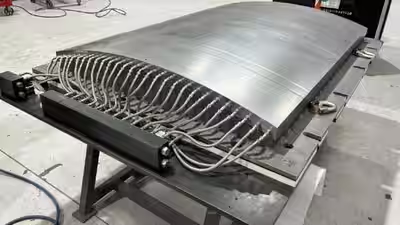
Oak Ridge scientists spent eight weeks 3D-printing a nearly 2-ton steel mold measuring 6 feet tall; Boeing will use the massive tool in NASA’s project to speed composite aircraft manufacturing

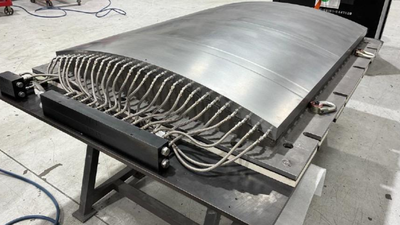
A team at the US Department of Energy’s Oak Ridge National Laboratory (ORNL) has spent eight weeks 3D-printing a massive steel mold that stands 6 feet tall, measures 4 feet wide and weighs nearly 2 tons. The tool, developed with Boeing, is designed for manufacturing thermoplastic composite aircraft components and will contribute to NASA’s Hi-Rate Composite Aircraft Manufacturing (HiCAM) project. According to ORNL, the project explores whether large metal tooling can be produced through additive manufacturing in ways that improve manufacturing flexibility, cost and efficiency. The work combines robotic metal printing, multiple steel types and computer simulations to overcome the challenges of producing a tool of this scale.
A massive mold built layer by layer
The tool is known as a Stamp Form Die (SFD), a type of punch press used to cut or shape materials. In aircraft manufacturing, SFD metal molds can be used to form thermoplastic composite parts. Thermoplastic aircraft doors, for example, are made by stamping heated plastic between two SFD molds. Traditionally, such molds are produced through conventional metalworking processes including machining, casting, forging and drilling. ORNL and Boeing wanted to investigate whether 3D printing could provide a faster and more flexible alternative for producing a thermally controlled SFD mold.The team used a process known as wire-arc additive manufacturing (WAAM). Instead of starting with a large block of metal and removing material, WAAM uses a robotic arm and welding torch to melt metal wire and build a structure layer by layer. ORNL’s Arc-1 system was used for the project. One feature that distinguishes the system is its ability to print with more than one type of metal by feeding multiple wires simultaneously. This allows engineers to combine materials in different parts of a structure depending on the performance required.
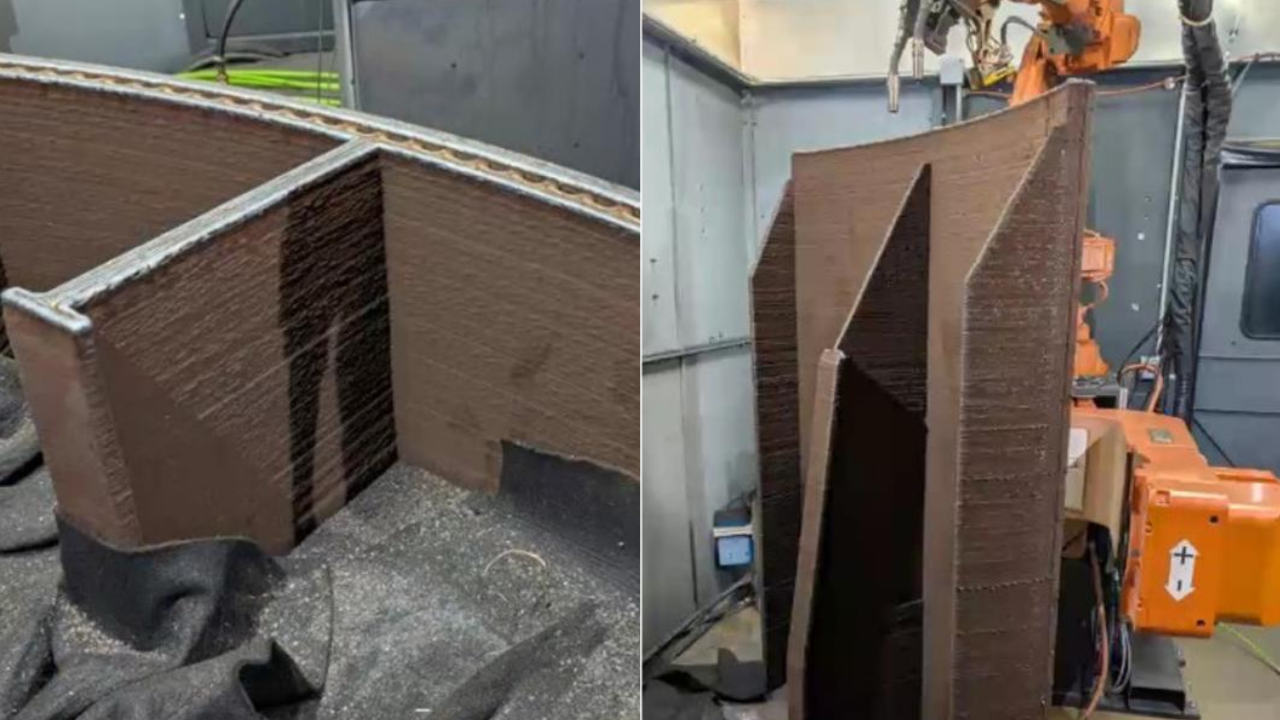
Boeing will use the massive tool in NASA’s project to speed composite aircraft manufacturing (Image Credit: ORNL, U.S. Dept. of Energy)
Combining two types of steel
The Boeing SFD mold uses mild steel in its structural regions, where strength and stiffness are important. Stainless steel was deposited on the mold surface to provide corrosion resistance, dimensional stability and a durable working interface.The additive manufacturing approach also allowed engineers to rethink how the mold would be heated and cooled. Conventional molds typically contain long, straight holes drilled into them to carry heating and cooling fluids. With 3D printing, the researchers were able to incorporate curved channels that follow the shape of the mold more closely. These channels can help transfer heat more efficiently, potentially improving the mold’s performance when it is used to form thermoplastic composite components.
The challenge of keeping the huge tool straight
Producing a structure this large through metal additive manufacturing presented a major technical challenge: warping. As layers of deposited metal cooled, residual stresses inside the material could cause the structure to twist or drift away from its intended dimensions. To control this problem, the team added temporary support ribs to the back of the mold.Researchers also used computer simulations to predict and compensate for the distortion that could occur during printing. According to ORNL, the team ran 32 simulation iterations before producing a mold that was within a few millimetres of its intended shape. After printing was completed, the mold was sent to Baker Industries in Michigan, where it was annealed to remove internal stresses. The temporary support ribs were then removed, and Baker Industries carried out the remaining fabrication work needed to meet Boeing’s requirements.
A test for faster composite manufacturing
The 3D-printed SFD is intended to support Boeing’s contribution to NASA’s Hi-Rate Composite Aircraft Manufacturing (HiCAM) project. NASA’s programme is focused on increasing the production rate of composite aircraft structures while maintaining the advantages of lightweight composite materials. NASA says HiCAM is working towards large-scale manufacturing demonstrations of a composite fuselage barrel and wing box in 2028 and 2029. The programme is part of a broader effort to develop manufacturing technologies that could enable future aircraft to be produced more quickly and at lower cost.For ORNL and Boeing, the large SFD served as a test case for applying wire-arc additive manufacturing to industrial tooling. ORNL said the technology developed through the project could be replicated for similar tools and potentially adapted to other sectors. The project also demonstrates how 3D printing can be used for objects far beyond the small components often associated with additive manufacturing. Rather than producing a finished aircraft part, researchers used the technology to create a nearly 2-ton tool designed to help manufacture composite components. ORNL said the approach could eventually have applications in industries such as energy and automotive manufacturing, where large, complex metal structures and specialised tooling are also required.The project therefore represents a different application of 3D printing: using robotic metal deposition to manufacture the enormous tools that can themselves help shape the next generation of aircraft components.