
A retired Kodak finance worker picked moss from a New York log and found an animal no one had seen before; a year later, scientists confirmed it as a new tardigrade species

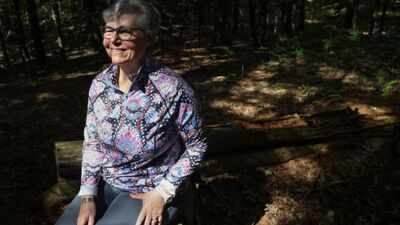
Judy Dobles, a retired worker from Kodak’s finance department, was walking a trail at the Rochester Museum & Science Center’s Cumming Nature Center in Naples, New York, when she made a discovery too small to see with the naked eye. A longtime volunteer and citizen scientist, Dobles collected a sample of moss growing on a log and later examined it under a microscope.According to Finger Lakes Public Radio, Dobles had walked the trail hundreds of times, but she said there was always something new to find. While looking through the moss sample, she first saw the microbes she expected. Then she noticed a tardigrade that did not look like any she had seen before.The tiny animal was a tardigrade, also known as a water bear or moss piglet. But this one was different. Further research showed that it was a species that had not previously been identified. Dobles contacted Piotr Gasiorek, an assistant professor at Jagellonian University in Poland who specialises in tardigrade biodiversity, to help formally identify it.It took about a year for the discovery to become official. The newly recognised species was named Mesocrista ojagwaji. The finding also added to the known number of tardigrade species recorded in New York, where Dobles had already found several species that had been identified elsewhere.“Globally, we are probably eliminating species faster than we can find them,” Dobles said. “In the soil, and at the microscopic level, there’s so much we don’t know.”
Tardigrades: Tiny but tough
Tardigrades are microscopic, eight-legged animals that can grow to just over a millimetre long. Because of their tiny size, they cannot be seen without a microscope. They are found in many different environments, including deep-sea habitats, tropical rainforests and Antarctica.Most tardigrades feed on plant cells, although some species are entirely carnivorous. These species can eat other microscopic animals, including other tardigrades.Despite their small size, tardigrades are known for their ability to survive extreme environmental conditions. Specimens have been shown to survive boiling water, extreme pressure, starvation and complete dehydration.Their ability to withstand harsh conditions has also taken them beyond Earth. In 2007, the Russian FOTON-M3 space mission exposed a sample of tardigrades to the vacuum of space for 10 days. After the animals were returned to Earth and rehydrated, they became active again.There are about 1,500 known species of tardigrades. Before Dobles’ research at Cumming Nature Center, 12 species were recognised in New York. That number has now reached 27, including the newly discovered species.
How A Moss Sample Led To The Discovery
Dobles’ discovery began with an ordinary piece of moss collected from a log at the nature centre. Under the microscope, she found a range of microbes and other microscopic life. Among them was the tardigrade that caught her attention because it did not resemble the ones she had previously seen.Recognising a potentially new species required more than simply spotting a different-looking animal. Dobles consulted Gasiorek, who specialises in tardigrade biodiversity, to help establish whether the animal was genuinely new to science.The process took roughly a year before the finding was formally recognised. The discovery showed how much microscopic life can remain undocumented even in familiar environments.Dobles said there are about 2 million species on Earth that have currently been named, while estimates suggest there could be 8 million or even more.Dobles also consulted Jamie Jacobs, a member of the Tonawanda Seneca Nation’s Turtle Clan who has devoted his life to preserving the Onondowa’ga language.Jacobs helped develop the name Mesocrista Ojagwaji. The first part refers to the tardigrade’s genus, while the latter is an Indigenous language reference to the animal’s spotting. The name differs from the traditional scientific naming system, which generally uses Latin etymology.
Why the name matters
For Dobles, choosing the name was also a way of recognising the history of the land where the nature centre now stands. She said she wanted other people to be part of the discovery rather than naming the species after herself.“I will say that everybody I talk to is always asking me, ‘Why didn’t you name it after yourself?’ And I’m like, ‘Why would I?’” Dobles said. “For me, it’s more fun to partner with other people and involve them in the process. And make that connection.”Sarah Jacoby Murphy, the centre’s director, said Dobles’ work showed that scientific discoveries do not always require large laboratories or major research projects.“Judy inspires all of us to do science exactly where we are,” Murphy said. “There is so much left to learn about our immense and intricate planet, and each one of us has the capacity to contribute to scientific knowledge in ways large and small.”