US is building a fortress around China. Its shrinking missile stocks could be the weak link

An old Latin adage states ‘Si vis pacem, para bellum,’ which means ‘if you want peace, prepare for war.’ As tensions continue to simmer in the Pacific, the United States is facing a serious deficit when it comes to certain types of precision weapons that it would need in a potential fight against China in the broader Indo-Pacific. Both the United States and China are working towards improving their combat capability against the other. The United States is working to improve its military posture against the Chinese. The Pentagon has picked up base by operationalising airbases that were disused after the Pacific campaign after the Second World War and by improving operational bases. The US strategy is to bottle Chinese forces in the first island chain, which is controlled by the allies of the US such as Japan, Taiwan and the Philippines. America has bases in Guam, the Caroline Islands and Tinian, to name a few that are in the second island chain. It is these bases that the United States plans to launch its attacks in case of a conflict flares up, as per the US Naval Institute, which is located on the grounds of the US Naval Academy.
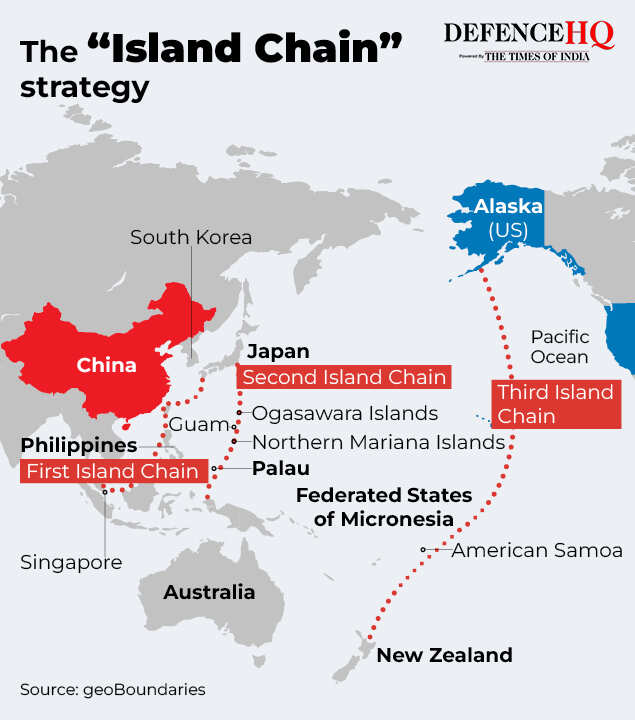
The US military’s ‘island chain’ strategy is designed to contain China near its own shore.
The Chinese, on the other hand, are working towards taking away the advantage from the US. To this effect, China is building up its rocket force, which is the custodian of its tactical (conventional) and strategic (nuclear) weapon-carrying missiles. To this extent the Chinese are increasingly planning to target these bases as well as air bases with long-range ballistic missiles and hypersonic glide vehicles, according to the Washington DC-based think tank the Center for Strategic and International Studies. With the United States trying to counter China’s move by using tactics based on dispersion across smaller islands across the Pacific in order to present a much larger group of targets for Beijing’s missileers.
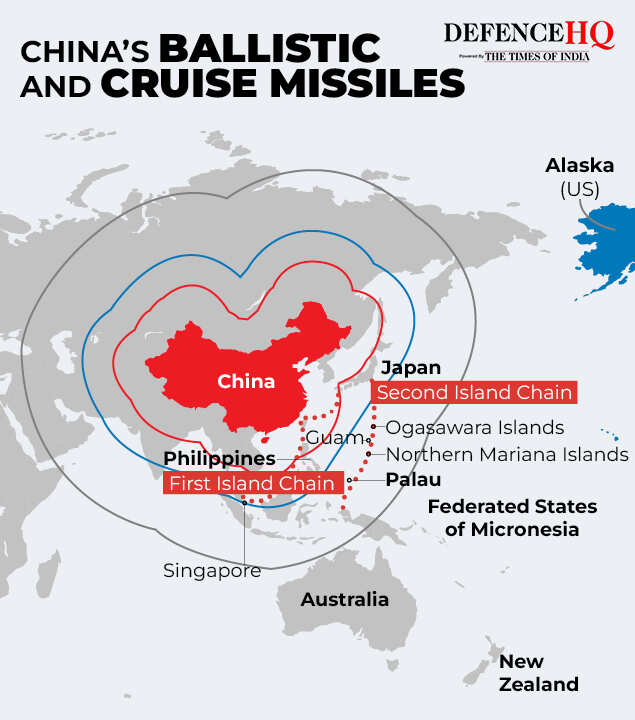
China plans to defeat the US, primarily with its missiles.
The cat-and-mouse arms race
As the world is inching towards another great power rivalry, the structure of the Thucydides Trap is working on both these nations. Both nations are developing measures to counter the other, just as the US and the USSR had entered an expensive arms race. As the fall of the Berlin Wall signaled the end of the Cold War, the first Gulf War a few months later demonstrated to the world how a technologically advanced coalition led by the US could dismantle one of the largest militaries in the world as the coalition walked over Saddam Hussein’s battle-hardened army that had been fighting the Iranians for the better part of the previous decade. China took notes and started strategising and modernising, states the New Delhi-based think tank the Observer Research Foundation. The Chinese have focused on certain technologies such as ballistic missiles and now increasingly on hypersonic weapons in order to seek a level of deterrence against the US.The current conflicts in both Ukraine and West Asia have stretched American resources. Initially when the conflict in Ukraine started, the US and many of its allies provided the war-ravaged nation with a lot of equipment, initially digging into their own weapon reserves to shore up Kyiv’s urgent capability. This led to the depletion of critical weapons, most important amongst these is the reduction of anti-tank weapons, artillery shells and importantly, Surface-to-Air Missiles (SAMs). The ongoing conflict in West Asia has made the matter worse for the Pentagon.
Iran conflict weakened America’s strategy
A paper by the US Naval War College makes the case that Washington cannot afford to let China dominate the Near Seas bounded by the First Island Chain, arguing the US forces working alongside allies must retain the ability to control the chokepoints leading out toward the Indian and Western Pacific Oceans. Rather than betting on any single defensive line, the paper favours a dispersed approach, distributed fires from islands around the conflict zone, built around maritime advantages such as submarine warfare and anti-submarine operations paired with capable allies and partner-capacity building. The idea is to create pockets of uncertainty at sea and weave together a network of counterweights that keeps Beijing cautious, rather than relying on a fixed perimeter to box in the Chinese.The paper frames this as a strategy of mobility rather than permanent occupation. The vision isn’t to garrison the island chain outright, but to retain the ability to mobilise joint and combined forces quickly enough to threaten key chokepoints, pushing China toward non-military paths to achieve its objectives. This would also require Washington to accept a degree of risk, being willing to engage in short, contained skirmishes to reinforce deterrence.
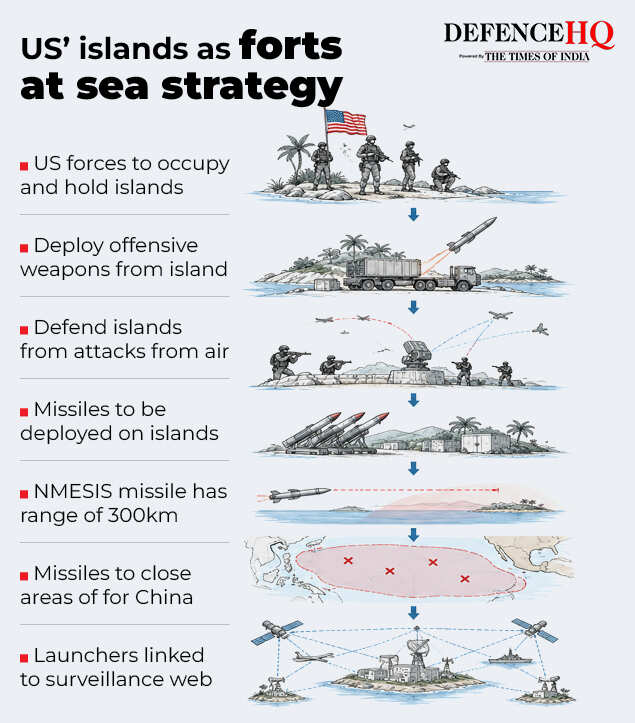
US’ islands as forts at sea strategy aims to deny China access to vast tracts of the sea.
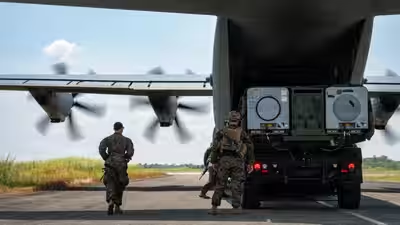
The key element in this fight is to hold islands to bottle in the Chinese. These islands are to act as forts at sea. Specialised weapons, such as Navy-Marine Expeditionary Ship Interdiction System (NMESIS), which have a range of around 300 km will provide a bubble in which the Chinese navy will ideally be denied entry. The launcher will be tied to a vast surveillance network that will have elements located in various places ranging from space to air to surface (both land and air) as well as those located underwater. The key element here will be defending these islands from threats such as aircraft and missiles. For which a vast network of air defence weapons of various types of air defence systems will have different types of capabilities.With the requirements of these limited systems now in the West Asian theatre and the stockpiles of missiles falling by the day, the US needs to step up production.
Even for America, which is a very rich country, ammunition reserves can be measured in days and not years. With the expenditure of a large amount of weapons, there is a fall in US ammunition reserves. The lead time for the procurement of these weapons is around 3-4 years. The most effective way forward for the US is to improve depth of stockpile, increase production and improve operational integration of these systems.
Maj Gen Rajan Kochhar (retd), Former MGAOC Central Command and Defence and Strategic Expert
America is racing against the clock to rebuild its military stockpiles, and the warning signs are hard to ignore. Years of supporting Ukraine’s war effort alongside the recent conflict with Iran have left US stocks of precision-guided munitions and air defence interceptors severely depleted, creating real gaps in Washington’s ability to credibly deter Chinese aggression, particularly any move to invade or blockade Taiwan. To close this gap, the Pentagon and Congress are being pushed to overhaul how weapons are produced, acquired and fielded, shifting toward what is being called precise mass, a category of cheap, rapidly manufactured drones, sensors and enabling technologies that can be fielded quickly and expended freely in combat.
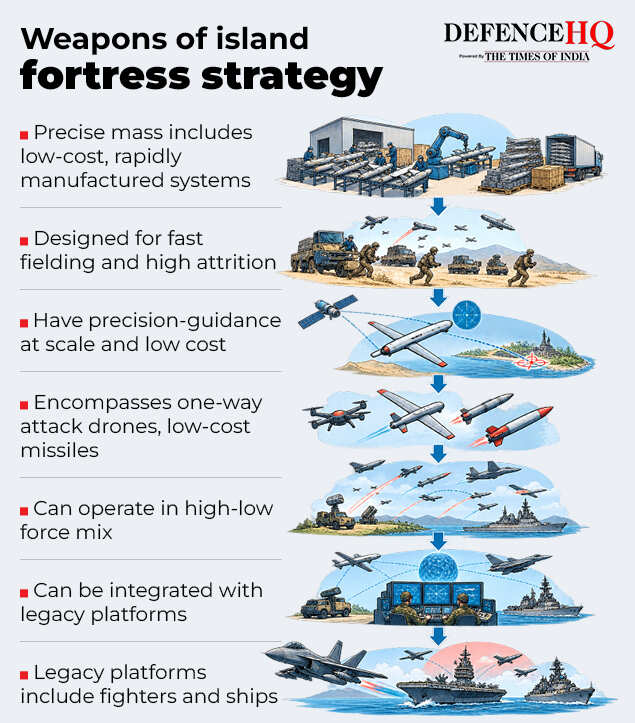
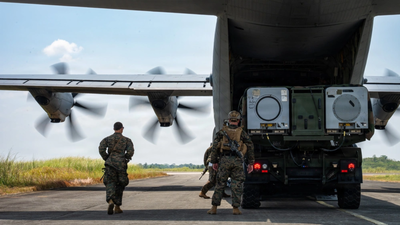
US’ islands as forts at sea strategy requires different types of weapons to contain China in case of a conflict.
Traditional high-end systems such as submarines, fighter jets and sophisticated munitions remain important, but their long production timelines and persistent workforce and material shortages mean they simply cannot scale fast enough within the two-year window officials are working against. The recommended fix is a high-low mix, pairing expendable, mass-produced systems with legacy platforms to generate sufficient combat power in time.Much of the challenge, however, is bureaucratic rather than technological. Decades of consolidation have left America’s defence industrial base less flexible and slower to respond, making faster contracting, relaxed procurement rules and a willingness to accept good enough capabilities over perfect ones essential. Ensuring that already-appropriated funds actually translate into production, rather than stalling in red tape, is seen as equally critical.The stakes extend well beyond budgets and factories. With China’s military rapidly fielding advanced missiles, naval assets and airpower designed to overwhelm American and allied forces in the Indo-Pacific, deterrence increasingly depends on the perception that U.S. forces can sustain a prolonged fight, not just win a short one. The message emerging from this push is unambiguous, unless America accelerates its industrial response now, any attempt by Beijing to coerce or seize Taiwan may not be met with adequate resistance.