
In 1998, Nasa sent a rose into space and discovered that microgravity could change its scent

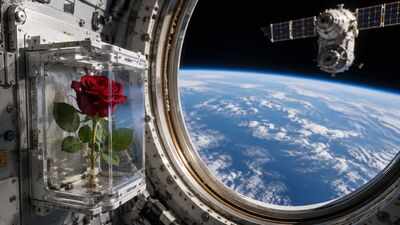
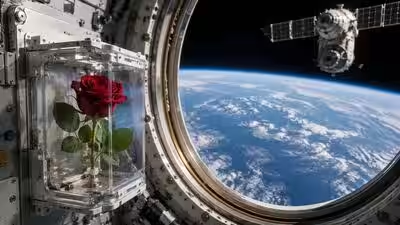
A small rose plant spent nine days travelling around Earth aboard Space Shuttle Discovery in 1998. It was not there simply as a botanical curiosity. The flower, ‘Overnight Scentsation’, had been selected for an experiment that asked a surprisingly specific question: would a rose smell the same without Earth’s gravity? When the shuttle returned, the answer was no. The flower had produced fewer volatile oils than its Earth-grown counterparts, and the balance of its fragrance had shifted. The change was subtle enough to require laboratory analysis, but distinctive enough to interest the perfume industry. The resulting scent was eventually turned into a commercial fragrance ingredient known as the “space rose” note.
Why Nasa selected Overnight Scentsation for the 1998 space rose experiment
‘Overnight Scentsation’ was not an arbitrary flower picked for a trip into orbit. The miniflora rose, created by hybridiser F. Harm Saville in 1990, was already known for having an unusually strong fragrance. According to the American Rose Society, it came from a cross between the floribunda ‘Taxi’ and the miniature rose ‘Lavender Jade’. It entered commercial cultivation in 1999, although its journey into space had taken place the year before.Its fragrance was an important part. Roses produce scents from volatile compounds, and the mixture can change with conditions such as temperature, humidity and the age of the flower. The American Rose Society notes that a rose’s fragrance can involve nearly 200 different compounds. That made the plant useful for an experiment in which the environment itself was being altered.
1998 Nasa space rose experiment aboard Discovery
On October 29, 1998, ‘Overnight Scentsation’ travelled into orbit aboard Discovery on mission STS-95. The plant was about seven inches tall and was carried as part of a wider programme of life-science and microgravity experiments. The mission also carried 77-year-old John Glenn, who returned to space decades after his first flight.The rose was housed inside an ASTROCULTURE chamber developed by the Wisconsin Centre for Space Automation and Robotics at the University of Wisconsin-Madison. The system provided controlled conditions for the plant, including light, temperature, humidity and nutrients. Two buds opened during the flight, giving the astronauts material that could actually be sampled.The experiment was a collaboration between Nasa, the Wisconsin centre and International Flavours and Fragrances, or IFF. For the fragrance company, the attraction was practical as well as scientific. IFF wanted to know whether microgravity could alter the compounds responsible for a flower’s smell and, if it did, whether that change might provide a new ingredient for perfumes or flavours. According to Nasa, the work was an investigation into how reduced gravity affected the production of essential oils in living flowers.
How astronauts collected fragrance samples from the rose in space
The astronauts collected samples from the flowers using a silicone fibre designed to capture volatile molecules. Four samples were taken, and each produced a different result. The final scent profile was calculated from those samples before the material was sent back for further analysis on Earth. What emerged was not simply a stronger or weaker version of the familiar rose aroma. IFF found that the flower had produced fewer volatile oils in space than comparable roses grown under normal conditions. When scientists reconstructed the fragrance in the laboratory, the difference became clearer. The familiar fresh, green character had shifted towards a different floral rose aroma.That distinction matters because fragrance is not determined by one ingredient. A flower’s smell comes from a mixture of compounds released into the surrounding air. Change the amounts or proportions of those compounds and the nose can perceive the result differently, even though the flower itself remains recognisably the same. Nasa’s account says the experiment had been expected to produce some change in the scent, since the researchers were interested in what would happen to essential oils under microgravity. What they obtained was a distinctly different fragrance profile.
How Nasa’s 1998 space rose became a commercial fragrance ingredient
The unusual aroma did not remain a laboratory curiosity. IFF developed it into what became known as the “space rose” note and commercialised it as a fragrance ingredient. The company later supplied the ingredient for Shiseido’s Zen perfume, which was described as combining floral, woody and spiritual notes.The route from shuttle experiment to perfume illustrates one of the less obvious uses of space research. The original experiment was not about producing a perfume in orbit. It was about understanding how a living plant responds when one of the most familiar forces in its environment is largely removed. The commercial value came afterwards, when the altered chemistry was identified and reproduced.IFF also saw possible applications beyond fine fragrance. Nasa reported that the resulting rose oil could be used to influence flavours, opening another possible route into the food industry.
How microgravity changed the chemistry behind the rose’s fragrance
Plants do not simply sit in their surroundings; they constantly respond to them. Light, temperature, humidity and gravity all form part of the environment in which plant tissues develop and produce chemicals. Fragrance compounds are among those chemical products. The rose experiment offered a particularly unusual way of isolating one environmental difference. Inside the shuttle’s controlled growing chamber, the plant received the conditions required to stay alive while experiencing microgravity. The resulting change in volatile oil production suggested that gravity, directly or indirectly, could influence the chemistry behind floral scent. The American Rose Society describes the experiment as an attempt to understand how low gravity altered the familiar fragrance of the rose.It was a small experiment, involving a small plant and a handful of flowers. But its subject was unusually specific: not whether plants can grow in space, but whether a flower can smell different when it does.
Overnight Scentsation: The first rose to travel into outer space
‘Overnight Scentsation’ eventually became associated with a piece of spaceflight history. The American Rose Society records it as the first rose to travel into outer space and notes that its reputation rests as much on its fragrance as on its unusual journey. Nasa flew another rose on a shuttle in 2008, but that was a different undertaking. The flower was intended for the New Year’s Rose Parade in Pasadena and was not part of the fragrance experiment.The 1998 experiment therefore remains distinctive for what happened to the flower’s chemistry rather than simply where the plant travelled. A miniature rose grown inside a spacecraft produced a different mixture of volatile compounds; scientists analysed the change, and a fragrance company turned that altered profile into a commercial ingredient.