

The insect that makes its own mudhouse and whose larva eats its prey alive: Meet the Potter Wasp which used clay to create its self-designed abodes which hide a terrible secret

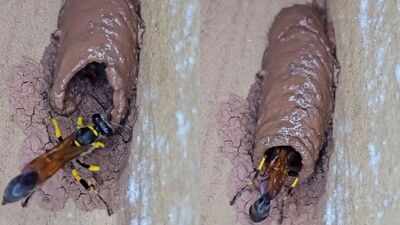
If you have ever seen a small yet beautiful house created with mud hanging from plant stalks in your house or by the corners of the walls, it might be housing an insect that has self-designed the abode. The potter wasps, part of the subfamily Eumeninae within the Vespidae family, are renowned for their unique pot-shaped mud nests, which bear a resemblance to clay pots crafted carefully on a potter’s wheel.
Meet the potter wasp
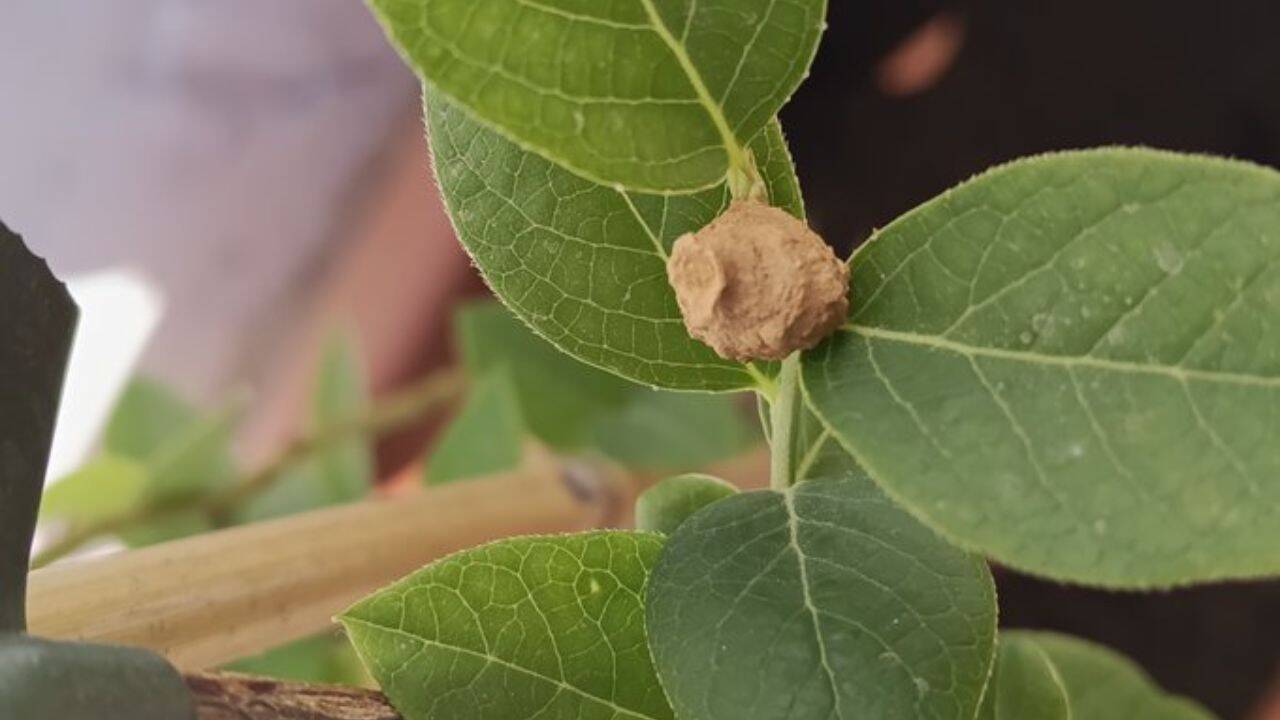
The female potter wasp constructs her nests using mud mixed with her saliva, attaching them to various surfaces like plant stalks or human structures.
Measuring about one inch in length, potter wasps, also known as mason wasps, feature a black body adorned with yellow-striped markings. Unlike social wasps that live in colonies, they tend to operate alone, and only come together primarily for mating during the summer months. Mature potter wasps emerge from their nests in the summer to find mates. When a potter wasp finds another potter wasp of the opposite sex, the two mate. The female then goes on to build a nest for her eggs.The female potter wasp constructs her nests using mud mixed with her saliva, attaching them to various surfaces like plant stalks or human structures. The potter wasp may attach her nest to any object that sits still long enough for her to build the nest. This may include a variety of human belongings. After laying between 12 and 20 white, banana-shaped eggs in each nest, she hunts for caterpillars, which she stores inside the nest to feed her larvae once they hatch. The developmental cycle of the larvae includes a pupation phase, and they typically emerge as adults in the summer following a period of growth and, in some cases, hibernation.They typically face threats from parasitic insects that lay their eggs in the larval bodies of potter wasps. Some parasitic insects include tachnia flies, cuckoo wasps, and ichneumon wasps.With thousands of species across over 200 genera, potter wasps contribute to the biodiversity of their environments. Worldwide, there are approximately 3,800 species (Subfamily: Eumeninae) of potter wasps (Order: Hymenoptera. Family: Vespidae.). Eumeninae is the most diverse of all subfamilies within Vespidae. In India, there are 189 potter wasp species that belong to 47 genera. They help control populations of agricultural pests like caterpillars. Their abandoned nests provide shelter for solitary bees, beetles and spiders. And occasionally, they also serve the role of pollinators.They thrive in a warm, humid climate which is ideal for nesting and foraging. They live in diverse habitats, including forests, grasslands, open fields, gardens, deserts and urban areas. While female wasps typically die after colder weather sets in or after completing their reproductive duties, the male wasps have an even shorter lifespan and die shortly after mating or within a few weeks of emerging from the cocoon.Potter wasps hunt by searching plants for small caterpillars and beetle larvae, stinging them with venom to paralyse them completely without killing them. The female wasp then carries the limp prey back to her tiny mud pot to serve as fresh, living food for her developing egg.
A unique nesting method
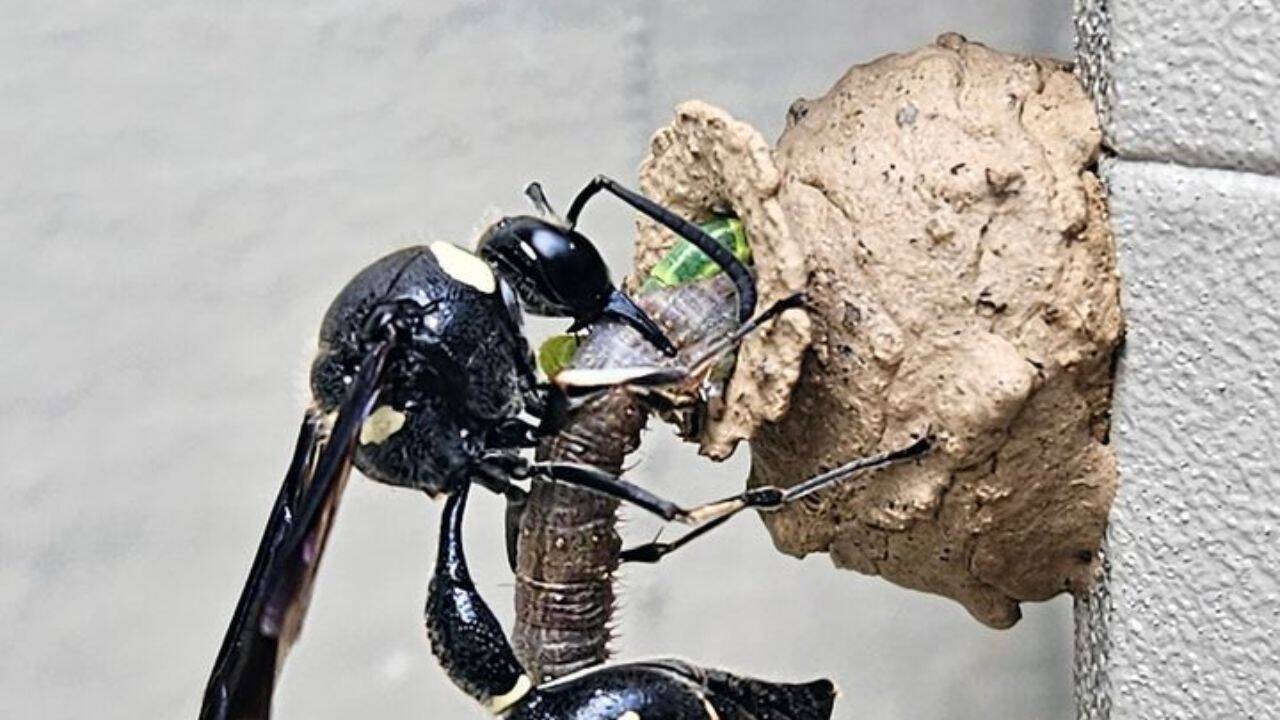
Once construction is over and the nest has dried, the mother wasp ventures out to hunt prey (usually caterpillars) and stores the paralysed prey in the cells.
Interestingly, not all potter wasps make pots for nests. They are renowned for exhibiting diverse nesting strategies and can be excavators, renters, or builders. Excavators dig their nests in the ground or in soft, decaying wood, creating tunnels and chambers where they lay their eggs and provision the cells with paralysed caterpillars. Renters prefer to rent pre-existing cavities like abandoned beetle burrows, hollow stems, or other natural cavities. These spaces are modified by adding mud partitions to create individual brood cells.Builders construct intricate mud nests that resemble tiny pots or jugs, which are often attached to twigs, rocks, or manmade structures. To create these, the wasp gathers mud and shapes it into brood cells, each carefully crafted and provisioned with caterpillars. Irrespective of the type of nest, all potter wasps exhibit remarkable nesting plasticity, adapting to various environments and utilising different materials to create secure spaces for their offspring. Some potter wasps are so versatile that they may even nest inside active termite mounds. These underground nests protect eggs from predators and harsh weather conditions. A completed potter wasp nest often has a flared entrance, which adds to its distinctive appearance. Once construction is over and the nest has dried, the mother wasp ventures out to hunt prey (usually caterpillars) and stores the paralysed prey in the cells. She then inserts her abdomen into the nest to lay an egg inside the brood cells.After provisioning the nest with caterpillars and laying eggs subsequently, the mother potter wasp seals each brood cell and the nest, securing the provisions within. Using mud, she creates a sturdy plug at the entrance of each brood cell. Depending on the species and the season, the mother wasp may then construct additional nests, repeating the process of gathering mud, building nests, laying eggs, and provisioning the cells with caterpillars multiple times within her lifespan.As the larvae hatch, they consume the stored caterpillars, sustaining their growth and development within the safety of the nest. Once the larva has consumed the provisioned caterpillars, it spins a cocoon within the brood cell and pupates. After the transformation, the adult wasp uses its strong mandibles to chew its way out of the cocoon and the nest’s mud plug. The young wasp then acclimates to its surroundings, takes its first flight, and begins its independent life, foraging for food, and eventually seeking a mate. The primary goal of adult potter wasps is to reproduce and ensure the survival of their species. Males and females typically mate shortly after emerging from their cocoons.After mating, the females begin looking for suitable nesting sites to lay the eggs and begin the lifecycle anew. Potter wasps are a reminder that nature has provided even its smaller members with powers larger than life. Just like humans live in houses made for them, potter wasps are no less so with their architectural prowess.