
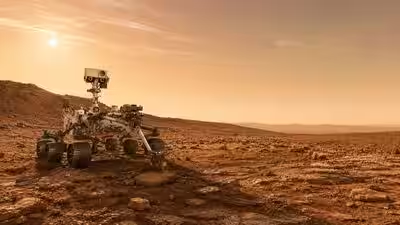
Nasa Perseverance rover finds Mars can have spring-like ground temperatures while the air above remains near freezing |

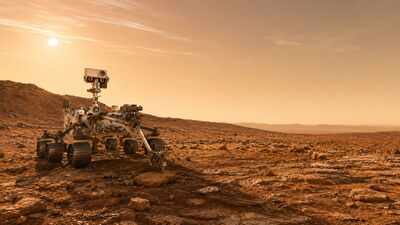
Mars is a planet where two parts of the body could experience entirely different seasons at once. Standing on the Martian equator at noon would mean feeling spring at feet and winter at head, with the ground reaching 24 degrees Celsius while the air just above it stays close to freezing. This is not a trick of perception. It is a direct result of how thin the Martian atmosphere is and how little of it exists to carry heat away from the sunlit surface. Research from instruments aboard Nasa’s Perseverance rover has since measured this effect directly, confirming that sharp temperature contrasts of this kind are a real and repeatable feature of the Martian climate, not an exaggerated comparison.
Mars temperature differences between the surface and air
On Earth, the temperature we experience is usually a shared value. The air around us is thick enough to mix efficiently with the ground beneath our feet, so the two rarely diverge by much on a calm day. According to Nasa, Mars breaks this pattern almost completely. The surface can be as warm as 20 degrees Celsius at certain points in the Martian year, while the coldest recorded temperatures drop to around minus 153 degrees Celsius. It is within this wide range that the noon equator example sits, with the ground itself briefly warmed to a comfortable 24 degrees Celsius even as the air only a short distance above remains near 0 degrees Celsius.The explanation lies in how each surface responds to sunlight. Ground and rock absorb solar energy quickly and convert it into heat, and this happens close to where the light lands. The atmosphere, being extremely thin, simply does not contain enough gas molecules to absorb and redistribute that same energy at a comparable rate. The result is two readings that appear to belong to different planets, even though they were taken metres apart.
How Mars atmosphere allows heat to escape
The reason this gap exists comes down to basic atmospheric density. Mars’ atmosphere is far thinner than Earth’s, made up mostly of carbon dioxide, nitrogen and argon, and offers little resistance to heat escaping back into space. On Earth, a dense atmosphere acts something like an insulating layer, holding warmth near the surface long enough for the ground and the air to reach similar temperatures. Mars has no equivalent buffer.This thinness affects more than temperature readings. It also explains why Martian skies appear hazy and reddish rather than blue, since there is comparatively little atmosphere available to scatter sunlight the way Earth’s does. The same scarcity of gas that fails to trap heat is also responsible for the planet’s colour and its vulnerability to impacts from small objects that would normally burn up before reaching Earth’s surface.
Mars temperature changes sharply within 1.5 metres of the ground
The spring-and-winter comparison is not simply a calculation drawn from averages. It has been tested directly using data gathered by the Mars Environmental Dynamics Analyser, an instrument package fitted to the Perseverance rover in Jezero Crater. According to the study published in the Journal of Geophysical Research, titled ‘Near Surface Atmospheric Temperatures at Jezero From Mars 2020 MEDA Measurements’, temperature readings were taken from sensors positioned at different heights above the Martian ground, including levels close to where a person’s feet and head might be.The study found that during the hottest part of the day, the temperature difference between the surface and the air just above it can become extremely steep, concentrated almost entirely within the first metre and a half above the ground. At its most intense, this vertical change reached around 26 degrees Celsius per metre near midday, a figure that helps explain why a standing person could genuinely feel two different seasons within the height of their own body. The same research noted that this steep gradient develops during a clearly defined convective period each day and tends to level out again by the late afternoon, when the atmosphere becomes closer to a single, uniform temperature from the surface upward.
How extreme Mars temperatures create challenges for rover design
Understanding this gap between ground and air temperature is not just a curiosity for scientists. It has practical consequences for how future missions and potential human visits to Mars are planned. A surface reading of 24 degrees Celsius might sound inviting, but it says nothing about the conditions a person would actually experience while standing there, since the air surrounding their body would remain dangerously cold regardless of how warm the ground beneath them became.This distinction also shapes how rovers and future habitats are engineered. Equipment sitting close to the Martian surface can be exposed to very different thermal stresses than instruments mounted higher up, and this must be accounted for when designing anything meant to survive repeated daily temperature swings. The spring-and-winter comparison, first popularised by Nasa confirmed through direct measurement, remains one of the clearest ways to explain just how differently heat behaves on a planet with almost no atmosphere to speak of.