
James Webb’s ‘little red dots’ may be 100,000-sun monster stars; their collapse could have seeded the universe’s first giant black holes

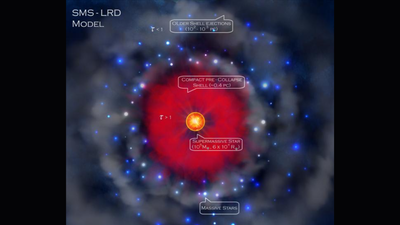
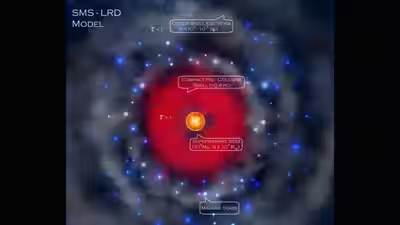
Mysterious, compact objects discovered in the early universe may actually be enormous “monster stars” with masses up to 100,000 times greater than the Sun.According to a new study by the Center for Astrophysics | Harvard & Smithsonian, these giant stars could explain the unusual features of the “little red dots” spotted by the James Webb Space Telescope.Their eventual collapse could also explain how the universe’s first supermassive black holes formed so quickly, less than a billion years after the Big Bang.The study, led by Devesh Nandal of the Harvard College Observatory, part of the Center for Astrophysics in Cambridge, Massachusetts, presents a single model that matches the objects’ light spectrum, compact appearance, and chemical makeup.“To my knowledge, it is the first model that can explain so many of the observed properties at once, from the spectra to the morphology to the chemical signatures,” Nandal said in a statement released by the Center for Astrophysics. “Even competing scenarios are now invoking supermassive stars as the central engine.”
Unusual light patterns puzzle scientists
The objects were first discovered in deep-field images captured by the James Webb Space Telescope and were nicknamed “little red dots” because of their tiny size and bright red appearance in infrared light.Although they formed when the universe was still very young, their light patterns have not matched existing astronomical models.Scientists have suggested several possibilities, including young galaxies, rapidly growing black holes, hypothetical quasi-stars, powerful star-forming regions, or even a completely new type of cosmic object.Normally, active galaxies powered by feeding supermassive black holes produce strong X-ray and radio emissions. However, the little red dots remain surprisingly faint or completely invisible in X-ray observations despite being extremely bright.“Little red dots are mysterious because they combine clues that do not usually fit together,” Nandal said. “They seem to be telling us that something very luminous is hidden inside dense gas.”Data collected by the telescope also revealed unusual hydrogen absorption and emission patterns, along with high levels of nitrogen.Earlier research by Nandal and his colleagues showed that primordial stars with masses around 100,000 times that of the Sun could produce these same hydrogen signatures.However, scientists still needed to explain how these stars could create the dense gas clouds seen around the objects.
Giant stars create dense gas shells
To answer that question, the Harvard team modelled the lives, evolution, and mass loss of supermassive stars.They found that instead of slowly losing mass near the end of their lives like ordinary stars, these massive stars go through violent and repeated instability events known as “strange-mode” pulsations.These powerful pulses throw huge shells of dense gas into the area around the star, forming a compact cocoon that closely matches what the James Webb Space Telescope has observed.“The spectrum and the morphology are two sides of the same physical problem,” Nandal said. “The spectrum tells us what kind of source is producing the light and how that light is processed, while the shape tells us where the surrounding material is and how compact it must be.”The gas shells are made mainly of hydrogen and helium but also contain large amounts of nitrogen.This nitrogen-rich composition closely matches recent observations of the little red dots, providing more evidence in support of the supermassive star theory.
A possible answer to the black hole mystery
The model could also help solve one of astronomy’s biggest mysteries, how supermassive black holes formed so early in the universe.Scientists have long struggled to explain how black holes with millions or billions of times the Sun’s mass already existed less than a billion years after the Big Bang, as ordinary black holes would not have had enough time to grow that large.According to the team’s model, these supermassive stars burn through their nuclear fuel very quickly before collapsing directly into black holes without exploding as supernovae.This process creates a massive “heavy seed” black hole with tens of thousands of solar masses, giving it a major head start in growing into the giant black holes found at the centres of early galaxies.“What I find most fascinating is that this result brings together many independent clues in one physical picture,” Nandal said.The researchers now plan to improve their models to predict more detailed light spectra, allowing future observations by the James Webb Space Telescope to test whether these giant stars were truly the ancestors of the universe’s first supermassive black holes.