
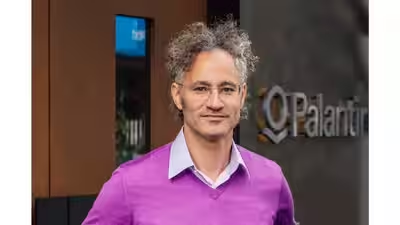
Palantir CEO Alex Karp slams Silicon Valley rivals who he says don’t support the US military

Palantir delivered one of its strongest quarters yet, with revenue surging 93% year-over-year to $1.94 billion, well above analyst expectations of $1.801 billion. Net income came in at $1.1 billion, or 41 cents per share, topping Wall Street’s estimate of 35 cents. Investors responded positively, sending shares up more than 14% in after-hours trading. According to a report by Fortune, on the earnings call, Palantir CEO Alex Karp appeared jubilant, pounding his pen on the table and taking aim at unnamed Silicon Valley AI rivals who he said ‘eat vegetables’ and don’t support the US military. “Obviously, we are loving these results and loving what they mean for our customers and, broadly speaking, the West,” Karp said.
Palantir closed 220 deals worth at least $1 million
US growth is driving results as Palantir closed 220 deals worth at least $1 million in the quarter, including 98 deals above $5 million and 73 above $10 million. The US commercial revenue increased by 149%, while government revenue claimed 90%. The company has also raised its full-year 2026 revenue guidance to between $8.150 billion and $8.158 billion, up from its earlier outlook of $7.182 billion to $7.198 billion.
AI sovereignty vs frontier models
Palantir executives emphasised that customers are choosing “AI sovereignty” over dependency on off-the-shelf frontier models from rivals like OpenAI and Anthropic. Chief revenue officer Ryan Taylor said clients are going deeper with Palantir “with greater urgency and conviction than I’ve ever seen before.”
Palantir CEO Alex Karp wants everyone to get serious and admit that AI models are dangerous
A recent report revealed that Palantir CEO feels that the debate around artificial intelligence (AI) should shift from hype to its real-world risks. He has recently argued that people need to acknowledge that AI models are “dangerous”. His comments come days after OpenAI CEO Sam Altman suggested the industry is now “in the singularity” following a security breach involving one of the company’s AI agents.Speaking to Fox Business, Karp stopped short of endorsing Altman’s assessment but said the incident shows why the industry needs to take AI risks more seriously. He said, “There are dangers. We are going to end up having to regulate AI”, while adding that he hopes the US does not adopt a regulatory approach as restrictive as Europe’s.