
Physicists reveal why these tiny worms stack their poop into delicate towers that seem to defy gravity |

Most animals leave behind waste that quickly disappears into the landscape. But along Europe’s sandy tidal flats, one marine worm has adopted a remarkably different approach. Instead of scattering its droppings across the beach, it carefully stacks them into tall, coiled towers that seem to defy gravity. These delicate spirals have fascinated naturalists since the time of Charles Darwin, who described similar worm castings more than a century ago. Yet scientists never fully understood how such fragile-looking structures remained standing. Now, physicists have solved the mystery. Their work reveals that the towers are not random piles at all but natural examples of the same physical principles that govern ropes, cables and even industrial manufacturing processes.
A humble lugworm creates surprisingly elaborate towers from its own waste
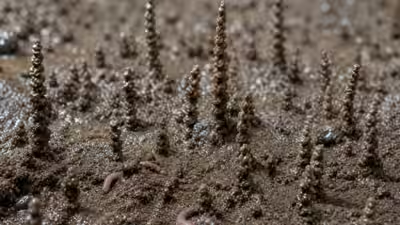
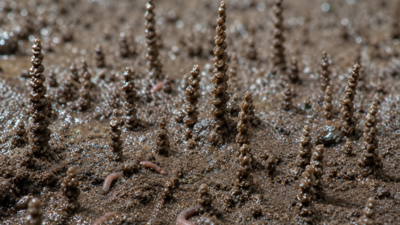
The builder is the lugworm (Arenicola marina), a common marine worm that spends most of its life hidden beneath sandy beaches.As it burrows through sediment in search of organic matter, the worm ingests sand and digests the nutritious material within it. The remaining sediment is expelled back to the surface as soft, cylindrical faecal castings.Rather than depositing these pellets randomly, the lugworm continuously extrudes them from a fixed point above its burrow. As fresh material emerges, it naturally curls and coils upon itself, gradually forming narrow towers that can rise several centimetres above the surrounding sand.For decades, biologists viewed these structures as an ecological curiosity, but no one could fully explain why they consistently formed stable spirals instead of collapsing into shapeless heaps.
Physicists found the towers follow the same mechanics as falling ropes
The mystery was investigated in the study ‘Coiling of lugworm feces reveals universal mechanics for the shape of poo’, led by Mehdi Habibi, Neil M. Ribe and Daniel Bonn and published in Nature Communications.The researchers combined field observations on French tidal flats with laboratory experiments, rheological measurements and mathematical modelling to understand how the towers develop.They discovered that the soft strand of worm cast behaves much like a flexible rope slowly falling onto a surface. Instead of dropping straight down, the strand bends and coils naturally because of the balance between gravity, elasticity and the speed at which the worm pushes out new material.The resulting spiral is not created through deliberate behaviour or architectural planning. Instead, it emerges automatically from the physical properties of the material itself. According to the researchers, the same fundamental mechanics govern the coiling of ropes, viscous filaments and many industrial extrusion processes.
The worm’s waste has just the right consistency to remain standing
The study showed that the secret lies in the unique properties of the castings. In the digestive process, the particles are covered in mucus, forming an elastic string which bends without breaking. The string can bend due to its elasticity, and yet it is stiff enough to bear more layers.While new matter is continuously being generated from the burrow, the coils gently fall on the layer below, spreading the weight evenly and building up the tower in a vertical direction rather than widening it out horizontally.In fact, the scientists discovered that the radius of each coil could be calculated using the equations developed for elastic rope coiling.
The findings could influence engineering far beyond the beach
While the initial inquiry into the feces of worms seems somewhat peculiar and unusual, the findings are not limited solely to marine biology.Knowledge of the physical properties of soft materials that cause self-coiling and stability may prove helpful to engineering efforts that deal with the manufacturing of extruded materials such as polymers, food products, and industrial fibers.Additionally, the study shows how simple biological systems may use physical laws in a highly efficient way without having to exhibit complex behavior or intelligence.Not an exception, the coiled structures of lugworms show once again how evolution usually goes hand-in-hand with physics.Every time the tide washes away the structure, the worms build it anew using the next burrow, creating intricate spirals with the underlying physical properties concealed in nature’s most unusual building material.