
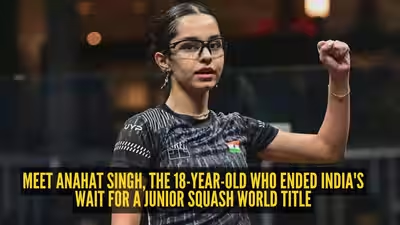
Meet Anahat Singh, the Gen Z star who created history for India with a world squash title |


Some victories are measured by medals. Others are measured by the choices that come long before the podium.When 18-year-old Anahat Singh stood on top of the podium at the World Junior Squash Championships in Canada, wrapped in the Indian tricolour and smiling through a moment years in the making, the world saw history. She had become the first Indian ever to win the World Junior Squash Championship, defeating Egypt’s Ruqayya Salem in straight games and ending India’s long wait for the title.But Anahat’s story isn’t just about a squash racket or a world title.It’s about what happens when a teenager quietly decides that ordinary isn’t enough.
A childhood that wasn’t planned around squash
Interestingly, squash wasn’t her first love.Born in New Delhi in 2008, Anahat grew up in a family where sport was simply a way of life. Both her parents had played field hockey, while another member of the family was into tennis. Naturally, she found herself drawn towards sports too—but it was badminton that first caught her imagination. Like countless young Indians, she admired PV Sindhu and initially dreamed with a badminton racquet in hand.Then came squash.Not with a grand plan.Not because someone predicted she’d become a world champion.She tried it almost by chance.And somewhere between those early practice sessions and her first tournaments, she realised she’d found something that challenged her in a completely different way.That casual decision quietly changed the course of her life.
Growing up while everyone else was growing up differently
Teenage years usually revolve around school trips, birthday parties, exams and deciding what to wear to college.For Anahat, they looked very different.While most students were worrying about report cards, she was worrying about world rankings.Instead of holidays, there were training camps.Instead of weekends off, there were flights to tournaments in different countries.Suitcases became more familiar than classrooms.The glamorous part is easy to celebrate now. The lonely part often gets forgotten.Behind every young sporting star are birthdays missed, festivals spent away from home, endless hours of training and countless mornings that begin long before the rest of the city wakes up.People often see the medal.Very few see the routine.
History doesn’t happen overnight
Before the headlines calling her India’s first world junior champion, there were years of quietly building towards this moment.She won the British Junior Open at the Under-11 level, collected titles across Europe and the United States, became one of India’s brightest junior prospects and, at just 14, represented the country at the 2022 Commonwealth Games—making her the youngest Indian athlete at those Games.Every tournament added experience.Every defeat added perspective.And every win reminded her that she belonged among the world’s best.The world title didn’t arrive suddenly.It arrived after years of showing up.
The hardest decision wasn’t on the court
Perhaps the most inspiring part of Anahat’s story has nothing to do with squash.Like many students her age, she had planned her future around university. The original plan was to join Harvard University, following in the footsteps of her elder sister.Then life presented her with a difficult question.Do you chase one dream?Or do you give another dream one uninterrupted chance?Anahat chose to defer college and take a gap year, deciding to dedicate herself completely to squash as she builds towards the Asian Games and, more importantly, the 2028 Los Angeles Olympics, where squash will finally make its Olympic debut. She has said this period is too important to split between academics and elite sport.For many families, taking a break before college can feel risky.For Anahat, it became an investment in a bigger dream.That takes courage.
More than a champion
There is something refreshing about the way Anahat carries herself.No larger-than-life image.No dramatic declarations.Just the quiet confidence of someone who knows there is still a long way to go.After her historic victory, she admitted the moment still didn’t feel real.“It felt really unreal. I felt like I was dreaming,” she said while reflecting on watching the Indian flag rise after her win.It’s the kind of honesty that makes her journey relatable.Because even history-makers sometimes need a moment to believe what they’ve just achieved.
A win that means more than one trophy
For years, Egypt has been the undisputed powerhouse of world squash, producing champions almost routinely.Breaking into that world is difficult.Winning it is even harder.

“It’s been my dream since I’ve started playing:” Anahat Singh after winning Squash Junior C’ships 2026 title
(File photo of Anahat Singh who has won Squash Junior C’ships 2026 title)Anahat didn’t just win a championship.She broke through a barrier that had stood in front of Indian squash for decades, becoming the country’s first junior world champion and inspiring a new generation of young players to believe the summit is reachable.Sometimes one athlete changes more than a record book.They change what an entire generation believes is possible.
The lesson goes beyond sport
You don’t have to play squash to learn something from Anahat Singh. Her journey isn’t really about forehands or rankings. It’s about consistency in a world obsessed with shortcuts. It’s about choosing discipline when nobody is watching. It’s about understanding that dreams occasionally demand uncomfortable decisions.Most importantly, it’s about accepting that success rarely arrives all at once.It comes one early morning.One practice session.One sacrifice.One failure.One comeback.One decision at a time.At just 18, Anahat Singh has already achieved something no Indian had managed before. Yet somehow, it feels less like the end of a story and more like the first chapter. The world now knows her as the teenager who made history.A few years from now, she may simply be remembered as the young woman who refused to let age, expectations or conventional timelines decide how far she could go.And perhaps that’s the most inspiring victory of all.