



Skyroot Aerospace’s Vikram-1 has secured a place in India’s space history as the first orbital rocket developed by an Indian private company to successfully reach orbit.But can India take the significance of the mission beyond a successful commercial launch and link it to a wider strategic ambition?Can the country’s growing private space industry eventually help build a launch system capable of responding rapidly during a national emergency? Vikram-1 makes such a capability more conceivable, but India has not yet demonstrated an operational responsive space-launch system.Vikram-1 does not by itself give India a responsive launch capability. A planned commercial mission is very different from maintaining rockets, satellites and launch infrastructure in readiness to replace critical space assets at short notice during a conflict.Yet the rocket marks an important turning point. It shows that India has crossed a symbolic threshold where private companies are no longer merely suppliers of components and technology to the national space programme. An Indian private company has now demonstrated the ability to develop and operate an orbital launcher, with institutional and infrastructure support from Isro and IN-SPACe.
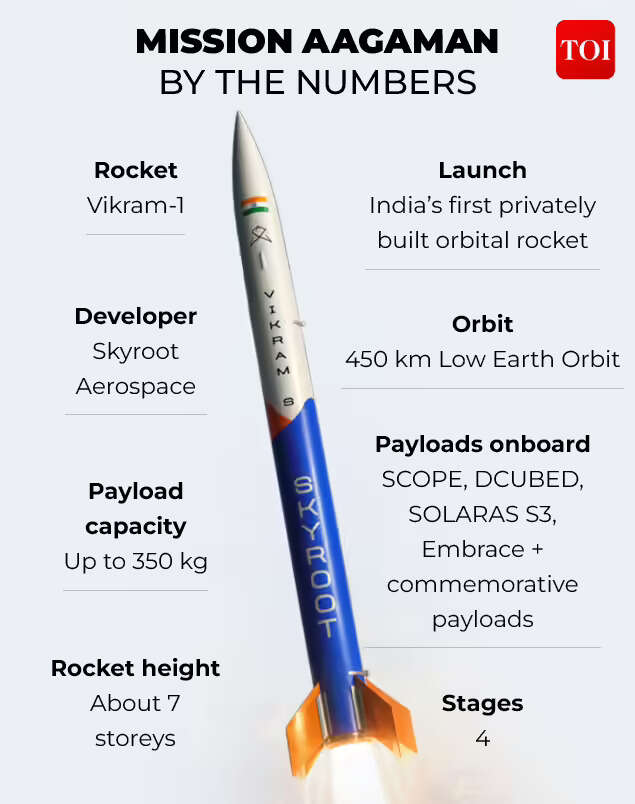
The features of Vikram-1
That distinction matters because modern warfare is becoming increasingly dependent on space. As countries rely more heavily on satellites for military communications, intelligence, surveillance and navigation, the ability to restore these services quickly is emerging as an important element of national security.The question, therefore, is not only whether private firms can build and launch rockets, but whether those rockets can eventually become part of a wider system that keeps a country’s space infrastructure functioning when it comes under pressure.
What is responsive space launch
The phrase may sound technical, but the concept is relatively straightforward. Responsive space capability refers to the ability to prepare, launch and operate a spacecraft within an operationally relevant timeframe. Rapidly replacing a damaged, disabled or destroyed satellite — often described as space reconstitution — is one important part of it.Instead of waiting months or years for a conventional launch schedule, the process is compressed so that a prepared satellite can be deployed within days or, in highly developed systems, shortly after a formal launch order is issued.The objective is not simply to launch a rocket quickly. It is to reduce the time between identifying a strategic requirement and placing a functioning satellite in the required orbit.
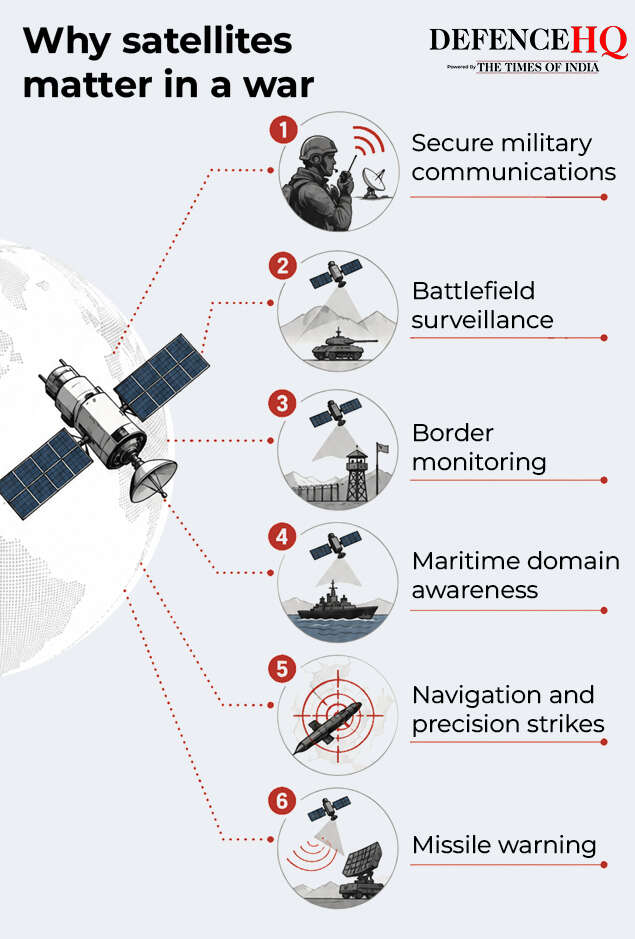
Satellites help in border monitoring.
Such speed does not mean that a rocket and satellite can necessarily be built from scratch within hours. It generally depends on having standardised satellites, prepared launch vehicles, suitable infrastructure and pre-agreed approvals already in place. Only then can the final interval between a launch decision and liftoff be sharply reduced.That ability is becoming increasingly valuable because satellites support countless activities that most people rarely notice. They keep communication networks running, provide navigation and timing services, monitor weather systems, support maritime surveillance, assist disaster management and underpin parts of financial and digital infrastructure.Militaries depend on them for intelligence gathering, battlefield communications, reconnaissance, navigation and, in some countries, missile warning.When these capabilities function normally, they remain largely invisible. Their importance becomes obvious only when they are disrupted.If critical satellites or parts of a constellation are jammed, disabled or destroyed during a conflict, military communications and surveillance can be degraded, navigation services may become less reliable and commanders may struggle to maintain situational awareness, particularly if adequate redundancy is unavailable. Civilian infrastructure can also face disruptions.Responsive launch seeks to minimise that gap by restoring essential capabilities before their loss begins to create a serious military or civilian disadvantage.It is, however, only one element of space resilience. Countries can also reduce vulnerability by deploying larger and more distributed constellations, hardening satellites, improving anti-jamming systems, building manoeuvrable spacecraft and using commercial or allied capacity as a backup.
Why Vikram-1 raises the bar
India’s space programme has traditionally been driven almost entirely by Isro. Private companies manufactured components, supplied technology and supported missions, but orbital launches remained the domain of the state. Vikram-1 changed that equation.For the first time, an Indian private company has demonstrated the ability to develop and operate an orbital launch vehicle. The achievement is important not simply because another rocket has entered service, but because it broadens India’s launch ecosystem.A larger launch ecosystem creates greater flexibility. Instead of depending solely on government launch schedules and production capacity, India can gradually create additional options through private industry.That does not automatically translate into responsive launch, but it establishes one of the foundations required for such a capability. A country cannot launch satellites rapidly unless it has sufficient launch vehicles, production lines, trained personnel and operational infrastructure available when required.
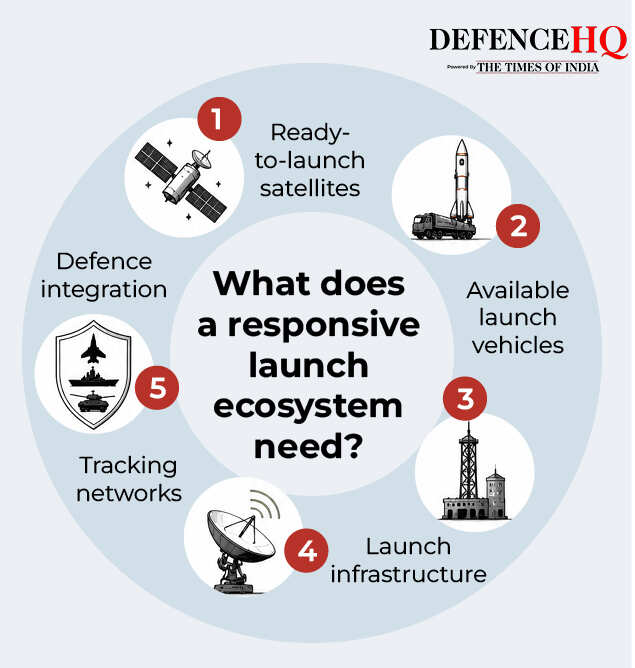
Response launch system need a robust ecosystem
The mission also provides an accessible way to understand a much broader strategic issue. If Indian private companies can repeatedly demonstrate reliable orbital launches, could they eventually help replace critical national assets during a future crisis? The answer remains cautious.Launching a commercial satellite according to a planned schedule is very different from maintaining rockets, payloads and launch infrastructure in permanent readiness for emergency deployment. Nevertheless, Vikram-1 demonstrates that India has begun developing one of the essential building blocks of a more resilient launch architecture. Its potential strategic role must also be viewed in the context of payload and orbit.Vikram-1 is primarily a small-satellite launcher intended for low-Earth orbit. It cannot be treated as a rapid replacement option for every Indian space asset, particularly large communications or navigation satellites operating in higher orbits.Its more plausible strategic role would be to deploy small communications, surveillance, reconnaissance or space-domain-awareness satellites, potentially as part of distributed low-Earth-orbit constellations. Such systems could supplement larger satellites and make it harder for an adversary to disrupt an entire capability by targeting a small number of assets.
Building a responsive launch system
Creating a genuinely responsive launch capability requires much more than a reliable rocket. Every stage of the process has to be designed around speed.The first requirement is the satellite itself. Spacecraft intended for rapid deployment would need standardised designs that could be assembled, tested and integrated within compressed timelines.If every satellite requires months of custom engineering before launch, even the fastest rocket cannot provide a genuinely responsive capability.Countries may therefore need pre-built satellites kept in reserve, modular spacecraft that can be configured for different missions, or production systems capable of completing them at short notice.The launcher must also be available when required. This could mean keeping completed vehicles ready for deployment, maintaining critical components in storage or operating production lines capable of preparing launch vehicles within a tightly defined period.Ground infrastructure is equally important. Launch pads, fuelling systems, tracking stations, mission-control facilities, integration buildings and range-safety procedures must all support rapid operations rather than only conventional launch schedules.
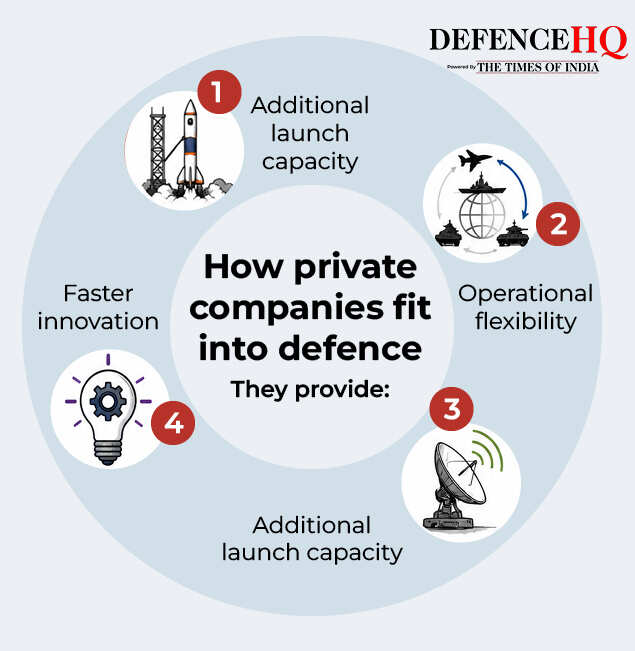
Private companies would provide addtional launch capacity
Launch-site availability is another consideration. A responsive system becomes less useful if it depends on a single facility whose launch calendar is already crowded or which could itself be disrupted during a crisis.Regulatory and safety approvals are also part of the equation. A responsive system would require pre-agreed emergency authorisation procedures so that necessary clearances could be completed on compressed timelines without compromising public or operational safety.The satellite must then be inserted into the correct orbit and brought into service quickly. Launching it is only part of the mission. Ground stations must establish contact, test the payload and integrate the spacecraft with existing military or civilian networks.In other words, responsive launch is not merely a rocket problem. It is a systems problem.For India, that means private launch companies alone cannot create such a capability. Government agencies, regulators, satellite manufacturers, ground-infrastructure operators, mission planners and the armed forces would all have to function within a framework designed for rapid decision-making and execution.
Why it matters during a conflict
The value of responsive launch becomes much clearer when viewed through the lens of national security.If India were to lose critical satellites during a conflict, the immediate priority would not necessarily be to replace every spacecraft. The focus would instead be on restoring the services most urgently required for ongoing operations.The priorities would depend on the nature of the conflict, but communications, surveillance, navigation, timing and space-domain-awareness capabilities could all require urgent restoration.Communications satellites keep commanders, troops, aircraft, ships and other platforms connected across vast distances, whether along India’s land borders, over the Indian Ocean or in remote regions where conventional communication networks remain limited.Surveillance and reconnaissance satellites provide intelligence, monitor borders, track military movement and strengthen maritime-domain awareness. Without them, decision-makers could have a weaker and less timely picture of developments on the ground and at sea.Navigation and precise timing services support aircraft, ships, logistics networks and precision-guided operations. Civilian infrastructure also depends on accurate timing signals for telecommunications, banking and digital networks. A prolonged disruption could therefore affect far more than military operations.Globally, space-based early-warning satellites are also used to detect missile launches and monitor strategic activity. Such systems can reduce the risk of surprise during periods of heightened tension. For India, the development or rapid restoration of these capabilities could become increasingly important as its military space architecture evolves.Responsive launch is therefore not about continuously placing new satellites into orbit. Its purpose is more practical: restoring essential services before temporary losses develop into operational disadvantages.Even a relatively short gap in communications, surveillance or navigation could affect military decision-making. But the ability to launch a satellite rapidly would matter only if the spacecraft, ground systems and users were also ready to bring the replacement into service.
The race for space
The United States has conducted some of the clearest public demonstrations of tactically responsive space operations, working with commercial companies to reduce the time required to prepare, launch and operate satellites after receiving a mission order.China also possesses an extensive state-controlled space programme, a growing range of solid-fuel launch vehicles and significant military-space infrastructure that could support rapid-launch operations. However, the readiness and precise structure of its wartime reconstitution capability remain difficult to assess from publicly available information.Russia remains an important space power because of its long launch history, military-space experience and extensive infrastructure, although the responsiveness and availability of its launch architecture would depend on operational and industrial conditions.Japan and European countries also possess strong indigenous or collective launch capabilities. Their systems are organised differently, and conventional access to space does not automatically mean that they maintain launch vehicles and satellites in a state of emergency readiness.Israel is smaller in scale but strategically significant because of its defence-oriented space programme and experience in operating military reconnaissance satellites.India’s position is different and considerably newer. The success of Vikram-1 strengthens the country’s private launch base, but it remains a step before true wartime responsiveness.
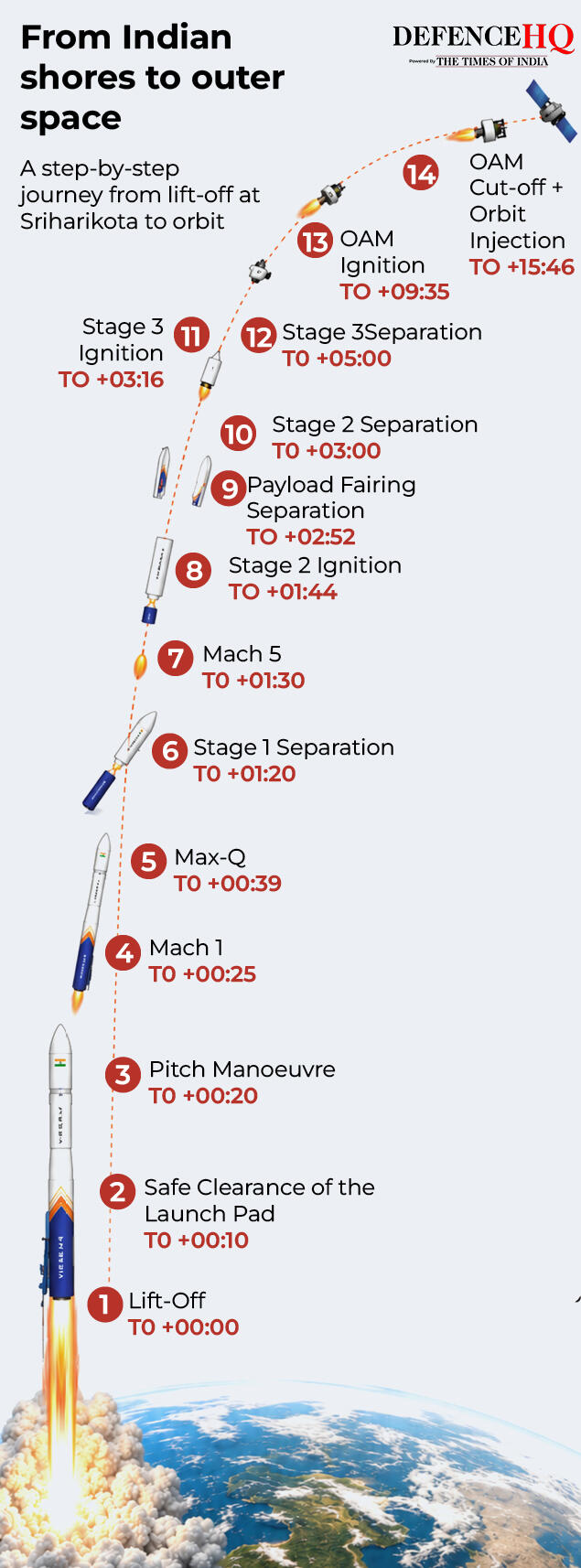
Vikram-1 step to step journey
India would still need standardised satellites, reserve payloads, prepared launch vehicles, rapid authorisation mechanisms, multiple launch options and close coordination between civilian and military institutions before it could claim an end-to-end responsive launch capability.Vikram-1 has therefore not given India the ability to replace a critical satellite at a moment’s notice. What it has provided is a new private launch option that could eventually become one component of a more resilient national space architecture.That is why the mission’s strategic importance extends beyond the rocket itself. Its success shows that India’s private sector can assume a larger role in providing access to orbit. Whether that capability can be transformed into a system capable of responding during a national emergency will depend on what India builds around it next.