Pickaxe Mountain revives the Kahuta question: Could India have crippled Pakistan’s nuclear leap?

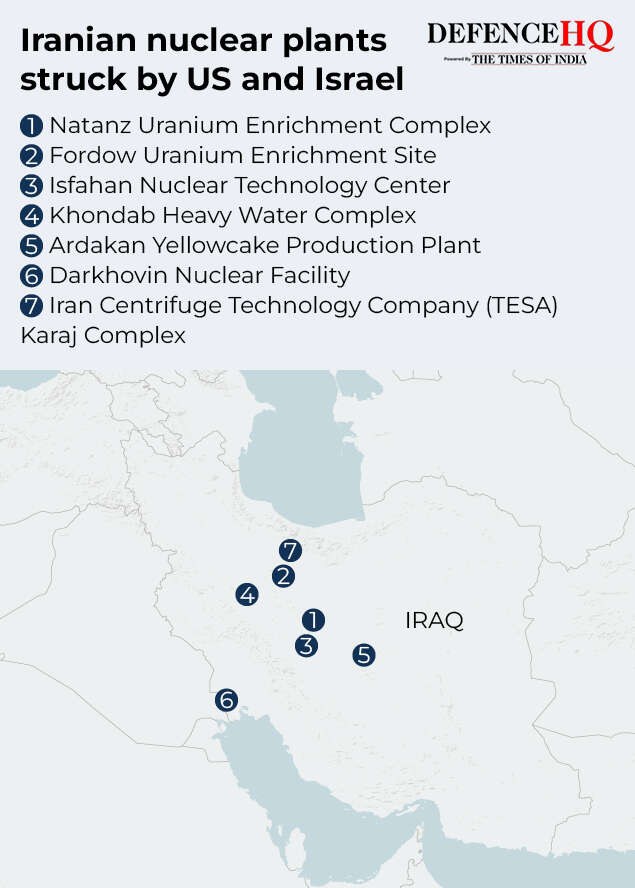
As the conflict in West Asia nears the five-month mark, US President Donald Trump has once again threatened to target the now-famous Pickaxe Mountain, a location at the heart of the current conflict.It is deep within the man-made tunnels of this mountain that Iran has hidden its nuclear facilities, quite literally out of reach of the Americans or the Israelis. At the heart of the conflict, which has had wide-ranging effects across the world, is Iran’s desire to develop nuclear weapons.
Both the United States and Israel have been working to deny Iran this capability. Iran has repeatedly threatened to wipe Israel off the map, while US presidents across party lines have repeatedly stated that Iran will not be allowed to possess nuclear weapons.In June last year, both Israel and the United States struck the Natanz nuclear facility, which is not far from Pickaxe Mountain’s underground facility in central Iran.Natanz, located roughly 250km south of Tehran, was the central facility for nuclear enrichment in the Islamic Republic and critical to the country’s nuclear weapons programme. The facility was once again struck during the opening days of the current conflict.
But these attacks were not the first of their kind. Due to the destructive power of nuclear weapons, countries have historically tried to ensure that their rivals do not gain access to these weapons of mass destruction, with the first such attacks taking place even before the first nuclear weapon was made.
The long history of striking nuclear programmes
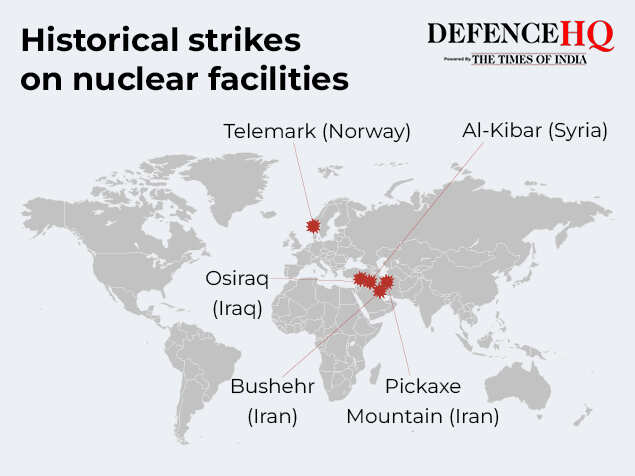
Long before the two blinding flashes snuffed out the light from Hiroshima and Nagasaki, the Germans, much like the Americans, had begun planning to build a nuclear weapon.During the dark days of World War II, the Allies carried out several operations to destroy a heavy-water production facility in Telemark in occupied Norway. The heavy water was considered critical to Germany’s nuclear weapons programme.Commando operations, air raids and sabotage were used to target the facility. By the end of the conflict, America had demonstrated how devastating an atomic bomb could be.
Israel’s doctrine of preventive strikes
Jump ahead to 1981. Iran and Iraq were at war, while Iraq, under Saddam Hussein and with assistance from France, was building a nuclear reactor at Osiraq.The Israelis, aware of Saddam Hussein’s plans, executed a daring air attack, using their newly acquired F-16s and F-15s to strike the nuclear facility in what came to be known as Operation Opera.The strike put Iraq’s nuclear ambitions on hold, and Saddam turned his attention towards fighting the Iranians.The reactor was located just south of Baghdad, Iraq’s capital, along the eastern bank of the Tigris river. During the Iran-Iraq War, Baghdad was thought to be among the most heavily defended air-defence sectors in the world.Israel did not lose a single aircraft in the operation, but the incident demonstrated the risks involved in attempting to destroy the reactor.Ironically, Iran had also attacked the same nuclear facility in 1980, just a week after the outbreak of hostilities, under the banner of Operation Scorch Sword.During the same Iran-Iraq conflict, Saddam’s air force struck the still-under-construction Iranian nuclear power plant at Bushehr multiple times, putting Iran’s nuclear ambitions on hold for several years.Similarly, in 2007, the Israeli air force struck Syria’s al-Kibar site, destroying a clandestine reactor built with North Korean assistance.The Israelis once again used F-15s and F-16s to bomb the Syrian nuclear site, ensuring that the country did not acquire the capability to develop nuclear weapons. The mission was called Operation Outside the Box.The Syrian Civil War began four years after the attack. ISIS later occupied the site, which the International Atomic Energy Agency had said was a nuclear reactor.
India’s nuclear dilemma
By the late 1970s, intelligence agencies had confirmed that Pakistan was enriching uranium at the Kahuta facility, located east of Islamabad.Indian planners debated a strike, with reports suggesting that the Indian Air Force had drawn up plans for a precision raid.Documents released by the US State Department in 2015 revealed that the Indian Air Force had conducted a study in 1981 on the feasibility of carrying out an air strike on the Kahuta facility, according to a report by the US-based Brookings Institution.On May 18, 1974, in the sweltering heat of the Thar desert in Pokhran, the earth shook as India tested its first nuclear weapon, codenamed Smiling Buddha. India described it as a peaceful nuclear explosion.India needed a strategic deterrent as China had demonstrated its nuclear capability in 1964, just two years after its war with India.Long before the Buddha smiled, Zulfikar Ali Bhutto, who was Pakistan’s foreign minister in 1965, stated: “If India builds the bomb, we will eat grass or leaves, even go hungry, but we will get one of our own. We have no alternative.”Bhutto believed that India would go nuclear in response to China and that Pakistan, too, should use the power of the atom for military purposes.
The Kahuta strike that never happened
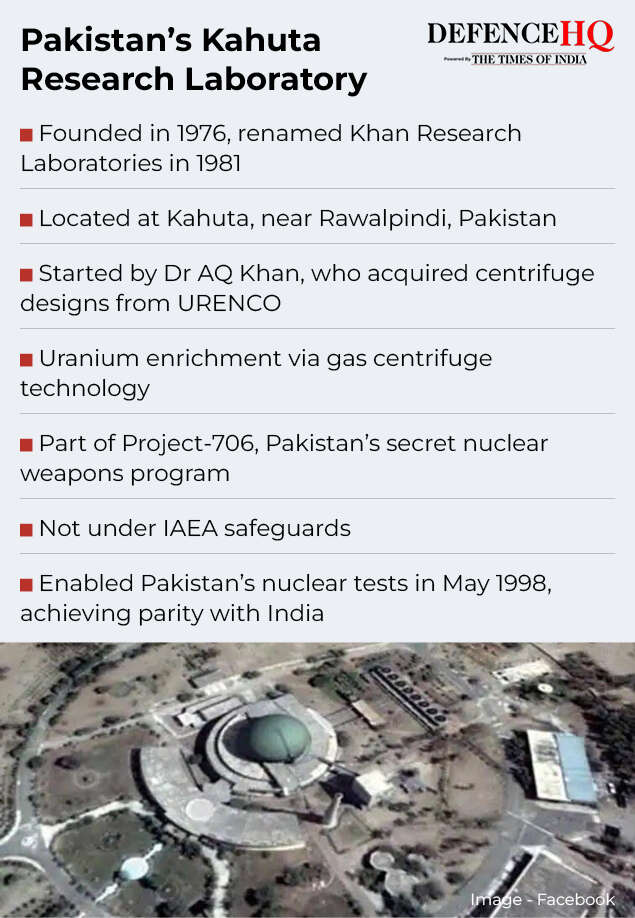
Israel, wary of a nuclear-armed Islamic nation, offered to attack Pakistan’s nuclear facility at Kahuta, located east of Islamabad and just 170km northwest of Jammu.Several subsequent accounts have claimed that India and Israel discussed a possible joint operation. According to these accounts, Israeli aircraft could have used Indian bases for the mission. However, the full operational plan has never been officially confirmed.
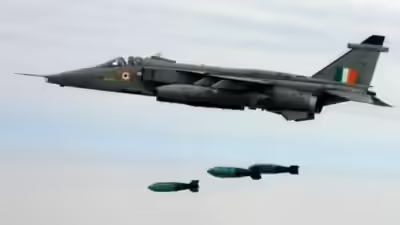
Kahuta is located at less than 150 KM from some of the forward bases of the IAF, which would be well within the reach of MiG21/23 and freshly inducted Jaguar aircraft. While it was physically within reach, it’s the strategic consideration that weighed heavily against the attack.
Air Marshal GS Bedi (retired), author and former Director General (Inspection & Safety)
The strike, as we know, was never carried out. By the late 1980s, Pakistan had achieved nuclear capability.The same Brookings Institution report states that the study concluded that the attack would have succeeded if carried out, although it also warned that the strike could lead to a wider conflict.In May 1998, India conducted a series of nuclear tests at Pokhran. Pakistan responded with its own tests 17 days later.The speed of Pakistan’s response demonstrated that it had already developed substantial nuclear capability before the tests. India’s decision not to strike Kahuta is often described as a “missed boat”—a moment when decisive action could have prevented Pakistan’s nuclearisation.
An attack on Kahuta promised a tactical setback for Pakistan, but a retaliatory strike on Trombay threatened a radiological disaster for Mumbai—a price India chose not to pay.
Lieutenant General K R Rao (retired), former DG Artillery
From pre-emption to mutual restraint
Amid tensions over nuclear weapons, India and Pakistan signed the Agreement on the Prohibition of Attack against Nuclear Installations and Facilities on December 31, 1988.The agreement entered into force on January 27, 1991. Since then, on January 1 every year, India and Pakistan have shared lists of their nuclear facilities.
It’s difficult to say what India could have achieved by attacking this facility. It was recovering from the 1971 Ops and on path to development. In my considered opinion the restraint exercised by the government paid India much greater dividends, which could be encashed at a later date through the image of a responsible nation, than the attack would have.
Air Marshal GS Bedi (retired), author and former Director General (Inspection & Safety)
The aim of the exercise is to prevent either side from carrying out the kind of attacks that Israel has conducted against its adversaries. By exchanging lists of their nuclear installations, both countries have sought to ensure that neither side attacks these facilities.Israel’s boldness delayed its adversaries’ nuclear programmes, while India’s caution allowed Pakistan to achieve parity.Today, India’s focus is on building resilience. Projects such as Sudarshan Chakra and Kusha aim to create a layered air and missile-defence shield integrating interceptors, sensors, lasers and command networks.The objective is not to strike an adversary’s nuclear facilities but to ensure survivability against saturation attacks.India’s nuclear dilemma has always been defined by restraint. Unlike Israel, which struck Iraq’s Osiraq reactor in 1981 and Syria’s al-Kibar facility in 2007, New Delhi never attempted a pre-emptive strike on Pakistan’s Kahuta nuclear-enrichment plant in the 1980s.That decision, born of caution, international pressure and fear of escalation, allowed Pakistan to cross the nuclear threshold, permanently altering South Asia’s strategic balance.