
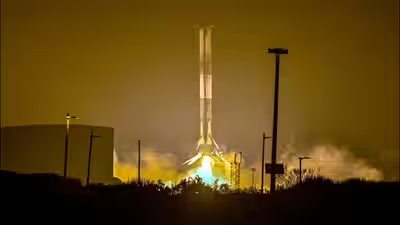

On July 10, China’s Long March 10B placed its payload into orbit before its first-stage booster returned to Earth and was captured by a net on an offshore platform. It was China’s first controlled recovery of an orbital-class rocket booster, making it only the second country after the United States to achieve the feat.The recovery brought China closer to the reusable-rocket model pioneered commercially by Elon Musk’s SpaceX. But another Chinese experiment points to a more radical ambition: reducing the need for rockets to burn vast quantities of fuel during lift-off.In late March, a research facility in Ziyang, a city near the Tibetan Plateau, successfully tested a high-temperature superconducting navigation system. Officials described it as a breakthrough for a proposed electromagnetic launch system in which electricity would catapult a rocket off the ground before its chemical engines took over.
CJP Jantar Mantar Protest Updates
The idea is not to do away with rockets altogether, at least not yet. It is to provide them with an initial electric boost, potentially reducing the amount of propellant they must carry and burn during the most demanding part of the launch.As the global space industry searches for cheaper and more efficient ways to reach orbit, could China’s electromagnetic launch system eventually challenge the chemical rockets on which SpaceX built its dominance?
Why reaching orbit requires so much fuel
Gravity makes reaching orbit extraordinarily difficult. A spacecraft in low-Earth orbit must travel at roughly 7.8 kilometres per second. To escape Earth’s gravitational influence entirely, it would need to reach an escape velocity of about 11.2 kilometres per second at the planet’s surface.Chemical rockets generate the enormous thrust needed to reach these speeds by burning fuel with an oxidiser and expelling hot gases at extremely high velocity. In simple terms, they convert stored chemical energy into the motion needed to lift a vehicle from the ground and accelerate it towards orbit.As a rocket burns through its propellant, however, its empty tanks and other components become unnecessary weight. Rockets are therefore divided into stages.The first stage provides most of the thrust during lift-off and the early part of the ascent before separating. A smaller upper stage then continues accelerating the payload until it reaches the velocity needed to enter orbit.This process consumes vast quantities of propellant. A rocket must carry both fuel and oxidiser because it cannot depend on atmospheric oxygen as it climbs towards space. Propellant consequently accounts for much of its mass at lift-off, leaving only a relatively small proportion for the payload.The problem is self-reinforcing: the more propellant a rocket carries, the heavier it becomes. It then needs still more propellant to lift that additional weight. The enormous energy requirement, high fuel consumption and complexity of the hardware make conventional space launches expensive and technically demanding.
How reusable rockets changed the economics
The high cost of spaceflight prompted companies and space agencies to pursue reusable rockets. If the most expensive parts of a launch vehicle could be recovered, inspected and flown again, the cost of subsequent missions could be reduced.Blue Origin was among the first private companies to demonstrate the potential of vertical rocket recovery when its suborbital New Shepard vehicle successfully took off and landed in 2015. SpaceX, however, turned rocket reuse into a large-scale commercial operation through the Falcon 9.After pushing the upper stage and its payload towards the required velocity, the Falcon 9’s first stage returns to Earth. It can land vertically on land or on a platform at sea before being prepared for another mission.Reuse has reduced the time and resources required for subsequent launches, allowing SpaceX to increase its launch frequency dramatically.
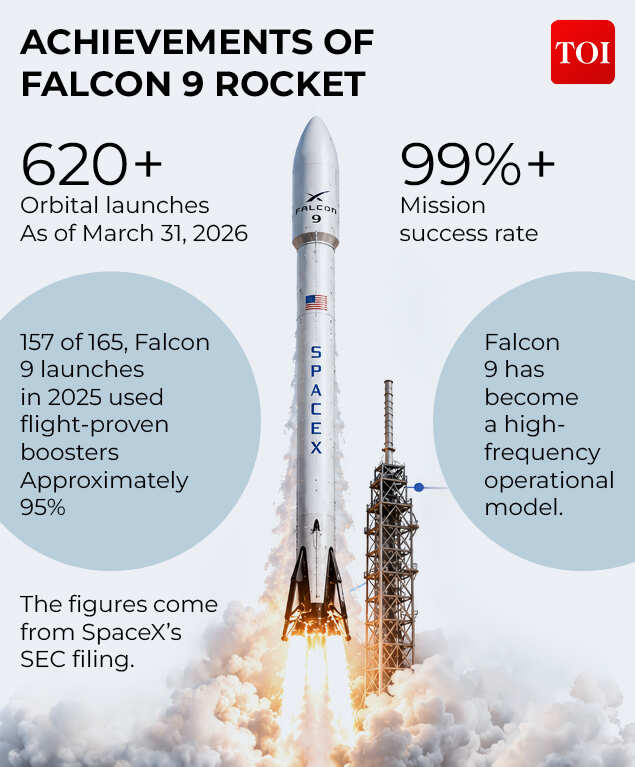
Boosters were reused in approximately 95 per cent of Falcon 9 launches in 2025.
According to a SpaceX filing with the US Securities and Exchange Commission dated May 20, 2026, Falcon 9 had completed approximately 620 orbital launches by March 31, with a mission success rate of more than 99 per cent. In 2025 alone, SpaceX launched 165 Falcon 9 rockets, 157 of them using previously flown boosters.The first version of Falcon 9, launched in 2010, reportedly brought the cost of reaching orbit down to about $2,700 per kilogram — approximately 85 per cent below the historical average of $18,500 per kilogram.This launch capacity has also helped SpaceX build a vertically integrated business. It develops rockets, uses them to deploy its own Starlink satellites, operates the satellite-internet network and builds spacecraft to transport astronauts and cargo.Investor confidence in this ecosystem was underlined by SpaceX’s record-breaking initial public offering in 2026. The IPO raised around $75 billion and valued the company at between $1.5 trillion and $2 trillion, helping make Musk the world’s first trillionaire.SpaceX is now developing Starship, a fully reusable super-heavy launch system designed to carry people and cargo to the Moon, Mars and beyond. If it becomes operational and can be flown again rapidly, Starship could reduce launch costs well beyond what Falcon 9 achieved.But even a fully reusable rocket faces a fundamental limitation: it must carry enormous quantities of propellant to overcome gravity and reach orbital velocity.China’s electromagnetic project seeks not to eliminate this requirement entirely, but to reduce the rocket’s dependence on chemical propulsion during the initial phase of launch.
China’s plan to launch rockets using electricity
A Chinese patent published in 2019 outlines a space-launch system that would use electrically powered linear motors to accelerate a rocket along a ground-based track before releasing it.Instead of relying solely on chemical engines from the launch pad, the rocket would receive an initial electromagnetic push and begin using its own propulsion after reaching a predetermined speed.
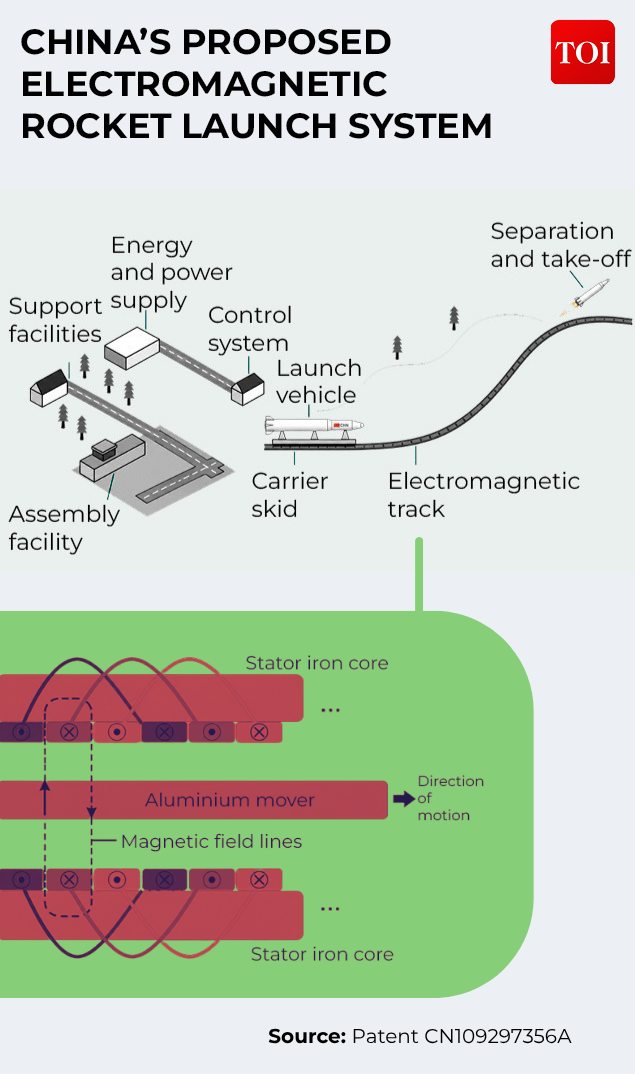
An overview of how China aims for potential rocket liftoff through electromagnetic acceleration.
The patent argues that such a system could address three shortcomings of conventional rockets: limited launch flexibility, complete dependence on chemical propulsion from lift-off, and the costs and inefficiencies associated with carrying large quantities of propellant.The proposed launch system consists of four coordinated parts: an energy-storage subsystem, an energy-conversion subsystem, a linear-motor subsystem, and a control and maintenance subsystem.The energy-storage system would draw electricity from an external supply and hold it until launch. It would then deliver the stored power to the energy-conversion system, which would transform it into alternating current with the electrical characteristics required to operate the linear motors.Under the US-granted version of the patent, the conversion system would use multiple inverter units arranged in modules. This would allow the immense electrical load to be distributed among the many linear motors positioned along the track.The motors would generate electromagnetic force and propel a rocket adapter along the launch track. Once the rocket reached the required speed, it would separate from the track and continue its flight using its own engines.A central control and maintenance system would coordinate the operation, issue commands to the other subsystems and monitor the launcher’s safety and reliability.In theory, the system would function somewhat like a high-powered magnetic catapult. By giving the rocket momentum before its engines take over, it could reduce the amount of propellant needed during the first stage of flight.
Why chemical rockets are not going away yet
Despite its potential, an electromagnetic launcher would face formidable technical and practical challenges.The most important is that it cannot eliminate chemical propulsion. It could provide an initial boost and reduce fuel consumption during the early stages of flight, but the rocket would still need engines to accelerate through the atmosphere and reach an orbital velocity of about 7.8 kilometres per second.The required infrastructure would also be enormous. The system would need a long electromagnetic track, large energy-storage facilities, advanced power-distribution networks and highly precise guidance and control equipment.Constructing and maintaining such infrastructure on or near the Qinghai-Tibet Plateau would pose additional logistical and engineering difficulties. Equipment, construction materials and rockets would have to be transported through remote and mountainous terrain, while maintenance and emergency operations would be far more complicated than at a conventional coastal launch site.Precision would be critical. A rocket travelling at extremely high speed along an electromagnetic track would have to remain aligned throughout the acceleration process. Even a small deviation could cause catastrophic failure.China is therefore exploring technologies such as high-temperature superconducting navigation systems to improve the accuracy and stability of the launcher.The forces acting on the rocket would be another challenge. Accelerating a heavy launch vehicle to very high speeds over a limited distance could expose the rocket, its payload and any crew to extreme stress. The vehicle might have to be designed specifically for electromagnetic launch rather than simply being placed on a track built for existing rockets.The location presents another trade-off. The Tibetan Plateau’s altitude could reduce atmospheric drag and allow the rocket to begin its powered flight above some of the densest parts of the atmosphere. But the same high-altitude, mountainous environment would make construction, transportation and maintenance more difficult.There is also a major gap between testing individual components and demonstrating a complete orbital launch system. China may have tested technologies relevant to electromagnetic propulsion, navigation and control, but it has not yet launched an orbital rocket using such a system.For the foreseeable future, chemical engines will remain essential. Even under China’s proposed system, the electromagnetic track would largely serve as a launch assist, potentially replacing part of the first stage’s work rather than making rockets obsolete.The more immediate challenge to SpaceX is therefore likely to come from China’s reusable rockets, including the Long March 10B. Electromagnetic launch technology represents a longer-term and far more ambitious bet.If China can make it work at scale, it could allow rockets to carry less fuel, more payload or both. That would not immediately end the era of chemical rockets, but it could change how their most expensive and fuel-intensive journey begins.