
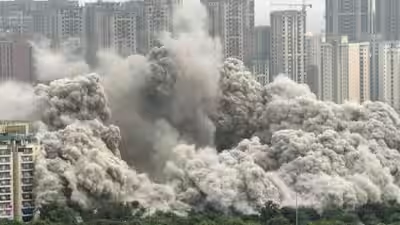
Noida Twin Towers case explained: What led to the demolition and why the case still stands in court |

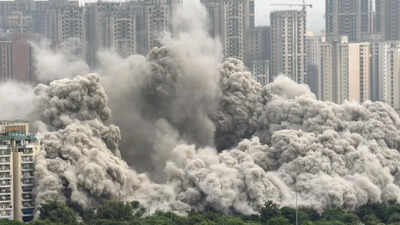
They once towered over Noida’s skyline as symbols of rapid urban growth. But on August 28, 2022, the Supertech Twin Towers, Apex and Ceyane, were reduced to dust in a controlled implosion in Noida’s Sector 93A.The Supertech Twin Towers were demolished after the Supreme Court upheld the Allahabad high court’s order declaring their construction illegal.Nearly four years later, while the towers are gone, the legal battle is not.The dispute began with the development of Supertech’s Emerald Court housing project. In 2005, the Noida Authority sanctioned a plan for 14 towers, each with a ground floor and nine upper floors. A revised plan, sanctioned in December 2006, increased the original towers to 11 floors and approved additional construction, including a new Tower 15, Tower 16 and a shopping complex. The plan also showed a green area in front of the existing Tower one.However, the plan changed significantly in 2009, when the earlier proposal for Tower 16 and a shopping complex was replaced by two much taller towers, later named Apex and Ceyane. The 2009 plan sanctioned the towers at 24 floors and 73 metres in height, with a distance of only nine metres between them.A further revision sanctioned in March 2012 increased the height for the towers to approximately 121 metres, with around 40 floors.These successive changes became the reason for legal dispute between the developer and residents of Emerald Court. Residents argued that the revised plans violated building regulations, reduced their rights in common areas and eliminated the green area shown in earlier sanctioned plans.The Supreme Court examined the Noida Building Regulations of 2006 and 2010, the National Building Code, 2005, and fire-safety requirements. It also considered expert reports, including one by the National Buildings Construction Corporation, which concluded that the towers did not comply with the applicable requirements.In 2014, the Allahabad High Court ordered the demolition of the two towers in 2014, which was eventually upheld by the Supreme Court in 2021. The Supreme Court said that illegal construction could not be protected simply because the buildings were nearly complete or apartments had already been sold. The Court directed the demolition to be carried out at Supertech’s cost.
Recent developments
The legal dispute, however, has continued over refunds to homebuyers who had booked apartments in the two towers. The refund process has been affected by Supertech’s insolvency case under the Insolvency and Bankruptcy Code, with eligible claims being pursued on a pro-rata basis from funds deposited by the Interim Resolution Professional (IRP).On July 23, 2026, the Supreme Court postponed a plea seeking refunds for some homebuyers by three months, to explore alternative ways of satisfying the claims of buyers who had not opted for alternative allotments.