After growing plants in space for years, NASA research could help astronauts grow medicines on demand, starting with tobacco and a harmless virus |

Growing fresh vegetables aboard the International Space Station has become a familiar part of NASA‘s efforts to support astronauts on long-duration missions. Now, researchers believe those same plants could take on a much bigger role by producing medicines whenever crews need them. A new study has shown that a tobacco relative, paired with a harmless plant virus, could one day serve as a living pharmaceutical factory in space. The approach could help astronauts manufacture therapeutic proteins during future missions to the Moon and Mars, reducing reliance on medicine supplies launched from Earth. While the technology is still at an early stage, scientists say it marks an important step towards making deep-space exploration more self-sufficient.
How the idea of growing medicines in space took root
NASA’s plant experiments have evolved significantly over the past two decades. Early studies focused on understanding whether crops could survive and thrive in microgravity. The goal was to provide astronauts with fresh food, improve air quality by recycling carbon dioxide into oxygen and support mental wellbeing during long stays in space.These efforts led to successful cultivation of crops such as lettuce, radishes and chilli peppers aboard the International Space Station. The latest research builds on this foundation by exploring whether plants could also manufacture valuable therapeutic compounds rather than simply serving as food.
Why future astronauts may need medicines grown in space
Long-duration missions present medical challenges that cannot be solved by simply packing more supplies before launch. A crewed mission to Mars could last several years, with no opportunity for emergency resupply or evacuation.Researchers have also raised concerns that some medicines may lose potency over time because of prolonged storage and exposure to the space environment. Producing medicines onboard would allow astronauts to create certain treatments when required instead of relying entirely on supplies carried from Earth.
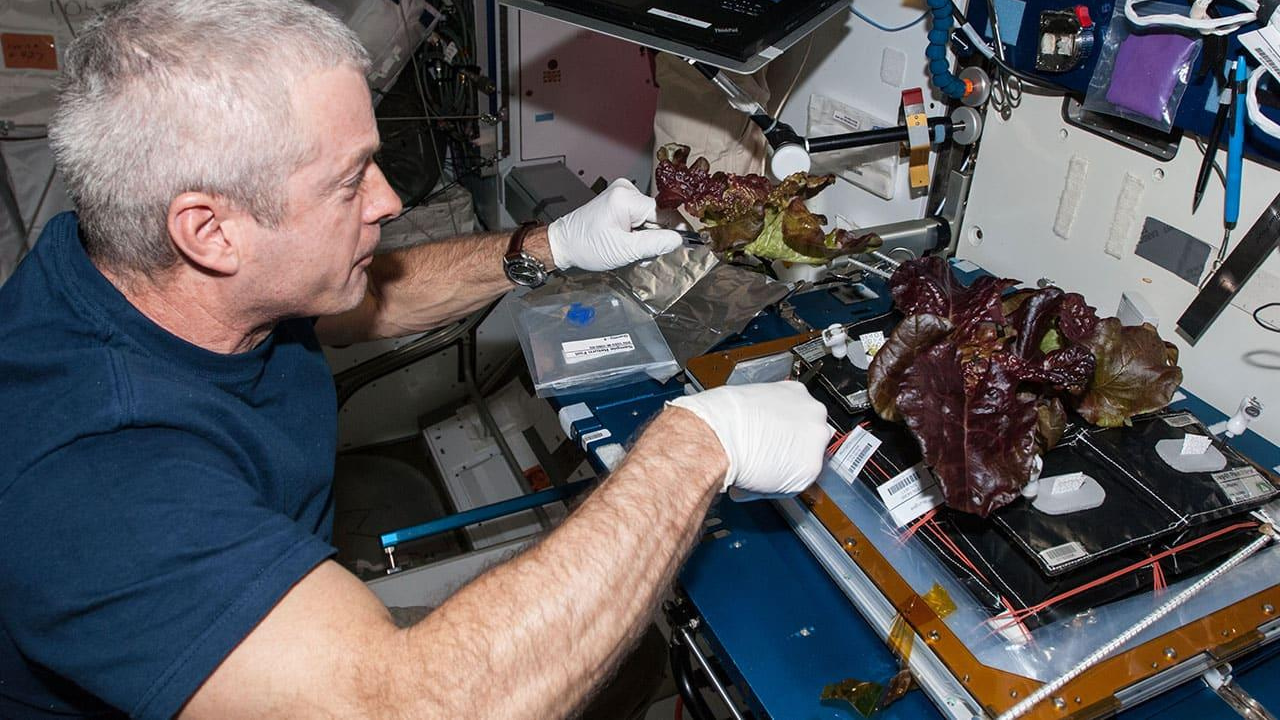
An astronaut caring for plants inside the Veggie growth chamber, part of NASA’s long-running research into producing fresh food during extended space missions.
Why scientists chose a tobacco relative
The study centres on Nicotiana benthamiana, a close relative of tobacco that has become one of the most widely used plants in biotechnology.Unlike commercial tobacco grown for cigarettes, this plant is prized because it grows quickly, is easy to genetically modify and can produce large quantities of proteins. Scientists have already used it on Earth to manufacture experimental vaccines, antibodies and other therapeutic proteins, making it an ideal candidate for pharmaceutical production in space.
The role of a harmless plant virus
The second key component of the research is the Cowpea mosaic virus, commonly known as CPMV. Although it infects certain plants, it does not infect humans and is considered harmless to people.Scientists are interested in CPMV because its protein shell can be engineered for medical applications. It is being studied as a platform for cancer immunotherapy, vaccine development and targeted drug delivery. In this research, the virus serves as a model for producing medically useful nanoparticles inside plants.
A new way to harvest medicines without harming the plant
One of the study’s most important achievements is the development of a method that allows therapeutic particles to be collected without destroying the plant.Traditional extraction techniques typically require leaves to be harvested, crushed and chemically processed. The new approach instead uses a vacuum-assisted infiltration process followed by centrifugation and filtration to recover the desired compounds. Because the plant remains alive, it can continue growing and potentially produce additional batches, making the process more efficient and sustainable for long missions.
The experiments were carried out under simulated space conditions
The researchers did not conduct their experiments aboard the International Space Station. Instead, they recreated several stresses associated with spaceflight in laboratory conditions.These included simulated microgravity using specialised equipment, temperature fluctuations and oxidative stress designed to mimic some effects of space radiation. The plants continued to produce the desired viral nanoparticles under these conditions, demonstrating that the manufacturing process could remain effective even in challenging environments.
Why this matters for missions to the Moon and Mars
Future lunar bases and crewed missions to Mars will need reliable healthcare systems that function independently of Earth. Carrying every possible medicine for years-long missions would increase payload weight and still might not cover every medical emergency.Plants capable of producing medicines on demand could become part of an integrated life-support system, supplying astronauts with fresh therapeutic compounds whenever needed. Such a capability could improve crew safety while reducing the amount of pharmaceutical cargo launched from Earth.
Challenges scientists still need to overcome
Despite the promising findings, researchers emphasise that the technology is still at the proof-of-concept stage. The production system must be tested in actual spaceflight to understand how prolonged microgravity and radiation affect both the plants and the medicines they produce.Scientists also need to ensure that any pharmaceuticals grown in space consistently meet strict quality and safety standards before they can be used by astronauts.
A step towards self-sufficient space exploration
As space agencies prepare for longer missions beyond low-Earth orbit, the ability to grow medicines alongside food could become an essential part of human exploration. While astronauts are not yet cultivating pharmacies in orbit, the latest research demonstrates that plants may one day do much more than provide fresh vegetables. They could become living bioreactors, helping future crews stay healthy as they venture farther from Earth than ever before.