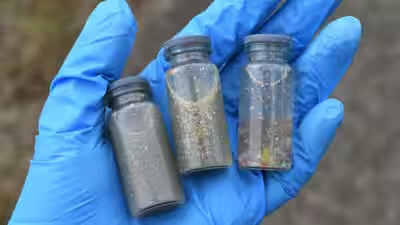
Scientists built a reusable magnetic material that removed more than 95% of microplastics and nanoplastics from water within one hour and showed early promise in removing some PFAS

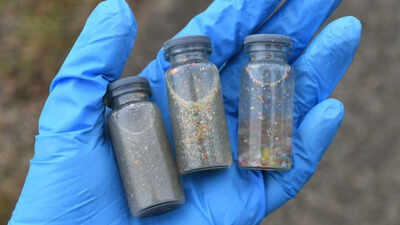
Scientists at RMIT University in Australia have built a reusable magnetic material that removed more than 95% of micro- and nanoplastics from water within one hour and showed early promise against some PFAS.The new water treatment technology captures plastic particles down to 30 nanometres while also pulling out toxic heavy metals, drug residues, and industrial dyes. The findings were published in the Chemical Engineering Journal in a paper titled “Scalable room-temperature synthesis of a MOF-based magnetic adsorbent for rapid simultaneous removal of PFAS and micro-nanoplastics” by lead author Dr Muhammad Haris alongside co-authors Professor Nicky Eshtiaghi and Associate Professor Nasir Mahmood from RMIT University.
Rapid cleaning under real-world conditions
In laboratory testing, the magnetic powder eliminated more than 95% of tiny plastic bits, including polyethylene, polypropylene, and polyester, across both fresh and salty water. The material captured 80% of pollutants within the first 15 minutes, directly matching the quick cleaning times used by commercial water treatment plants.“Our material is designed to remove micro- and nanoplastics quickly,” said Dr Haris, a researcher at RMIT’s School of Engineering.Besides plastics, the powder cleared over 95% of heavy metals like mercury, chromium, and copper, as well as ibuprofen and fabric dyes. Early testing also showed the material can catch larger molecules of PFAS, toxic chemicals that break down very slowly in nature. However, researchers note that PFAS removal remains at an early stage.“There is currently no effective solution for removing nanoplastics at scale,” said Professor Eshtiaghi. She noted that catching nanoscale plastics is critical, as these microscopic bits easily pass through normal filters.
Solving the recovery problem with magnets
A major problem with past water cleaning powders was getting the material back out of the water after it soaked up pollutants. To solve this, RMIT partnered with Canadian firm One Eye Industries to pair the absorbent powder with industrial magnets.The combined system was tested on industrial laundry wastewater, a major source of synthetic plastic fibre pollution. Despite high levels of soap, chemicals, and organic dirt, the material removed over 88% of polyester microfibres along with liquid dyes. Once the cleaning process finished, magnets easily pulled the powder out of the water so it could be used again.“Industry has been waiting for a practical way to move the removal of microplastics and emerging contaminants out of the laboratory and into real treatment environments,” said Roger Simonson, founder and inventor of One Eye Industries. “The challenge isn’t only capturing these particles, it’s recovering the treatment material quickly and reliably after it has done its job, without creating a new waste stream. Combining high-performance pollutant capture with proven magnetic separation creates a much stronger pathway to real-world deployment.”“It worked in realistic water conditions, handled mixed pollutants and could be recovered efficiently,” added Associate Professor Mahmood.
Cutting production costs by 75 per cent
The new design marks a big step forward from the team’s initial 2022 microplastic removal breakthrough. By switching to a room-temperature making process that uses cheaper raw materials, the researchers increased production fivefold while cutting costs by about 75%. Because the magnetic powder can be cleaned and reused many times, running costs stay low.“Our goal was to make the technology effective, practical and affordable at scale,” said Professor Eshtiaghi. “This includes ensuring the material can be recovered, reused and integrated into existing treatment systems.”
Commercial partnerships and global expansion
RMIT is now working with Indigenous-owned firm Fire and Test Australasia, based in Geelong, Victoria, to test the system on stormwater and community water networks.“Cleaning and protecting water are deeply important for Indigenous communities as custodians of land and waterways,” Eshtiaghi noted.The university has also partnered with Australian company Star Water Group to reach markets in the United States and Europe, where regulators are setting stricter rules on plastic and chemical levels in town water supplies.Simonson noted that the technology shows strong practical potential for clothing factories, industrial plants, town water systems, and local stormwater setups.
Tackling a growing environmental crisis
Microplastics and nanoplastics have become a growing environmental threat as more evidence shows their presence in rivers, oceans, drinking water, and food. These tiny pieces break off from larger plastic trash, synthetic clothes, and factory processes, making them almost impossible to trap using normal filters.Nanoplastics are especially risky because their tiny size lets them pass through cell walls and build up inside living creatures. Normal water treatment plants rely on sand, gravel, and basic settling pools that are simply not built to catch particles measured in nanometres.By making a material that physically grabs nanoplastics and can then be pulled out with magnets, the RMIT team offers a practical way to trap these tiny bits before they flow into public rivers and seas. Governments in Europe and North America are setting stricter limits on factory runoff, but simple tools that handle both plastic bits and chemical waste at the same time are becoming essential for treatment plants.