

A new Oxford-led study suggests animal life may have begun 700 to 800 million years ago, up to 200 million years earlier than the clearest fossil record and possibly before Snowball Earth

The animal kingdom may have started its journey on a much earlier Earth than scientists once thought. Long before recognisable creatures appeared in the fossil record, and perhaps before the planet was plunged into some of its most severe ice ages, primitive animals may already have been quietly evolving in ancient seas. A new study led by the University of Oxford suggests that animal life could have originated between 700 million and 800 million years ago, potentially 200 million years earlier than the clearest fossil evidence indicates. Published in Science Advances, the research challenges one of the assumptions that has shaped recent estimates of when animals first emerged.
The problem with a missing fossil
The fossil record gives scientists an incomplete picture of early animal life. The oldest definitive animal fossils date to around 574 million years ago, just before the dramatic diversification associated with the Cambrian Period. One important site in this debate is the Weng’an Biota in China, a roughly 590-million-year-old deposit famous for preserving microscopic organisms in remarkable detail. Because none of the fossils found there can be confidently identified as animals, scientists have used the site as a possible upper limit for animal origins. The reasoning seemed straightforward: if conditions were good enough to preserve delicate microscopic life, surely animals would have been preserved too if they had existed.
What Mongolia revealed
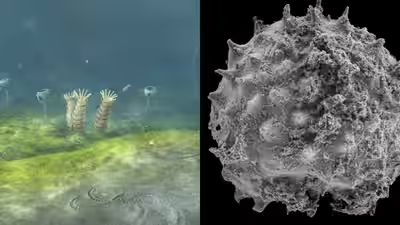
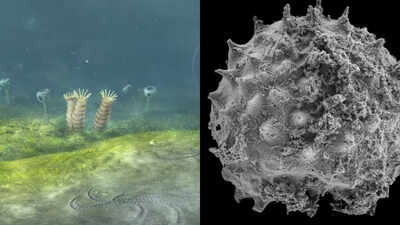
Researchers examined the Kheseen Biota in Mongolia, a fossil deposit more than 40 million years younger than Weng’an. By the time these rocks formed, animals were already known to have existed elsewhere, including in Namibia and South China. The team examined more than 140 samples, including material from previously undocumented locations, using scanning electron microscopy. The exceptionally preserved fossils included previously unknown acritarchs, tiny spherical organisms with spines and branching projections, as well as embryo-like fossils containing internal cells. Yet, despite the extraordinary preservation, there were still no fossils that could confidently be identified as animals. That matters because it shows that even a fossil deposit formed during a period when animals definitely existed can contain no recognisable animal remains. The absence of animal fossils at Weng’an, therefore, cannot by itself establish that animals had not yet evolved.
Pushing the molecular clock back
Instead of relying primarily on the younger Ediacaran deposits, the researchers turned to much older geological formations. These included Norway’s Svanbergfjellet Formation, Australia’s Bitter Springs Group and Arizona’s Chuar Group, dating from roughly 850 million to 730 million years ago. All three contain abundant and exceptionally preserved fossils and have geological characteristics capable of preserving early life. Yet no definitive animal fossils have been found there.The researchers used these formations as older constraints in molecular clock analyses. The technique compares genetic differences among living organisms and combines them with known fossil dates and estimated evolutionary rates to calculate when their ancient ancestors may have existed. With the older geological evidence incorporated into the calculations, the estimated origin of animals shifted backwards by around 200 million years, placing it between 800 million and 700 million years ago.
A world before Snowball Earth
There are already clues pointing towards a much older history. Chemical biomarkers preserved in ancient rocks have been interpreted as evidence consistent with sponges living at least 650 million years ago, well before the oldest definitive large animal fossils. If animals really did emerge between 700 million and 800 million years ago, they would have lived through a radically different planet. The Cryogenian Period began around 720 million years ago and included episodes of extreme global glaciation commonly known as Snowball Earth. That raises a provocative possibility: animal life may have existed before these frozen episodes, or perhaps even endured them.
An evolutionary mystery remains
The study does not provide an exact birth date for the animal kingdom. Instead, it highlights the limitations of using fossil absence as evidence of evolutionary absence, particularly when dealing with tiny, soft-bodied organisms that were unlikely to fossilise easily. Future discoveries from different environments will be crucial. Researchers will need to consider not only conventional body fossils but also traces of animal activity and chemical biomarkers.Images Courtesy: Oxford University


