
Operation Firewall-2026: ‘Joshita from Mumbai’, ‘Anvi from Delhi’ and the Pakistani spy trap | Visakhapatnam News

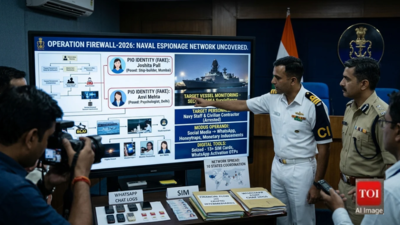
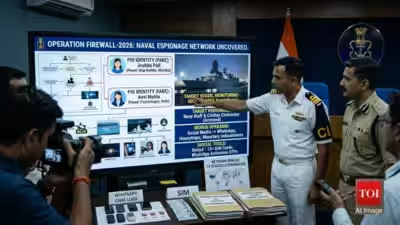
AMARAVATI: What began as a probe into suspected links between individuals in India and Pakistani intelligence operatives has opened up an alleged espionage network spanning multiple states, with naval personnel allegedly targeted through fake identities, honeytrap attempts, monetary inducements and digital tools ranging from Indian SIM cards to WhatsApp activation OTPs.Under “Operation Firewall-2026”, the Andhra Pradesh Counter Intelligence Cell coordinated with police forces across 10 states and Union Territories while probing the alleged network. Of the 18 suspects identified in the case, 13 are naval personnel, police said.At the centre of the investigation are two women PIO identities — “Joshita Pall”, who purportedly presented herself as a ship-building company employee in Mumbai, and “Anvi Mehta”, who allegedly posed as a psychologist based in Delhi.As per news agency PTI, the alleged operation, according to police material, followed a pattern: establish contact through fake social-media profiles, build familiarity and trust, move the conversation to WhatsApp, and then seek sensitive information through messages, voice calls, video calls, honeytrap attempts and monetary inducements.But the network went beyond the identities used to approach naval personnel.Investigators also uncovered an alleged support system involving Indian mobile numbers, SIM cards obtained under Indian names, WhatsApp activation OTPs and cryptocurrency-linked payments.Here is how the alleged spy trap worked:
- ‘Joshita’ from Mumbai
Two alleged female Pakistan Intelligence Operative (PIO) identities emerged in the investigation — “Joshita Pall” and “Anvi Mehta.”According to police, “Joshita Pall” allegedly established initial contact through Facebook and subsequently moved the conversation to WhatsApp.“She purported to be an employee of a ship-building company in Mumbai and sought information about the movement and number of ships and submarines, photographs, and photographs and details of their commanding officers,” said the press release.Monetary inducements were allegedly offered in exchange for such information.The second identity, “Anvi Mehta,” allegedly passed herself off as a psychologist based in Delhi.She allegedly attempted to honeytrap naval personnel through voice and video calls, sought photographs of naval ships and sensitive establishments, and attempted to induce personnel to display restricted or sensitive areas during video conversations, said the press release.These identities and the associated communications form part of the alleged modus operandi described in the investigation material.The alleged approach began with social-media contact.Further information shared by a government source to PTI indicated an alleged method involving false social-media identities, honeytrap attempts, monetary inducements, misuse of Indian mobile numbers, WhatsApp activation OTPs and payments facilitated through cryptocurrency channels and intermediaries.Further, persons identified as “female PIOs” allegedly approached defence personnel through fake profiles on Facebook and Instagram.“After establishing familiarity and trust, they shifted communication to Whatsapp and engaged the targets through messages, voice calls and video calls. The alleged approach involved false professional identities, misleading promises, sexually explicit content and monetary inducements intended to draw personnel into sharing sensitive defence information,” the release added.
What they wanted
The alleged targets were sought for information going well beyond routine details.The information sought reportedly included the movement and number of naval ships and submarines, photographs and videos of naval assets and sensitive establishments, including photographs and details of commanding officers, police said.Police probe also unearthed attempts to persuade personnel to show sensitive areas of naval establishments, ships and submarines during video calls.Visakhapatnam, which hosts the Eastern Naval Command (ENC), Naval Dockyard, Hindustan Shipyard Ltd (HSL) and Visakhapatnam Port, figures prominently in the case because of the strategic naval and defence establishments located there.
The OTP link
The alleged network also relied on an unusual digital support mechanism — Indian mobile numbers and WhatsApp activation OTPs.Indian mobile numbers and WhatsApp OTPs were allegedly used to facilitate the network and the probe identified a support network involving SIM cards obtained in the country under Indian names and the sharing of mobile-number OTPs with PIOs.“Indian personnel were allegedly offered monetary incentives through cryptocurrency or other intermediaries to share OTPs required to activate whatsapp accounts. Such OTPs were reportedly used to activate whatsapp accounts in Pakistan,” said the press release.These accounts were then allegedly utilised to contact further targets, attempt honey-trapping and collect sensitive defence information.The alleged sharing of activation OTPs is therefore being examined as a means of facilitating the wider espionage network.
The money trail
The investigation also identified an alleged financial arrangement in which funds originating from Pakistan were routed through cryptocurrency channels and traders or other intermediaries to persons drawn into the network.The operational diagram accompanying the case material illustrates a suspected flow of funds from PIOs through cryptocurrency deposits and transfers, followed by transactions through intermediaries to compromised persons, said the press release.
How the trap worked
According to the police material, the alleged method depended first on creating familiarity and trust.The fake identities allegedly approached defence personnel through social media, shifted conversations to WhatsApp and then engaged targets through messages, voice calls and video calls.The alleged approach involved false professional identities, misleading promises, sexually explicit content and monetary inducements.In the case of “Anvi Mehta”, police alleged that the identity was used in attempts to honeytrap naval personnel and persuade them to share photographs of naval ships and sensitive establishments or display restricted areas during video conversations.“Joshita Pall”, meanwhile, allegedly sought information about the movement and number of ships and submarines, photographs, and photographs and details of their commanding officers.
18 suspects, 13 of them naval personnel
Of the total 18 suspects in the espionage conspiracy, 13 are naval personnel who were allegedly indulging in spying prejudicial to national security, police said.The Andhra Pradesh Counter Intelligence Cell said it acted on credible information that certain individuals were in touch with Pakistani operatives.“The Andhra Pradesh Counter Intelligence Cell received credible information regarding certain persons in India allegedly maintaining direct contact with Pakistan Intelligence Operatives (PIOs) and their suspected involvement in an espionage conspiracy prejudicial to the national security of India,” it said.“Two suspects were arrested after a prima facie role was established in this case and further investigation is going on for the remaining suspects,” it said.Police arrested Pradeep Mukharjee, a navy employee from the Visakhapatnam naval base, and Annam Sai Varaprasad, a civilian contract driver engaged for naval officers in that city.Mukharjee was arrested recently from Coimbatore in Tamil Nadu. He was produced before a court in Vijayawada and sent to judicial custody till October 14. He is currently lodged in the district jail, Vijayawada.Varaprasad was sent to judicial remand till October 14 and he is also lodged in the same jail.According to police, Varaprasad allegedly shared sensitive and classified information relating to naval and defence establishments with PIOs in return for monetary benefits.Mukharjee was allegedly involved in sharing an OTP for activating a Whatsapp account by a PIO, communicating with the Pakistani operatives, and sharing sensitive information relating to naval and defence establishments.The Counter Intelligence Cell coordinated with police forces of 10 states to zero in on suspects allegedly maintaining direct contact with PIOs.The CI Cell coordinated with 10 states under “Operation Firewall-2026” to probe the suspects for sharing sensitive and classified information on defence establishments and strategic locations.As many as 12 CI Cell teams were deployed across Andhra Pradesh, Kerala, Maharashtra, Karnataka, Gujarat, Goa, Delhi, Tamil Nadu, Chhattisgarh and Bihar and Union Territories.In coordination with the concerned states’ ATSs (Anti-Terrorist Squads), naval officials and local police, the CI Cell investigation teams examined the complicity of the 18 suspects.
Encrypted communications
The suspects shared information on Visakhapatnam and other parts of the country through encrypted communication channels, the release said.The police Counter Intelligence Cell seized electronic gadgets as the probe continues on the remaining suspects.
OTP warning
Police warned that any person who knowingly shares WhatsApp OTPs with unknown persons for account activation or knowingly shares sensitive defence-related information with unauthorised persons, including suspected PIOs, may face legal action.“The alleged methods described in this case underline the need for vigilance regarding unknown social-media contacts, false professional identities, requests for defence photographs or videos, demands for activation OTPs and offers of money in exchange for information,” said the press release.A case was registered at the Counter Intelligence Police Station in Vijayawada on September 2.It was registered under various sections of the Bharatiya Nyaya Sanhita, 2023, Unlawful Activities (Prevention) Act, 1967, and Official Secrets Act, 1923.“The alleged conspiracy is being investigated for its implications for India’s national security, sovereignty and integrity,” the police press release added.The investigation is sensitive and ongoing, police said. They did not divulge details on the rest of the suspects.(With agency inputs)