

A squadron inside one jet: US, China are racing to build 6th-gen fighters, redefine air warfare

As tensions simmer in the Indo-Pacific, the US and China are developing a new, more powerful generation of fighter aircraft for a potential conflict. Unlike earlier fighters that relied heavily on speed and manoeuvrability, these aircraft will use stealth, artificial intelligence and connectivity as key advantages.Even as fifth-generation fighters such as the F-22 Raptor, F-35 Lightning II and China’s J-20 have transformed stealth, sensor fusion and situational awareness, military planners are already preparing for the next era of aerial combat. Sixth-generation fighters are being designed not simply as advanced aircraft, but as command nodes within a highly connected battlefield ecosystem incorporating unmanned systems and multidomain strike capabilities.
Those in the race for sixth-generation dominance
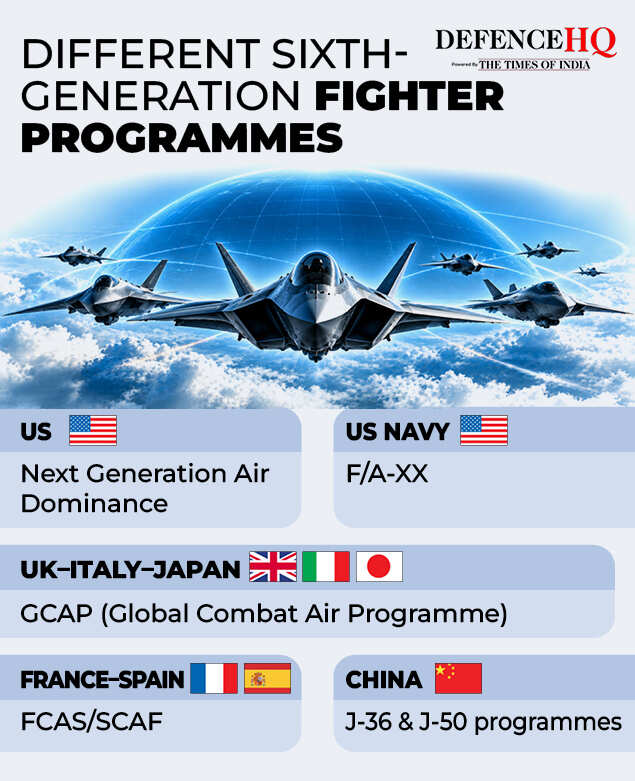
Currently six programs for sixth-gen fighter aircraft are underway. The US and China are running two programs each.
China and the United States are currently at the forefront of the sixth-generation race, followed by the United Kingdom, Japan, Italy and several other European nations.Programmes such as the US Air Force’s Next Generation Air Dominance (NGAD), the US Navy’s F/A-XX, the UK-Japan-Italy Global Combat Air Programme (GCAP), and the French-led Future Combat Air System (FCAS) all aim to field operational aircraft in the 2030s.China, meanwhile, has shown considerable momentum with the testing of advanced prototypes identified as the J-36 and J-50. Unlike previous generations, which focused primarily on speed, manoeuvrability and stealth, sixth-generation programmes aim to redefine air combat by integrating manned and unmanned systems, advanced AI and capabilities designed to operate in heavily contested environments.
The need for a new generation of fighters
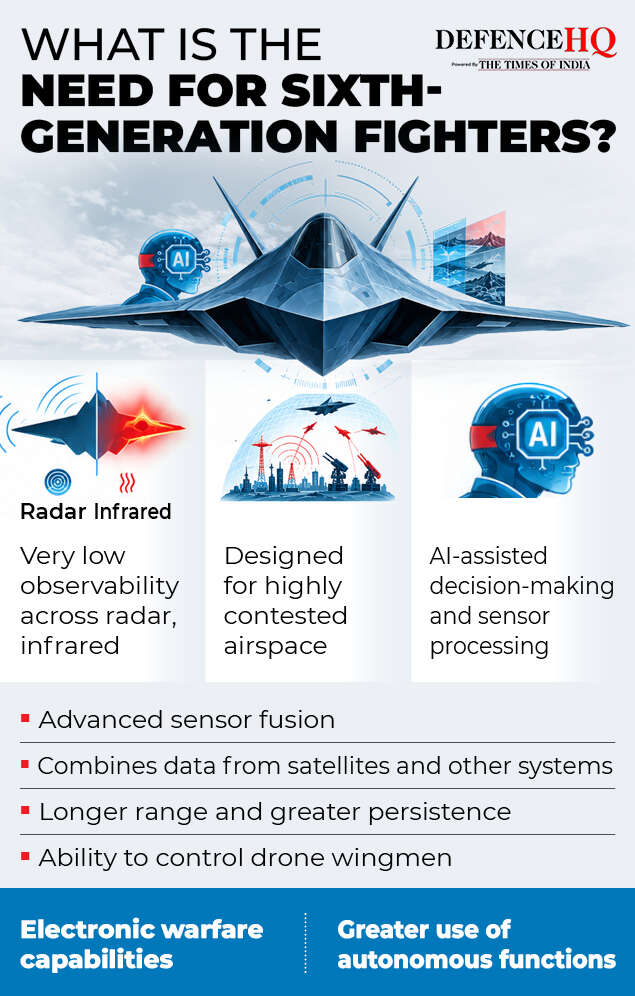
The sixth-generation fighter aircraft is expected to change the way aerial warfare is conducted.
The push towards sixth-generation aircraft is being driven as much by geopolitical changes as by technological advances. Since the end of the Cold War, the United States has enjoyed largely unchallenged dominance in military aviation. But China’s rapid air force modernisation, increasingly sophisticated Russian air defences and the growing complexity of future battlefields have raised questions about how long existing aircraft can remain effective.A key driver is the rise of anti-access/area-denial environments. Countries such as China have invested heavily in integrated air-defence networks, long-range missiles, electronic warfare and anti-satellite capabilities designed to prevent adversaries from operating freely in contested regions.In a potential conflict over Taiwan or elsewhere in the Indo-Pacific, aircraft may have to operate far from friendly bases, making range and endurance critical. At the same time, advances in radar, passive sensors and AI could erode the stealth advantage enjoyed by fifth-generation fighters. Future aircraft will therefore need to reduce not only their radar cross-section but also their thermal and electromagnetic signatures.
What makes a sixth-generation fighter?
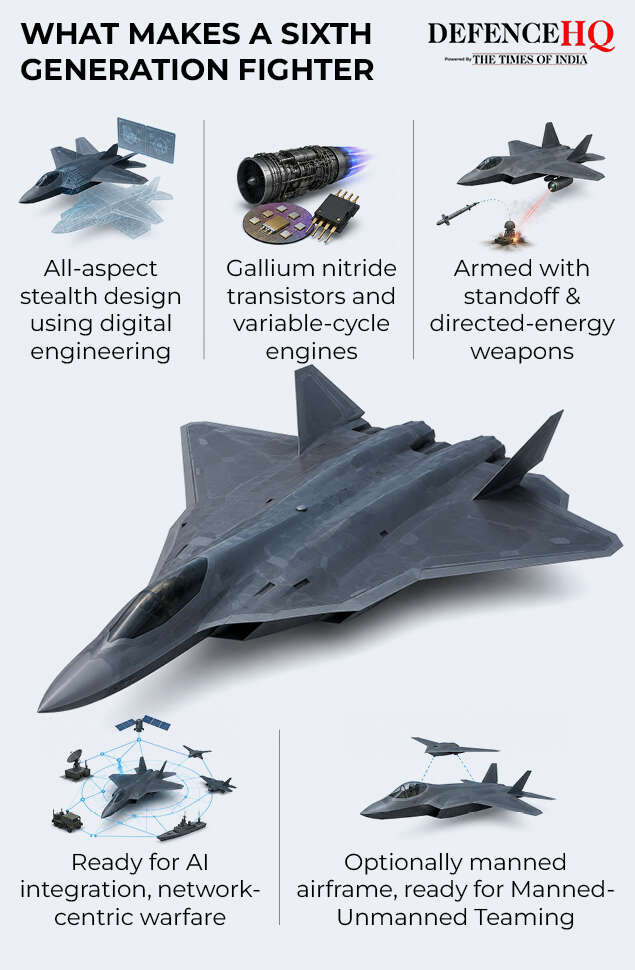
Different types of technologies, both electronic and mechanical, will deliver on the promise of a sixth-generation fighter.
Although there is no universally agreed definition, several characteristics are emerging as hallmarks of sixth-generation fighters.Artificial intelligence is expected to form the backbone of future combat aviation, functioning less as a replacement for pilots and more as a digital co-pilot capable of processing vast amounts of information in real time. AI systems could assist with threat analysis, navigation, sensor management, electronic warfare and target prioritisation.
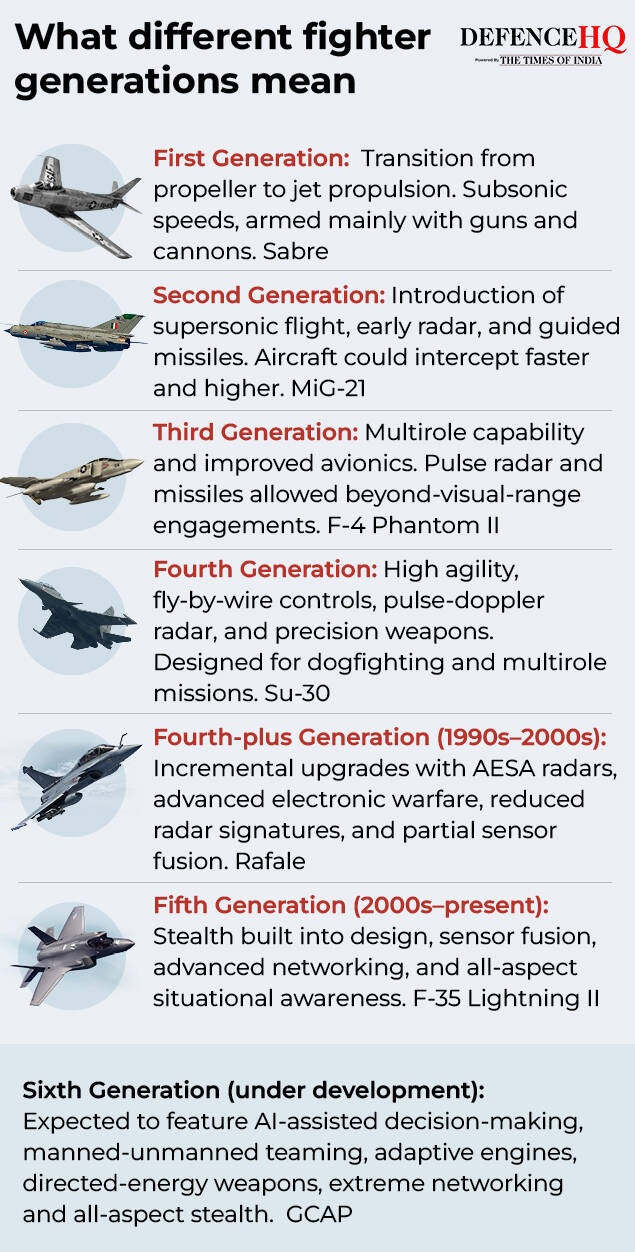
Different generations of combat aircraft, in a manner, act as milestones in how the airframes and technology intermingle.
No pilot can realistically process all the information generated during modern air combat. AI could filter that data and recommend courses of action, allowing pilots to focus on mission objectives while humans retain final control over lethal decisions.Closely linked to this is manned-unmanned teaming, one of the biggest shifts in sixth-generation combat. Future fighters are expected to operate alongside autonomous or semi-autonomous drones, often described as loyal wingmen or Collaborative Combat Aircraft.
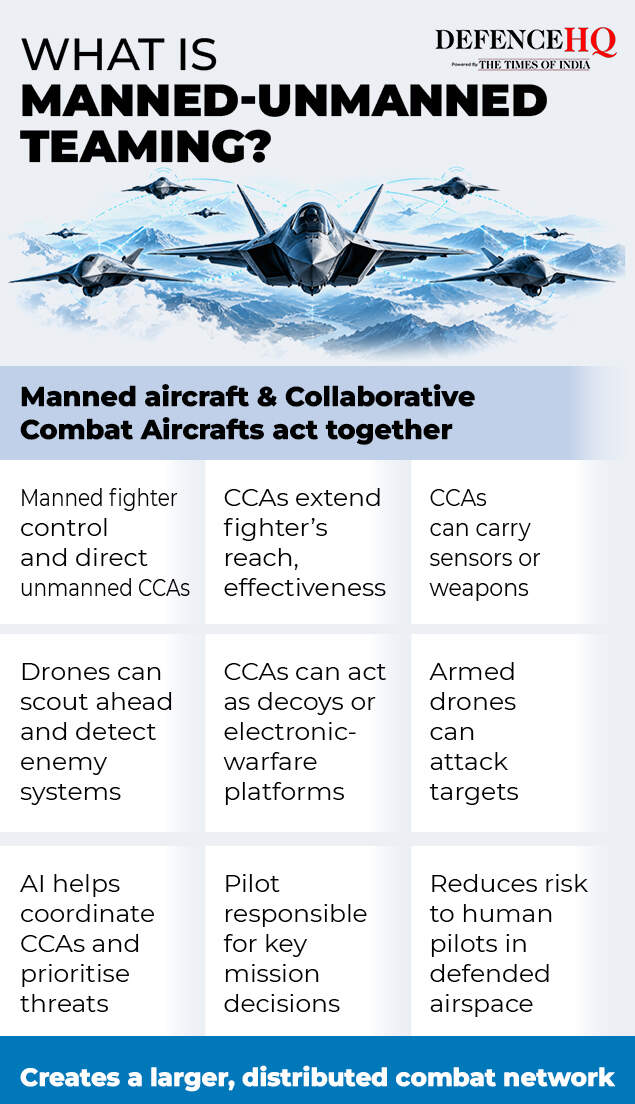
The future of combat will see both manned and unmanned systems fighting together.
These drones could perform reconnaissance, electronic warfare, strike, decoy or communications-relay missions, allowing commanders to send less expensive and potentially expendable platforms into the most dangerous environments. A single pilot could eventually direct several drones, multiplying the combat power of one aircraft.Survivability is also becoming more important. Fifth-generation stealth has largely focused on reducing radar cross-section, particularly from the front. Sixth-generation designs aim to reduce detectability across multiple domains and from a wider range of angles, including infrared signatures from engines and electromagnetic emissions that could reveal an aircraft’s position.Advanced electronic warfare systems will also be used to confuse or deceive enemy sensors. In an increasingly networked battlespace, survivability will depend as much on information superiority and situational awareness as on avoiding detection.
Information and connectivity key to victory
Perhaps the biggest shift is the move from platform-centric to network-centric warfare. Future fighters are expected to operate within a shared combat cloud linking aircraft, drones, satellites, ships, ground forces and command centres.Data gathered by one platform could be shared across the network, allowing every connected system to act on a common picture of the battlefield. In this model, the fighter becomes less important as an individual platform and more important as a node within a much larger combat network.Many countries are also developing adaptive-cycle engines capable of dynamically adjusting performance. They can switch between high-performance output and greater fuel efficiency depending on mission requirements. Unlike conventional engines, which typically prioritise either efficiency or power, adaptive-cycle designs aim to deliver both while improving range and thermal management.Directed-energy weapons, including high-energy lasers, are also under development. Power generation and thermal management remain major challenges, but continued research could eventually make such weapons practical for defending against missiles, drones and sensors.
The sixth-generation fighter is no longer a futuristic concept; it is the current gold standard because it redefines air combat as a networked, AI-enabled system of systems, rather than just a faster, stealthier airframe. For the IAF, looking at sixth-generation technology now is not about chasing technology; it is about ensuring that when our next-generation fighters enter service, they are built around the right combat architecture — manned-unmanned teaming, combat-cloud networking and adaptive sensing — so that we do not spend the next 30-odd years trying to retrofit legacy platforms for a war they were never designed to fight.
Air Marshal GS Bedi (Retd) is a former Director General( Inspection & Safety) and Author of India in Pursuit of Hypersonic Flight
US seeks to retain its lead
The United States aims to maintain its long-standing lead through the Next Generation Air Dominance programme, conceived as a family of systems rather than a single aircraft and built around the Boeing-developed F-47.The aircraft is expected to combine extended range, advanced stealth and close integration with collaborative drones, with a particular focus on long-range operations across the Indo-Pacific.The US Navy is pursuing the parallel F/A-XX programme to replace parts of its Super Hornet fleet with a similarly networked and drone-enabled capability.The US has already begun testing Collaborative Combat Aircraft at scale, including Boeing’s MQ-28 during Exercise Valiant Shield in 2026 in the Western Pacific.
China’s rapid progression
China’s progress has drawn close scrutiny. The successful fielding of the J-20 demonstrated Beijing’s ability to challenge traditional Western leadership in advanced fighter design. More recent sightings of the J-36 and J-50 suggest China could be moving rapidly towards sixth-generation capability.Both aircraft appear to feature advanced stealth shaping, tailless configurations and design concepts consistent with networked warfare. The programmes also fit China’s broader military modernisation strategy and its emphasis on system-of-systems warfare, a concept that closely mirrors Western visions of future combat.If current trends continue, China could become the first serious competitor capable of challenging the United States across multiple dimensions of advanced military aviation.
Europe advances on the drawing board
Europe’s approach has centred on multinational collaboration rather than independent national programmes.GCAP brings together the United Kingdom, Japan and Italy to develop an advanced multirole aircraft expected to enter service around 2035. The aircraft is intended to replace the Eurofighter Typhoon and Japan’s F-2 while preserving long-term industrial independence.Meanwhile, FCAS, originally a joint programme between France, Germany and Spain, continues under French leadership following Germany’s exit. It is built around a New Generation Fighter, remote-carrier drones and a shared digital combat cloud.Together, these programmes reflect Europe’s effort to maintain strategic autonomy rather than rely heavily on American aircraft.
India joins the race
India has also entered the sixth-generation conversation. Defence minister Rajnath Singh has said India intends to develop not only a fifth-generation but also a sixth-generation fighter.The statement comes as the Indian Air Force’s squadron strength stands at 29 against a sanctioned strength of 42, roughly 70% of its authorised level.The defence ministry has confirmed that India is engaging with both GCAP and FCAS. France now leads FCAS, with Spain remaining a partner. FCAS is expected to make its first flight around 2028-29, broadly aligning with the planned first flight of India’s Advanced Medium Combat Aircraft.The split between France and Germany could, in some respects, work in India’s favour. Disagreements over carrier operability and nuclear delivery capabilities contributed to Germany’s exit, while India already possesses both capabilities, bringing its operational requirements closer to those of France.For India, engagement with both programmes appears aimed less at choosing a single partner and more at securing a role in shaping the next generation of aerial combat.As traditional close-range aerial combat becomes less central to modern air warfare, information dominance, electronic warfare and long-range engagement could emerge as decisive factors. Pilots may increasingly function as mission commanders directing groups of drones rather than personally engaging individual targets.As warfare becomes more integrated across the air, land, sea, space and cyber domains, victory may ultimately depend less on individual platforms and more on the effectiveness of the broader combat ecosystem.