
Researchers described 18 previously unpublished hominin fossils from South Africa, including an adult Homo erectus dated to 2 million years ago, 200,000 years older than other known adult fossils

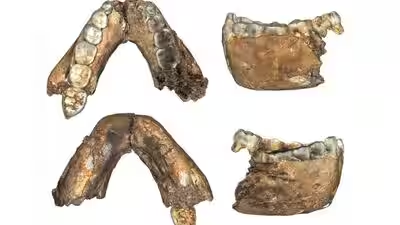
Researchers have described 18 previously unpublished hominin fossils from the Drimolen Main Quarry in South Africa, including a fossil from an adult Homo erectus dated to 2 million years ago. The finding is 200,000 years older than other known adult Homo erectus fossils found elsewhere in the world.The fossils were excavated at the Drimolen Main Quarry, part of South Africa’s ‘Cradle of Humankind’. The site is one of the richest deposits of human ancestors in the world. Although the site was discovered in 1992 and fossils were excavated there until 2019, many of the fossils had not been published and were therefore unknown to science.La Trobe University archaeologists, along with researchers from South Africa and the United States, have now described 18 more fossils from the site. The fossils have been attributed to two hominin species, Homo erectus and Paranthropus robustus.Among them is the first fossil from an adult Homo erectus identified at Drimolen. The researchers say it provides further confirmation that the species first appeared in southern Africa about 2 million years ago. The findings were published in Annals of Human Biology.
Adult Homo erectus fossil fills important gap
The newly described fossil, identified as DNH 127, is an adult Homo erectus specimen dated to 2 million years ago. It is 200,000 years older than other adult Homo erectus fossils found in places such as Dmanisi in Georgia, which are dated to 1.8 million years ago.Lead researcher Dr Jesse Martin said the earlier evidence from Drimolen came from a child fossil, DNH 134, estimated to have belonged to a child aged between two and four years.“Homo erectus is the first species of hominin that researchers broadly agree fits within our own genus Homo and is likely directly ancestral to us. Drimolen preserves evidence for the first appearance of this species 2 million years ago, however the original fossil, DNH 134, belonged to a child aged between two and four, and there was uncertainty about what the adult version may have looked like,” Martin said.The new adult fossil gives researchers evidence of what Homo erectus was like at the same site and period. Martin said the fossil provides further confirmation that the species first appeared in southern Africa 2 million years ago.“This paper publishes a new adult fossil attributed to Homo erectus, DNH 127, providing further confirmation that this species first appeared in southern Africa 2 million years ago,” he said.The researchers also studied fossils belonging to P. robustus. Their findings suggest that this species underwent microevolution between 2 million and 1.8 million years ago.
P. robustus developed larger teeth
The researchers found that P. robustus developed larger teeth and chewing muscles during the 200,000-year period between the fossils from Drimolen and those from the 1.8-million-year-old Swartkrans cave.Martin said this change was linked to the way the species processed food. While Homo erectus was evolving larger brains and smaller molar teeth, possibly in connection with meat eating, P. robustus retained a brain size slightly larger than that of chimpanzees and developed very large molar teeth.Martin compared the teeth and chewing muscles of P. robustus to a mortar and pestle, which are used to process tough and hard foods.The two hominin species lived in the same landscape and are both preserved in the Drimolen cave. However, their numbers at the site were very different. Martin said P. robustus outnumbered Homo erectus at Drimolen by more than 10 to one 2 million years ago.“These two human species shared the same landscape and are both preserved in Drimolen cave. While we know that Homo erectus and the lineage leading to us was ultimately the successful one, 2 million years ago P. robustus outnumbered Homo erectus at Drimolen by more than 10 to one. During this time period it was our ancestors that looked like the outside long-odds chance to survive,” Martin said.
Fossils show changes over 200,000 years
The researchers also compared the P. robustus fossils from the 2-million-year-old Drimolen Cave with fossils from the 1.8-million-year-old Swartkrans cave.“This paper confirms that the P. robustus fossils from the 2-million-year-old Drimolen Cave are slightly but importantly different from the P. Robustus fossils at the 1.8-million-year-old Swartkrans cave,” Martin said.He said the teeth of P. robustus became larger during the 200,000-year period, along with the muscles used for chewing.“During this 200,000-year period, P. Robustus teeth became even larger, and so did the muscles associated with chewing. Hominin fossils are so rare that generally the differences between them are huge, and researchers are left to make educated guesses regarding what existed in the missing parts of the fossil record.”The number of fossils found at Drimolen allowed researchers to examine these smaller changes more closely. Martin said some of the fossils described in the new paper provide an unusual opportunity to study microevolutionary changes in human ancestors.“However, the large number of fossils from Drimolen, some of which are published in this paper, allow an unprecedented insight into the micro-evolutionary changes that shaped human ancestors.”The uniqueness of the Drimolen P. robustus population had previously been recognised through the proposed new sub-species name P. robustus ukusa. Martin said the fossils described in the new research support this formal recognition.