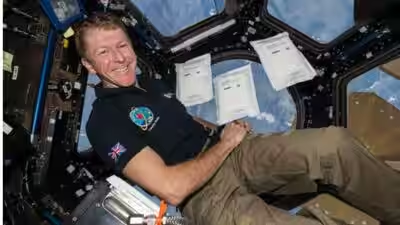
In 2015, 2kg of rocket seeds went to the space station; after their return, 600,000 UK children helped test them, and researchers found they grew more slowly but remained viable

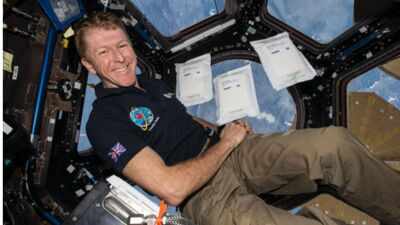
ESA astronaut Tim Peake took 2kg of rocket seeds to the International Space Station (ISS) in 2015 as part of his six-month Principia mission. The seeds endured intense vibrations from launch and spaceflight and received up to 100 times more radiation than they would have experienced on Earth. After returning in 2016, they were planted and monitored by around 600,000 children across the UK in a large-scale experiment led by Royal Holloway, the Royal Horticultural Society, and the UK Space Agency. The results, published in the journal Life, showed that the space seeds grew more slowly and aged faster than Earth-bound controls, but they remained viable and capable of germination.
A citizen science experiment on a national scale
The Rocket Science project was organised by the Royal Horticultural Society’s Campaign for School Gardening in partnership with the UK Space Agency. More than 8,600 schools and groups across the UK were tasked with planting the space-flown seeds alongside control seeds that had never left Earth. Children recorded germination rates, growth patterns and other observations as part of a controlled study designed to emulate how professional scientists work.Alana Cama, Schools and Groups Manager at the Royal Horticultural Society, said the project gave a window into space biology and put young people at the center of innovative research. She said the experiment was not only inspirational, but also contributed to understanding how plants respond to unusual environments and whether food could realistically be grown on long-term space missions. For many students, the ability to handle seeds that had been to space made abstract concepts of radiation and microgravity feel tangible, reported the European Space Agency (ESA).What happened to the seeds in orbit For six months the rocket seeds were aboard the International Space Station, subjected to conditions much harsher than those found on Earth. The launch and re-entry phases bombarded them with intense mechanical vibrations, while the space environment delivered radiation levels up to 100 times higher than terrestrial background levels. These stresses can damage DNA, disrupt cellular processes and accelerate the aging of biological material. Despite these challenges, the seeds survived the journey intact. When they were planted back on Earth they germinated and grew, confirming that the fundamental biology of the seeds had not been destroyed. The key question was whether their vigour, meaning their speed and strength of growth, had been affected by the spaceflight experience, as per ESA.
Slower growth but still alive
The report further shared that researchers led by Gerhard Leubner and Jake Chandler of Royal Holloway, along with Alistair Griffiths of the Royal Horticultural Society, analysed the data collected by the schoolchildren. They found that the space-flown seeds grew slightly more slowly than their Earth-bound counterparts and showed greater sensitivity to ageing. This suggests that the six-month journey accelerated the normal ageing process of the seeds, reducing their vigour even though they remained alive.Jake Chandler explained, as per ESA, that transporting high-quality seeds into space and beyond will be crucial for supporting human exploration of Mars and other worlds. He said the study’s findings indicate that spaceflight reduces seed vigour, but that the seeds remained viable, meaning the prospect of eating home-grown salad on Mars may be one small step closer. The research points to the importance of protecting seeds from radiation and mechanical stress during future missions.
Representative image
Why this matters for Mars missions
“When humans travel to Mars, they will need to find ways to feed themselves, and this research helps us understand some of the biology of seed storage and germination which will be vital for future space missions,” Tim Peake said in the report by ESA.The Rocket Science experiment provides a real-world data point on how spaceflight affects seed biology. It suggests that with proper shielding and handling, seeds can survive a trip to the International Space Station and still germinate on return. For longer missions to Mars, researchers will need to refine storage methods and perhaps develop new seed varieties that are more resistant to radiation and vibration.
A collaboration across institutions
The research brought together partners from across the UK and Europe. Alongside Royal Holloway and the Royal Horticultural Society, contributors included the University of Marburg in Germany, Science and Advice for Scottish Agriculture, and Tozer Seeds in the UK. The UK Space Agency supported the project and hosted a live question-and-answer session with Peake, Chandler, and Cama to share the findings with the public, as per ESA.This partnership model shows how large-scale citizen science can complement lab-based research. The project spread the experiment over thousands of schools to create a dataset that no single lab could create. The interaction between expert supervision and student participation resulted in both scientific value and educational benefit.
The future of space agriculture
The RHS Rocket Science experiment shows how plant seeds respond to space conditions. Even with reduced gravity, the seeds’ survival and ability to germinate are promising steps forward for long-duration spaceflight.Scientists can now focus on refining seed storage, testing different plant species, and designing protective packaging against cosmic radiation and vibration. The end goal is to enable astronauts to cultivate fresh food during extended missions to the Moon or Mars, cutting reliance on pre-packaged Earth rations. Everyday space seeds returning to classrooms on Earth show that small, practical experiments are laying the foundation for sustainable life off-planet.