In 2022, he built a pocket-sized device to extract drinking water from the air in Death Valley using only sunlight; in 2025, he won the Nobel Prize in Chemistry

Between August 19 and 23, 2022, Omar Yaghi’s team placed a thermos-sized cylinder in Furnace Creek, inside the Death Valley National Park. The device was not connected to anything and for three complete cycles of night and day the device extracted liquid water from the air of one of the driest and hottest places on the planet. Two years later, Yaghi’s invention scored him a Nobel Prize in Chemistry, the first to a Saudi national, according to a report by Vozpopuli.
From humble beginnings to big solutions
Omar M. Yaghi was born in 1965 in Amman, Jordan, into a refugee family originally from Palestine. He grew up in a single room with his parents, eight siblings, and even livestock — a few cows. His father, who ran a butcher shop and raised cattle, insisted that his son pursue an education abroad. At 15, in 1980, with limited English, Yaghi moved alone to Troy, New York.He enrolled at Hudson Valley Community College shortly after arriving and then transferred to the State University of New York (SUNY) at Albany in 1983, where he developed a deep passion for chemistry. To support himself during this period, Yaghi bagged groceries and mopped floors. He graduated cum laude in 1985 with a Bachelor of Science in chemistry. Pursuing further specialisation, he earned a PhD in chemistry from the University of Illinois at Urbana-Champaign in 1990. Following his doctorate, Yaghi was awarded a prestigious National Science Foundation postdoctoral fellowship at Harvard University, where he worked from 1990 to 1992.By 1992, he secured a faculty position at Arizona State University, where he began shaping his career. In 1999, he joined the University of Michigan faculty, followed by a move to UCLA in 2007. In 2012, Yaghi joined the University of California, Berkeley, as a professor of chemistry. There, he became co-director of the Kavli Energy NanoScience Institute and served as Director of the Molecular Foundry at Lawrence Berkeley National Laboratory from 2012 to 2013. Today, Yaghi holds the James and Neeltje Tretter Chair in the College of Chemistry at UC Berkeley. He is the founding director of the Berkeley Global Science Institute, established to promote international scientific collaboration, and co-director of the California Research Alliance by BASF, focused on sustainable chemical research.
The work for water
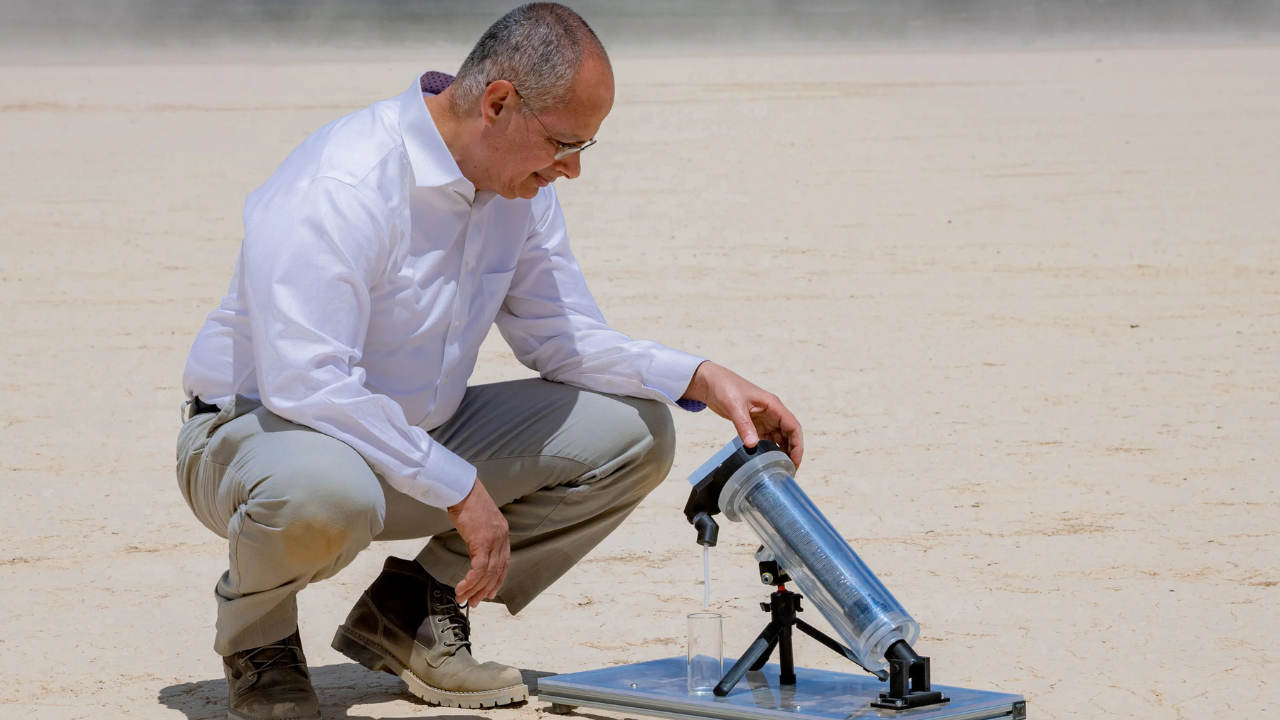
The device Omar Yaghi used to extract water from the air in Death Valley contains 35 grams of a material called MOF-303
As a child living in Jordan, Yaghi often queued up for water, an experience that inspired his work. “You store as much water as you can within those four hours and that’s the water you would use for those two weeks. If you ran out of water, you had to find a different source,” Yaghi said in a documentary. “I grew up really appreciating the stress caused by water. It affects all aspects of life.”The device Omar Yaghi used to extract water from the air in Death Valley contains 35 grams of a material called MOF-303, and what it produces each day, at the rate measured in the desert, fits in a spoonful. The figure used by the team at the University of California, Berkeley, is different: 210 grams of water per kilogram of material per day, about a glassful, and this is the figure that indicates the potential scale of the idea.“We have now shown that these materials, mounted on a device, can collect water from the air even in the most arduous and extreme conditions, including Death Valley,” explained Yaghi, the chemist who led the work, when presenting the results in 2023. The conditions were recorded in the article the team published in July 2023 in the journal Nature Water (available at this link ). The ground reached 65 degrees Celsius during the day, the average relative humidity at night remained at 14%, and the peak barely reached 21% around 4:30 a.m., which is when the device does its work.“MOFs are a completely new chemistry, based on joining inorganic and organic units in large porous structures,” summarises Yaghi, who invented this family of materials in the 1990s. The one inside the cylinder is called MOF-303; it contains aluminium and works like a sponge that absorbs moisture from the air at night and, during the day, with the sun’s heat, releases it as vapour that condenses on the cold walls and drips into a reservoir.The 210 grams per kilo dropped to 114 on the driest night and rose to 285 in the control trial that the team repeated in Berkeley with much more pleasant humidity, and of all the vapour that the device captures, it returns between 85% and 90% as drinking water.
Setting an example
Yaghi has never promoted the prototype as a consumer solution and defends it as proof that the principle works without an electric grid.On October 8, 2025, the Royal Swedish Academy of Sciences awarded the Nobel Prize in Chemistry to three scientists: Omar Yaghi, Susumu Kitagawa of Kyoto University, and Richard Robson of the University of Melbourne. The trio was recognised “for the development of metal–organic frameworks (MOFs),” a class of materials that have revolutionised the ability to trap gases, capture carbon dioxide, and even harvest water from desert air.In February 2026, his company, Atoco, unveiled a machine that, according to the company, produces up to 1,000 litres per day using solar energy in air with less than 20% humidity, although that figure comes from the manufacturer and there is still no published trial to support it, like the one from Furnace Creek. “The science is already here; what’s needed now is the courage to scale these solutions,” Yaghi said at the presentation.