
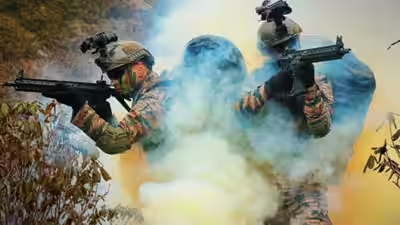

Artificial intelligence is no longer a futuristic idea for India’s armed forces. It has already seen combat, even as the services acknowledge that the country is still at an early stage of harnessing it fully. That mix of proven utility and limited maturity defines where Indian military AI stands today.Operation Sindoor offers the clearest evidence. The Army has said 23 AI applications were brought together during the operation, drawing on 26 years of data on Pakistani military movements combined with live feeds for modelling. These tools were about 94% accurate in pinpointing where an enemy gun or missile unit would be located along the border.They also produced a full battlefield picture and post-strike assessments, tightening the Observe, Orient, Decide and Act (OODA) loop that commanders are trained to compress. Among the tools used were an electronic intelligence collation and analysis system, a surveillance network integrated with Project Sanjay, predictive modelling software and an in-house weather application that gave conditions, including wind speed, 48 hours ahead, helping plan extended-range artillery fire.
Connecting sensors and shooters
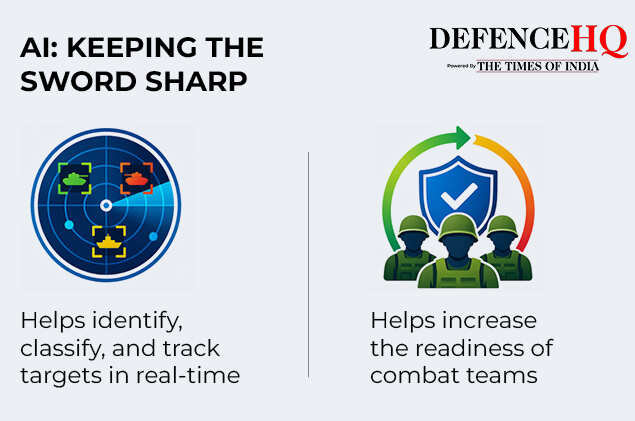
AI helps commanders take more timely decisions, thereby enhancing the effectiveness of the forces.
The wider architecture is taking shape around the same idea. Akashteer, the Army’s air defence control system, the Artillery Combat Command and Control System and the Air Force’s Integrated Air Command and Control System all bring sensors and shooters onto a single interface, so that decisions and orders move faster.Their function is similar to what the Americans attempted with Project Maven. Two bodies, the Defence AI Council (DAIC) and the Defence AI Project Agency (DAIPA), have been set up to steer the modernisation. As India moves towards integrated theatre commands, with wide frontiers, countless sensors and a large mix of weapons, AI is expected to become the connective tissue between them.
AI reaches the infantryman
On the ground, AI is also being built into what an infantryman carries. Israel’s SMARTSHOOTER has been recognised in the precision fire control category for its SMASH system, which combines AI, computer vision and tracking algorithms to lock onto a moving target and time the shot, turning a standard rifle into a precision weapon.It is aimed at small drones, and the US Army placed a follow-on order worth about $10.7 million in May. Night fighting is being upgraded as well. Systems such as the AN/PSQ-42 Enhanced Night Vision Goggle-Binocular blend image-intensified and thermal views and overlay navigation waypoints and friendly-force positions, improving the effectiveness of soldiers on the ground.
Project Maven and the race to process battlefield data
Project Maven began as the Pentagon’s Algorithmic Warfare Cross-Functional Team (AWCFT), tasked with automating the processing of drone video from the fight against the Islamic State in Iraq and Syria.The problem was scale. American forces were collecting terabytes of data every day from hundreds of manned, unmanned and space-based systems, yet much of the footage was never reviewed. The aim was to train software to flag patterns, such as the planting of an improvised explosive device, and warn nearby troops.In March, US Central Command said its forces were using a variety of advanced AI tools in the campaign against Iran to sift vast amounts of data in seconds, while stressing that humans make the final decision on what to strike. It did not name the systems involved.
From kill chain to kill web
Artificial intelligence is already helping our commanders make faster and better-informed decisions, by turning enormous volumes of data into a usable picture. But speed is only useful if the input can be trusted. India must build its own algorithms, trained on its own data and tuned to its own terrain and threats, rather than depend on systems we cannot fully inspect. We must also remember that an adversary will try to interfere with the data feeding these tools, through deception, jamming or poisoning, so every output needs to be treated with caution. That is why humans must stay in the loop. AI can inform a decision, but accountability for that decision must always rest with a human being, not a machine
Air Vice Marshall Anil Golani, former DG Centre for Air Power and Strategic Studies
This has altered military thinking. For decades, the kill chain was taught as a linear sequence: find, fix, track, target, engage and assess. Militaries tried to shorten their own chain and break the enemy’s.AI enables a kill web instead, in which information moves between many sensors and shooters at once. That gives commanders redundancy and the flexibility to strike a target with whichever weapon suits it best, while software sorts incoming data and helps prioritise targets.US Central Command reported that American forces had struck more than 10,000 targets in Iran by late March, and AI is understood to have helped speed up the targeting cycle.
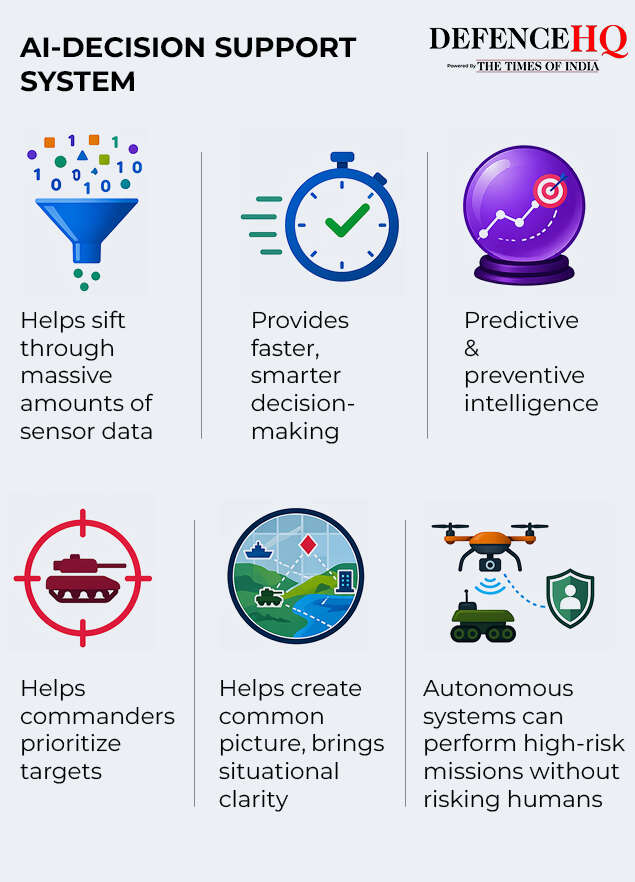
AI uses data captured from many different sources to help form a clear picture of the battlefield.
Gaza, Ukraine and the limits of machine targeting
Earlier Israeli systems were an important step in this direction and a controversial one. Investigations by +972 Magazine and Local Call reported that two tools, Lavender and Gospel, were used in Gaza after the October 2023 attack, with Lavender flagging as many as 37,000 people as suspected militants. The Israeli military disputes parts of that account.Russia and Ukraine have followed a parallel path. Ukraine says several dozen domestically made AI systems are now in use to help drones find and reach targets, and its battlefield detection software is reported to identify roughly 70% of enemy targets across more than a lakh drone video streams every month.
Why speed matters on the battlefield
For the soldier on the ground, the biggest gain is speed. In areas covered by heavy signal jamming, manually piloted drones lose effectiveness, and onboard AI lets cheap drones spot and fly to their targets without constant human control.That shortens the most dangerous phase of any engagement, the gap between a threat appearing and a response being fired, and allows fewer personnel to cover more ground.The technology, though, is not infallible. Current recognition software can struggle to tell a soldier from a civilian or a friendly fighter from a hostile one, and decoys can still fool it when the sensors are not sophisticated enough.For now, AI-assisted targeting works best as an aid to human judgement rather than a substitute for it, particularly in close or ambiguous combat.
Giving soldiers a clearer battlefield picture
Situational awareness is closely linked. A soldier today can face gunfire, drone surveillance, electronic warfare, GPS denial and cyber disruption at the same time.AI-assisted data fusion pulls sensor, radar and surveillance feeds into a single picture, which lets a small unit take in far more information than unaided human attention could manage.
Beyond AI: Reducing the soldier’s physical burden
Physical endurance also matters. A soldier carrying heavy equipment tires faster, moves slower and is more prone to injury, all of which erode combat effectiveness over a long operation.Passive exoskeletons developed by DRDO with Tata Advanced Systems, along with the JaipurBelt and ArmMax supplied by Rajasthan-based Newndra Innovations to the Army, Air Force and National Disaster Response Force, are meant to ease that burden.Strictly speaking, these devices are mechanical rather than AI-driven, but they form part of the same effort to keep troops effective for longer, especially at high-altitude locations such as Siachen and Ladakh, where thin air and cold already drain stamina.
AI and battlefield medicine
Survival after injury is the final piece. Haemorrhage remains the leading cause of preventable death on the battlefield, and most of those who bleed out do so before reaching a medical facility.Decision-support tools such as the American APPRAISE system help medics assess bleeding risk in real time from vital-sign data captured at the point of injury, giving a field medic some of the triage judgement of a trauma specialist.India’s Armed Forces Medical Services has also used AI-linked telemedicine for remote casualty triage, letting troops in border areas send vital signs and injury images to base hospitals for real-time guidance.
The human still makes the final call
The limits of trust remain the defining constraint. AI systems can be attacked through data poisoning, deception and jamming, and they are still imperfect at separating real threats from decoys.Ukraine officially keeps AI out of the final stage of target interception, even as battlefield pressure pushes towards greater autonomy, because commanders do not yet fully trust machine judgement in high-stakes moments. The United Nations General Assembly has also taken up the implications of military AI for international peace and security.For India and every other force adopting the technology, the direction is clear: AI is speeding up detection, easing physical strain and improving survival, but the decision to fire still rests with a human being.