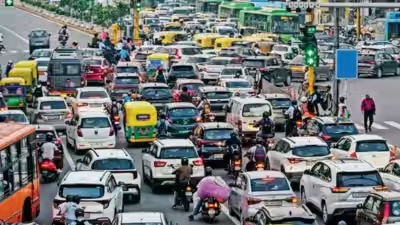

NEW DELHI: It’s frustrating being stuck at the ITO intersection. The signal inevitably turns red, the clock keeps ticking, and the long queue of vehicles barely moves. Five minutes pass. Sometimes six. Or seven. When the traffic finally starts inching forward, it feels like the wait at the intersection has been longer than the commute itself.It is the kind of wait that makes commuters look at the signal again and again, check the time, wonder which lane will move first and hope the next cycle will be quicker. But often, it is not.
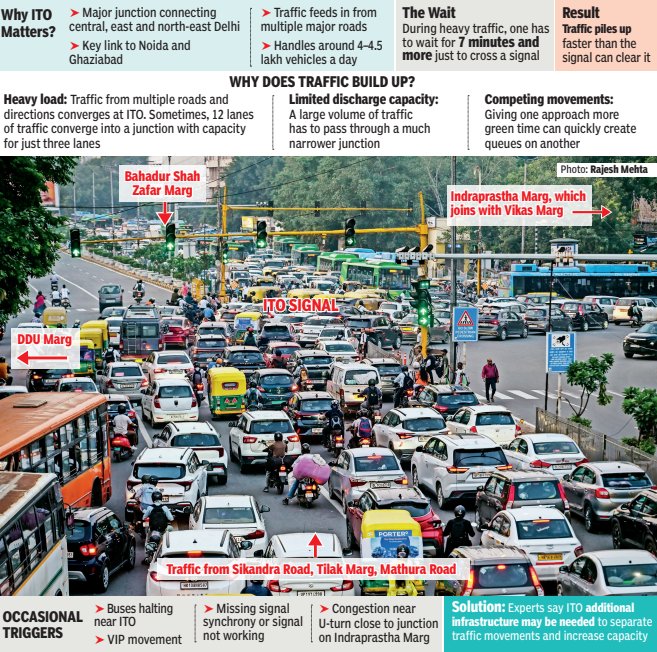
Why does traffic build up?
For thousands crossing ITO every day, this has become a familiar part of their morning and evening commute, leaving them wondering why traffic at one of Delhi’s busiest intersections gets stuck so easily.For Ishmeet, who commutes from Noida to ITO, the uncertainty is often as frustrating as the delay. She leaves work around 6 pm knowing the peak-hour commute can stretch to nearly an hour. “I waited six minutes yesterday just to cross the junction. Even the left turn is not free, and buses keep stopping abruptly. It’s a mess,” she says.Rajesh, another commuter, says the situation is “very extreme, and always has been”. He adds, “It turns into a nightmare if there’s a VIP movement on top of that.”And when the traffic finally starts moving at ITO, the relief can be short-lived. A bus halting abruptly, a vehicle breaking down, an ambulance trying to wriggle through, or a sudden diversion can be enough to make an already slow junction slower. Traffic wait time can sometimes exceed 10 minutes, extra time that can feel particularly long.ITO is a crucial traffic node linking central, east and northeast Delhi with Noida and Ghaziabad. Delhi Traffic Police and Municipal Corporation of Delhi (MCD) estimates put daily traffic at ITO at around 4 lakh to 4.5 lakh vehicles, with some recent studies pegging peak congestion volumes at 6 lakh to 7 lakh.Traffic personnel are deployed here during peak hours, often manually managing signals to juggle competing traffic flows. The question, therefore, is whether manual traffic management is not working or whether ITO intersection has reached its vehicle capacity.A traffic police source said the problem is not simply the volume of the vehicles, but the number of major movements competing for the same limited road space. ITO is fed by IP Marg, Laxmi Nagar, DDU Marg-Minto Road, W Point, Mathura Road, Tilak Marg and Sikandra Road, leaving little scope to prioritise one movement for long without creating a queue elsewhere.The imbalance is particularly stark during peak hours. In the morning, the Laxmi Nagar side can feed five to six lanes, while only around three lanes can be discharged. In the evening, nearly 12 lanes converge towards the junction from W Point side, but only about two and a half lanes can be cleared in one go.“Normally, traffic police can prioritise the most congested arm and allow some delays on other approaches. At ITO, however, two or three major movements are heavily loaded at the same time. So, prioritising one quickly creates a queue on another,” the source said.In other words, clearing one side can mean holding up another. And once vehicles cannot clear the junction in one signal cycle, queues begin eating into space meant for other movements. One blocked arm slows another, setting off a chain reaction.Traffic to and from New Delhi Railway Station adds to the burden. Emergency movements add another variable, with ambulances from nearby hospitals and colleges often requiring traffic personnel to intervene and facilitate their passage.Breakdowns, accidents, diversions, VIP movements or sudden traffic surges exacerbate the problem. At a junction already operating close to saturation, even a small disruption can send congestion spilling into adjoining roads.There is also a signal synchronisation issue. Even after the ITO signal turns green, vehicles can get stuck at the pedestrian signal ahead, where the red phase can hold traffic for a considerable time. At night, it stays red even longer, leaving the queue ahead stuck and creating a backlog.As an immediate measure, traffic officials have sought faster completion of alternative routes to take some pressure off ITO junction. They have specifically sought quicker repair of the road connecting WHO building to Hans Bhawan, which could reduce the load on ITO signal by 10% to 20%.But signal management alone may no longer be enough. S Velmurugan, a road safety and traffic engineering expert and senior adviser at National Council of Applied Economic Research, said, “In 2001, traffic volume at ITO was around three lakh PCUs. Today, it would be closer to five lakh. Every signal has a capacity, and all roads feeding ITO are important arterial ones. Manual signal management and longer green times are not sustainable. The aim is to prevent approach roads from getting completely blocked, which is why longer red phases are sometimes necessary.“Automated synchronised signals can respond to queues, but they too have limits. ITO has crossed its optimal capacity and is effectively saturated. Changing signal cycles alone will not offer a lasting solution. A flyover along ITO corridor may be needed to separate traffic movements and add road capacity,” the former chief scientist at CSIR-CRRI added.Velmurugan’s suggestion points to a larger question: If signal management is no longer sufficient, can adding infrastructure provide the extra capacity ITO needs?In April, PWD decided to undertake a feasibility study covering around 156 km of key roads, intersections and junctions, with ITO among the identified bottlenecks. But this proposal is hardly new. Plans to span ITO with flyovers date to 2003, followed by PWD proposals in 2005 and 2008-09, despite objections from Delhi Urban Arts Commission. In 2012, authorities proposed three cloverleaf flyovers to make the junction signal-free. Years later, fresh studies are still being commissioned to decongest the corridor.A similar problem is visible at Chirag Dilli, where ongoing Metro work has added pressure to an already busy junction connecting Outer Ring Road with Saket, Greater Kailash, Panchsheel Park and Lajpat Nagar, while also feeding traffic towards AIIMS, IIT Delhi and several Metro stations.During peak hours, around 60,000 vehicles pass through the junction. The pressure shifts through the day: the Chirag Dilli arm is busy in the morning, while the Lajpat Nagar side becomes a pressure point later. Queues can sometimes stretch half a kilometre beyond the foot overbridge.The Nehru Place side appears to move the slowest, not necessarily because of the traffic volume, but as it comes last in the signal sequence. Traffic cops manually regulate the signals, prioritising heavier movements, leaving the Nehru Place side with only a brief green phase. Limited or confusing signage, inadequate lane markings and poor road discipline add to the pressure.