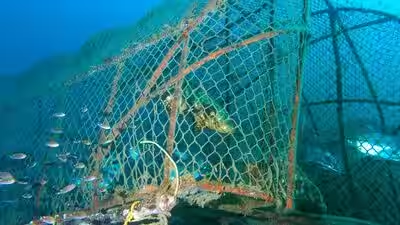

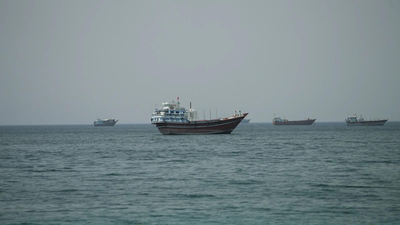
Iran’s Islamic Revolutionary Guard Corps (IRGC) navy has claimed it captured a second advanced US unmanned underwater vehicle, the Remus 600, in the Strait of Hormuz.According to a statement carried by Iranian state broadcaster IRIB on Sunday, the operation targeted what Iranian military authorities described as the “second subsurface [submarine] of the American terrorist army” operating in the strategic waterway.The IRGC said the operation was carried out through a “coordinated and complex operation” involving military intelligence and electronic warfare capabilities.“With the help of God Almighty, the IRGC navy soldiers, through a coordinated and complex operation with intelligence and electronic warfare, were able to trap an advanced UAV of the American terrorist army that was operating in the Strait of Hormuz for the purpose of espionage,” the statement read.The IRGC Navy identified the captured platform as a Remus 600, an autonomous unmanned underwater vehicle. Iranian officials alleged that it was carrying out espionage missions inside the strait.“This submersible is a type of intelligent and advanced submersible called the Remus 600, which was captured by the IRGC navy and is now in the hands of the force’s specialists to retrieve its information,” it added.IRIB said the captured vehicle had been handed over to specialist military technicians, who would analyse the system and recover its stored data.The IRGC navy also reiterated its position on maritime traffic through the Strait of Hormuz, declaring the waterway closed and warning that it would continue taking “strong and relentless” action against unauthorised traffic.“The IRGC navy firmly declares that the Strait of Hormuz is closed and we are taking strong and relentless action against dangerous movements and unauthorised traffic through the Strait of Hormuz,” the statement added.
Iran vows no retreat
The claim came as Iranian leaders continued to signal that Tehran would not back down in its confrontation with the US and Israel.Iranian President Masoud Pezeshkian said earlier on Sunday that Tehran would remain resolute, after US President Donald Trump rejected Iran’s proposal for a seven-day ceasefire and the reopening of the Strait of Hormuz.Speaking to people gathered at an airport after his return from the United Nations General Assembly in New York, Pezeshkian said, “We stand firm with strength, we are at the service of our people, we will stand until our last breath, and we promise that as long as we have life in our bodies, we will be honest servants to the people; you have put us to shame, I do not consider myself worthy of your presence, I am your servant.”Iranian Armed Forces senior spokesperson Brigadier General Abolfazl Shekarchi also said Tehran had resolved “to have not the slightest retreat in the face of the enemy and to suppress him.”Shekarchi said Iran was “the most experienced country in the world in asymmetric warfare” and warned the US against interfering in the management of the Strait of Hormuz.“The Americans should not dream of interfering in the management of the Strait of Hormuz, and if they interfere, they will receive a slap from the Iranian Armed Forces; they must leave our region,” he said.He further warned, “Any ship that passes through the Strait of Hormuz outside the route designated by Iran will not have security.”
Iran’s ceasefire proposal
Pezeshkian and Iranian foreign minister Abbas Araghchi had earlier travelled to the US for the UN gathering of world leaders, where Tehran proposed a seven-day roadmap aimed at ending the fighting and reopening the Strait of Hormuz.Under the proposal, Washington would lift its naval blockade of Iranian ports, waive sanctions on Iranian oil sales, release an estimated $12 billion in frozen Iranian assets and observe a ceasefire covering the region, including Lebanon and Yemen.In return, Iran would reopen the Strait of Hormuz, while negotiations with the US on a final agreement over Tehran’s nuclear programme would begin on the seventh day. Araghchi said the initial steps would take four to five days, with the waterway reopening on the sixth day.Trump, however, rejected Iran’s proposal for a seven-day ceasefire.