
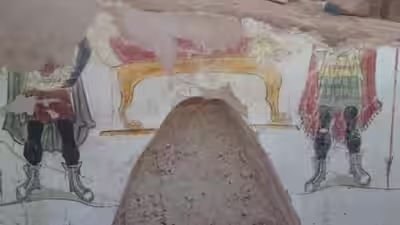
Archaeologists have discovered a 1,700-year-old Roman-era pyramid tomb in Egypt’s Dakhla Oasis; the small mud-brick monument combines Egyptian, Greek and Roman traditions and held a married couple

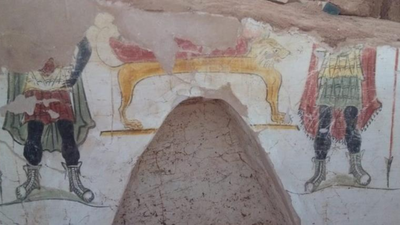
A rare pyramid-shaped tomb dating to the Roman period has been uncovered at Bir Al-Shaghala in Egypt’s Dakhla Oasis, revealing a striking blend of Egyptian funerary traditions and Greek and Roman influences. The discovery was announced by Egypt’s Ministry of Tourism and Antiquities on September 24 and has since been reported by Ahram Online, Archaeology Magazine and the Egyptian State Information Service. Built largely from mud brick, the tomb was intended for a man and his wife. Archaeologists believe the monument dates to the late third or early fourth century AD, placing it roughly 1,700 years in the past. Its design and surviving inscriptions offer a glimpse into how different cultural and religious traditions existed alongside one another in Roman-era Egypt.
An Egyptian-style entrance
The tomb is reached by a staircase of 14 steps leading to a sandstone entrance. Although the monument belongs to the Roman period, the entrance is unmistakably Egyptian in style. Its decoration includes hieroglyphic funerary spells, a winged sun disk and two cobras. Archaeologists also identified a scene associated with the seventh hour of the Amduat, an ancient Egyptian funerary text describing the sun god’s journey through the underworld.The entrance had been sealed with a stone slab carrying Osirian imagery and additional protective funerary texts. Behind it lies a mud-brick hall with a vaulted ceiling and two burial chambers. The combination is not entirely unexpected for Bir Al-Shaghala. Earlier archaeological research at the site has documented Roman-period tombs with pyramidal superstructures and a mixture of Egyptian architectural and funerary traditions.
A Greek poem inside a Roman-era tomb
One of the discovery’s most unusual finds is a rectangular stone funerary stele set into the southern wall of the pyramid-shaped structure. The stele contains a 19-line funerary poem written in ancient Greek and dedicated to a man identified as Psychtis, or Pisechtes in some reports. Preliminary studies suggest that he may have been a judge, although that identification has not been established conclusively. The inscription has been dated to the late third or early fourth century AD.Its presence alongside Egyptian funerary imagery illustrates the cultural complexity of the oasis during this period. Greek was widely used in parts of Roman Egypt, while Egyptian religious traditions continued to shape burial practices.
More clues about the people buried there
The excavation also produced objects associated with funerary rituals, including a sandstone offering table positioned above a purification basin, pottery vessels and a bronze coin carrying an image of the Roman emperor Constantine. The coin provides another chronological clue, while the offering table and basin point to ritual activity connected with the tomb.Archaeologists also found evidence that the monument may have been reused later. A mud-brick chapel and a small funerary shrine with four square columns were discovered above the main entrance.
A window into Roman-era Dakhla
Bir Al-Shaghala formed part of the necropolis of Mothis, the ancient capital of the Dakhla Oasis during the Ptolemaic and Roman periods. Excavations at the site have been ongoing since 2002 and have revealed tombs with different layouts, decorations and architectural traditions.The wider cemetery is particularly notable for its pyramid-topped tombs, mud-brick construction and underground burial chambers. Previous archaeological studies have shown that these monuments were used by members of the oasis community and incorporated elements from Egyptian funerary architecture alongside traditions that developed during the Ptolemaic and Roman eras.The newly discovered tomb adds another piece to that picture. Its Egyptian hieroglyphs and underworld imagery, Greek funerary poem and Roman-era artefact all survive within the same monument, offering archaeologists evidence of how identities and traditions overlapped in the Dakhla Oasis nearly two millennia ago.