



Information dominance is one of the most important aspects of modern warfare. For a long time, military leadership worldwide was hamstrung by the “fog of war” — critical, battle-winning decisions could not be taken timely because of information gaps.Today, the fog has largely been reduced by more sensors, near-instantaneous communications, streamlined information channels, and automation and computing that aid commanders.In both reel life and real life, military satellites have shown they can provide detailed reconnaissance across spectrums from visual to through-cloud and weather-piercing radars.Satellites are also central to global communications. India plans a constellation of 52 military satellites under Space-Based Surveillance Phase‑III at a cost of Rs 27,000 crore, aiming to have it operational by 2029. The program will give India the ability to monitor its vast western and northern fronts, as well as maritime approaches.
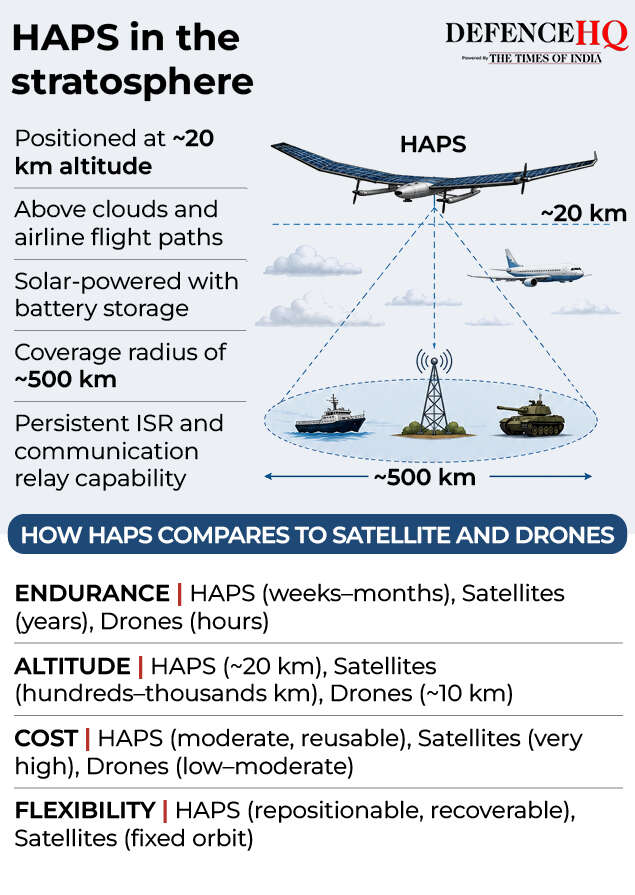
Satellites remain crown jewels of this domain, but their high cost, vulnerability to anti-satellite weapons (which India has also developed), and orbital limits have created demand for alternatives. Enter High-Altitude Pseudo‑Satellites (HAPS)—stratospheric platforms promising persistence, flexibility and affordability.HAPS offer several advantages over space-based satellites. Unlike satellites confined to fixed orbital paths, HAPS can be deployed flexibly and repositioned as needed. Operating at around 20 km, they fly close enough to deliver high-resolution imagery and real-time intelligence.Their endurance — weeks or even months — allows continuous coverage over an area without the revisit delays of satellites. HAPS are also more cost-effective, relying on solar power and lightweight design to reduce operational expenses. They can be recovered, upgraded and redeployed, offering modularity satellites cannot. These systems complement existing ground- and air-based sensors, building redundancies that help the shooter element of the equation.India is advancing both fixed-wing HAPS and stratospheric airships through joint efforts by DRDO, the National Aerospace Laboratory (NAL) and industry. These unmanned systems are designed to operate around 20 km, well above commercial traffic and weather systems.HAPS combine satellite persistence with aircraft flexibility, bridging a critical surveillance and reconnaissance gap. A single platform can provide continuous optical, infrared and signals-intelligence coverage over a 500 km radius for weeks, far exceeding patrol aircraft endurance and low-Earth-orbit revisit cycles.These systems rely on lightweight structures and highly efficient solar panels to sustain long endurance, storing energy in batteries for night operations. Unlike traditional balloons and airships that struggle with station-keeping, heavier‑than‑air UAVs such as NAL’s design better maintain position and deliver consistent coverage.Operating at extreme altitudes and low forward speeds demands high aerodynamic efficiency; lightweight structures introduce aeroelasticity concerns. Propellers must perform across wide air-density ranges, and avionics, payloads and batteries must withstand temperatures down to –85°C and very low pressures. Lithium‑ion batteries, commonly used for their energy density, lose performance in such cold.Despite these hurdles, NAL’s subscale demonstrator achieved an 11‑hour flight and reached 25,000 feet. The final full-scale HAPS will have a wingspan exceeding 30 metres while weighing only 150 kilograms, reflecting the trade-off between endurance and efficiency.Once operational, these platforms will give India persistent, cost-effective surveillance, strengthening national security and placing the country among a few advancing stratospheric UAV technology.They will help field commanders cut the fog of war during critical moments. Another important use is communications relay: because radio waves are line‑of‑sight, a HAPS can act as a vital communication node over the battlefield.In May 2025, DRDO successfully tested a Stratospheric Airship Platform demonstrator that reached 17 km. A full‑scale stratospheric flight to 20 km is planned next year. The airship can carry heavier payloads than fixed‑wing HAPS, enabling more powerful radars and larger communication relays.Deploying such systems is necessary given the possibility of two fronts becoming active with little notice. Along the Line of Actual Control, China’s infrastructure build-up and troop movements demand constant monitoring; HAPS can provide real-time intelligence without tasking a satellite or waiting for an overflight.On the western front, Pakistan’s cross‑border infiltration and terror launch pads require continuous ISR. In the maritime domain, the Indian Ocean Region is witnessing increasing Chinese naval presence; HAPS can watch sea lanes, chokepoints and island territories. India’s full-scale fixed‑wing HAPS is stated to fly at 75,000 feet for up to 90 days.In civilian contexts, these systems can support remote sensing, disaster relief, oceanography, agricultural observation and mobile communications to remote areas.Besides India, many nations are developing similar programs, with the US and Europe leading. Zephyr, developed initially by UK-based QinetiQ and now produced by Airbus, set the benchmark for fixed‑wing HAPS with a 64‑day flight after taking off from Yuma Proving Ground. In the US, Nasa flew fixed‑wing HAPS such as Pathfinder and Helios; South Korea and Japan have also built similar platforms.High‑Altitude Pseudo‑Satellites provide cost‑effective solutions to many military problems. They can be deployed globally to provide persistent surveillance or communications, helping strategists make better decisions when it matters most.