


NEW DELHI: The Election Commission is facing a fresh political storm over the Special Intensive Revision (SIR) exercise, with the opposition demanding Chief Election Commissioner Gyanesh Kumar’s resignation following a report in The Indian Express on differences within the poll panel over the exercise.According to the report, Election Commissioners Sukhbir Singh Sandhu and Vivek Joshi had objected at least 14 times over 10 months to SIR-related decisions, including those concerning voter deletions and electoral roll data. The report has brought into focus a question that has surfaced at different points in the Election Commission’s history: what happens when members of the poll panel disagree over how it should exercise its powers?There have been two prominent instances when such differences moved beyond the commission’s internal proceedings and became matters of public and judicial scrutiny. In the 1990s, Chief Election Commissioner TN Seshan challenged the creation of a multi-member Election Commission and the appointment of two Election Commissioners alongside him. In 2019, Election Commissioner Ashok Lavasa publicly dissented from the majority view on complaints alleging Model Code of Conduct violations by senior political leaders.
When Seshan challenged other Election Commissioners
TN Seshan was appointed Chief Election Commissioner in December 1990 and became known for his strict enforcement of the Model Code of Conduct and his assertion of the Election Commission’s constitutional powers. The structure of the commission changed in October 1993, when the government moved to make the poll panel a three-member body.On October 1, 1993, the President promulgated an ordinance providing for two Election Commissioners in addition to the CEC. On the same day, MS Gill and GVG Krishnamurthy were appointed as Election Commissioners. Seshan challenged the move in the Supreme Court, alleging that the appointments were intended to dilute his authority and “sideline” him. The government defended the move, maintaining that the Constitution permitted a multi-member Election Commission.The dispute soon spilled beyond the courtroom. The Supreme Court’s eventual judgment recorded “unpleasant exchanges” between Seshan and Krishnamurthy at a meeting in October 1993, noting that allegations and counter-allegations had been made by the two commissioners. Gill later spoke publicly about the strained relationship, recalling his attempts to establish contact with Seshan after the appointments.“The CEC, however, acted as if we don’t exist,” Gill famously said in 1995.Seshan approached the Supreme Court on October 26, 1993, challenging the ordinance and the appointments. The case raised a larger constitutional question: could the Chief Election Commissioner exercise overriding authority in a commission that now had two other members, or were all three meant to function collectively?
1995 verdict: CEC not above other ECs
The constitutional battle ended with a Supreme Court Constitution Bench judgment on July 14, 1995, which upheld the law providing for a multi-member Election Commission as well as the appointments of Gill and Krishnamurthy.The court rejected the proposition that the CEC’s view would automatically prevail over those of the other Election Commissioners. “If the CEC is considered to be a superior in the sense that his word is final, he would render the ECs non-functional or ornamental,” the court observed.The judgment also commented on the personal friction that had accompanied the constitutional dispute. “It is a pity they did not try to work as a team,” the court said, adding that “suspicion and distrust got the better of them”, while expressing the hope that the commissioners would work with mutual respect and confidence.The verdict thus established the framework for the functioning of a multi-member Election Commission, making clear that the CEC could not treat the other Election Commissioners as subordinate members whose views could simply be overridden.
2019: Lavasa’s dissent
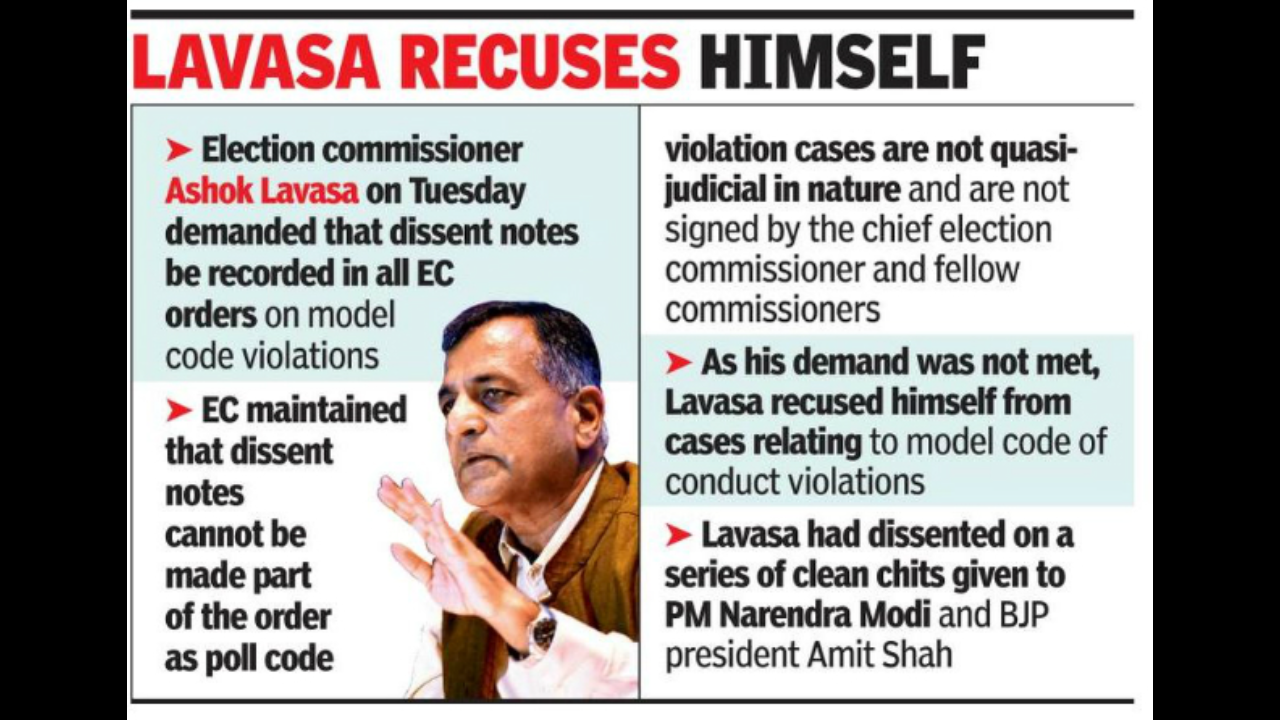
More than two decades later, another disagreement within the Election Commission became public during the 2019 Lok Sabha elections. The commission then comprised CEC Sunil Arora and Election Commissioners Ashok Lavasa and Sushil Chandra, with Lavasa disagreeing with the majority view in several complaints alleging Model Code violations by Prime Minister Narendra Modi and then BJP president Amit Shah.The majority gave PM Modi and Shah clean chits in the complaints, while Lavasa wanted his dissenting views to be recorded and included in the commission’s orders. The disagreement subsequently became a dispute over whether a minority opinion should form part of the final order issued by the poll panel.
Ashok Lavasa resigned before he was made CEC.
Lavasa eventually informed Arora that he would stay away from proceedings concerning MCC complaints. In a letter, he said his minority decisions were being “suppressed” in a manner contrary to conventions followed by multi-member statutory bodies and wrote: “In the present circumstances, I am left with no option but to keep away from such proceedings.”
‘We are not clones’: Sunil Arora
The dispute became public during the election campaign, prompting then CEC Sunil Arora to respond. On May 18, 2019, Arora said the three members of the Commission were not expected to agree on every issue.“The three members of ECI are not expected to be template or clones of each other,” Arora said, describing the controversy as “unsavoury and avoidable”. He also noted that differences of opinion had existed within the Commission in the past.
Share your thoughts in the comments
Be respectful · TOI community guidelines
The full Commission subsequently discussed how dissent should be recorded. Lavasa’s demand that minority views be made part of the final MCC orders was not accepted. Instead, the commission decided that the views of all members would be recorded in its proceedings, while the final order would reflect the majority decision.
Lavasa resigns before he could become CEC
On August 18, 2020, Lavasa resigned as Election Commissioner after being appointed vice-president of the Asian Development Bank. He had joined the Election Commission in January 2018 and still had more than two years left in his tenure. He was also next in line to become Chief Election Commissioner.The Election Commission formally bid farewell to Lavasa later that month, with Arora saying the ECI’s loss was the Asian Development Bank’s gain.


