


McDonald’s says its AI-enabled drive-thru system can now take orders in English and Spanish with 90% accuracy; it could save at least 50 labour hours a week; CFO Ian Borden notes that company has no intention to reduce staff

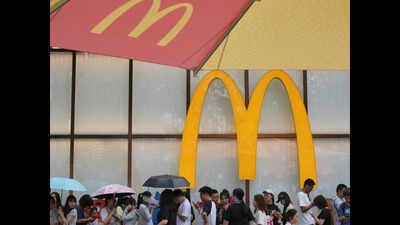
McDonald’s announced that its AI-enabled drive-thru system called Archy can now take orders in both English and Spanish with 90% accuracy. According to a report by CBS, the company said that the system could save at least 50 labour hours per week at a typical restaurant by streamlining order-taking. CFO Ian Borden also stressed that the intention is not to reduce staff but to free employees to focus on hospitality and food preparation tasks, such as hand-breading chicken.
$8.5 billion global modernization plan of McDonald’s
The announcement came as McDonald’s unveiled a $8.5 billion investment plan over the next decade to modernize its 46,000 restaurants worldwide. CEO Chris Kempczinski said the company must improve productivity and capture market share in a flat fast-food traffic environment. Planned upgrades include lockers for delivery orders, redesigned kitchen layouts, bigger play areas, and more visible coffee preparation stations to enhance quality perceptions.
Archy and ArchIQ: AI at the center of the plan
A key piece of the modernization push is McDonald’s AI-enabled drive-thru ordering system, Archy, which the company says can now take orders in both English and Spanish with 90% accuracy. According to CFO Ian Borden, the system could eventually save at least 50 labor hours per week at a typical restaurant. Importantly, Borden was clear that the goal isn’t to cut staffing — instead, employees freed up from order-taking would be redirected toward hospitality-focused tasks or hands-on food preparation work, like hand-breading chicken.Archy operates alongside ArchIQ, a broader AI system McDonald’s developed in partnership with Google that’s designed to improve order accuracy while automating backend tasks like inventory management and staff scheduling. Kempczinski said early testing shows customers have responded well to Archy specifically because it makes their orders more accurate, adding that the company’s approach to AI isn’t rooted in treating the technology as inherently good or bad, but in being deliberate about how it’s actually deployed.
Beyond AI: physical store upgrades
The modernization plan extends well past software. McDonald’s said upcoming restaurant redesigns will include lockers for handling delivery orders, more visible coffee preparation areas meant to improve customers’ perception of quality, larger play areas, and reworked kitchen layouts. Order-accuracy scales, already active in 10,000 restaurants globally, are set to expand to 20,000 locations by 2028.
Menu changes driven by protein demand
On the food side, McDonald’s highlighted strong results from its hand-breaded chicken, currently rolled out across 10,000 restaurants in Asia and a small number of locations near Chicago, with plans to expand testing into additional US markets and Ireland next year — a category where rivals like Chick-fil-A and KFC have long had an edge. The company also plans to introduce grilled chicken sandwiches and wraps, along with experimenting with items like egg bites and bowls.Skye Anderson, president of McDonald’s USA, tied this shift directly to changing consumer habits, noting that roughly 30 million Americans currently use GLP-1 weight loss drugs and are increasingly seeking smaller, protein-dense meals as a result. She pointed to internal research suggesting a much larger opportunity, though, with roughly 60 million Americans actively looking to add more protein to their diets overall — a gap she framed as a chance for McDonald’s to give customers more reasons to choose the brand first.
Staying focused on value amid cost-of-living pressure
Despite the modernization push, Kempczinski emphasized that value remains central to McDonald’s strategy, particularly for lower-income consumers. He defined low-income US households as those earning $45,000 or less annually, noting that while this group still eats fast food, they’re doing so less frequently than before. He credited meal bundles like the $5 meal deal with helping address that pressure, and said McDonald’s is exploring introducing entry-level pricing on a basic menu of items in the US, mirroring an approach it already uses in Europe and other markets. He described the current economic backdrop as one demanding constant attention to value, noting that cost-of-living pressure on consumers isn’t going away anytime soon.
Employee training and customer value
McDonald’s is also rolling out new hospitality-focused training, showing employees what a perfectly cooked Big Mac tastes like and encouraging more pleasant customer interactions. At the same time, the company remains focused on value, exploring entry-level pricing for basic menu items in the U.S. to counter cost-of-living pressures.


