
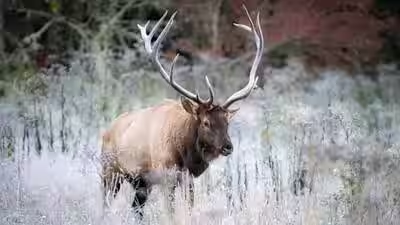
In 2001, 25 elk were brought to Great Smoky Mountains National Park from Kentucky; 25 years later, more than 250 elk have been recorded in the Smokies

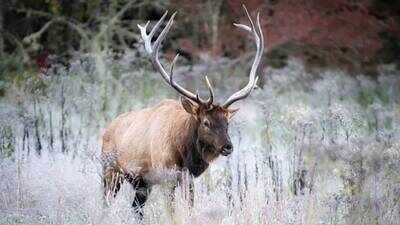
The reintroduction of elk to Great Smoky Mountains National Park is being described by wildlife experts as one of the region’s notable conservation success stories, 25 years after the animals were brought back to the park.In 2001, park officials relocated 25 elk from Land Between the Lakes National Recreation Area in Kentucky to the Smokies. The following year, another 27 elk from Elk Island National Park in Alberta, Canada, were added to the herd.Today, more than 250 elk have been recorded in the Smokies, according to WBIR.
From extinction to a growing herd
Elk were once abundant throughout the southern Appalachian Mountains and the eastern United States. However, over-hunting and habitat loss caused their numbers to collapse.The National Park Service says the last elk in North Carolina is believed to have been killed in the late 1700s, while the last elk in Tennessee was reportedly killed in the mid-1800s. By 1900, elk populations across North America had fallen dramatically.The effort to return elk to the Smokies eventually gained momentum through the Rocky Mountain Elk Foundation, with the reintroduction taking place more than 150 years after settlers had hunted the animals to local extinction, according to Friends of the Smokies.The initial release took place in Cataloochee Valley, North Carolina, in 2001.
Rangers had to address disease concerns
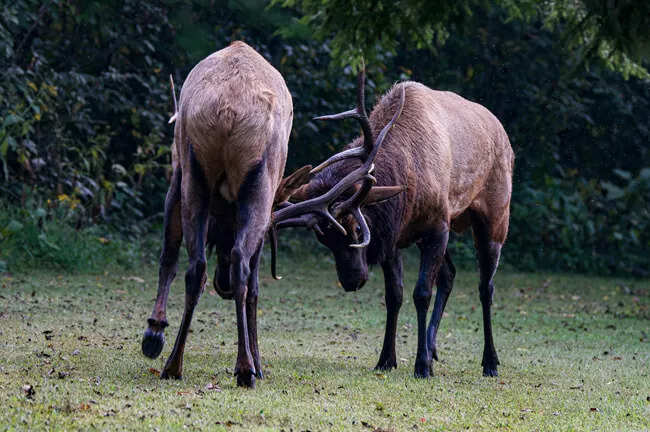
In 2001, 25 elk were brought back to the Smokies. Twenty-five years later, more than 250 have been recorded in the national park. (Photo: Paul Driessche)
Kim DeLozier, a retired Great Smoky Mountains National Park ranger who led the elk reintroduction effort 25 years ago, recalled that disease and parasites were among the biggest concerns surrounding the project.“One of the biggest concerns from the farming community, for the state veterinarians, was disease and parasites,” DeLozier said.He explained that officials needed to identify a suitable herd that had been monitored and surveyed for several years before they could demonstrate that bringing the animals into the Smokies represented an acceptable risk.For DeLozier, watching the herd grow has become one of the defining achievements of his more than three-decade career.“It’s at the top; there’s no doubt about it,” he said.
‘One of the most remarkable conservation success stories’
Dana Soehn, president and CEO of Friends of the Smokies, worked for the National Park Service for nearly three decades and was present 25 years ago when the elk were released.She took her young sons to witness the historic event.“The return of the elk is one of the most remarkable conservation success stories in the East, and certainly one of the most rewarding of my career,” Soehn said.The success has also produced unexpected movements beyond the herd’s traditional range.Joe Yarkovich, who was an intern at Great Smoky Mountains National Park in 2001 and is now involved with the elk management program, said elk could eventually reach areas farther from their established territory.Two female elk were recently photographed near Townsend, Tennessee, roughly 30 miles from the herd’s primary range in Cataloochee Valley.“Yeah, they could make it to Cades Cove, absolutely,” Yarkovich said.He expects such movements could become more common as the population grows.“As the herd continues to grow, I think we’re probably going to see more and more animals making far-out pioneering movements into new areas,” he said.Wildlife biologists say exactly when elk will cross farther into new areas remains up to the animals themselves.
Elk are the largest animals in the park
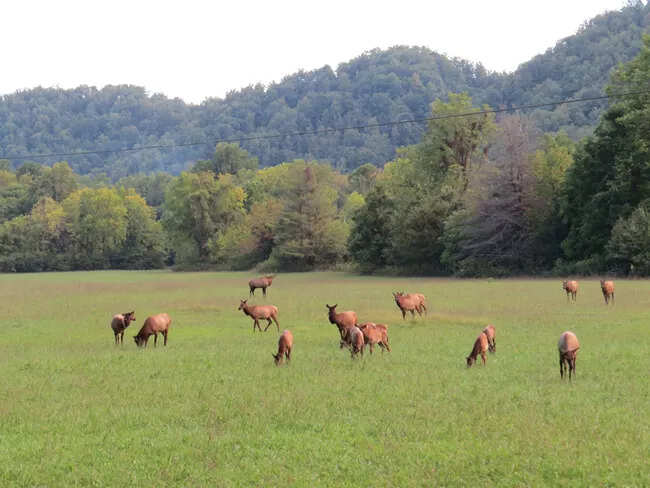
From 25 elk in 2001 to more than 250 today, the Smokies’ elk reintroduction has become a remarkable conservation story. (Photo: Warren Bielenberg)
According to the National Park Service, elk are the largest animals in Great Smoky Mountains National Park.The animals can weigh as much as 1,000 pounds for males, while females can reach about 600 pounds. Adults can measure between seven and 10 feet from nose to tail and stand approximately 4½ to 5 feet tall at the shoulder.Elk typically live in herds and feed on grasses, forbs, acorns, bark, leaves and buds from shrubs and trees.In western North Carolina, the elk population is estimated at approximately 270, with around 150 spending at least part of the year inside the national park, according to National Park Service information.
Where visitors can see the elk
Visitors can encounter elk at several locations on the North Carolina side of Great Smoky Mountains National Park, including Cataloochee, Balsam Mountain and Oconaluftee.The animals are generally most active during the early morning and late evening, and cloudy days can also provide opportunities for viewing.However, park officials emphasize that elk remain wild animals. Visitors should maintain a distance of at least 25 yards and move farther away if their presence causes an animal to alter its natural behavior.Particular caution is advised around cows with calves and bulls, which can defend themselves or their territory.Visitors are also warned never to touch or move elk calves. Young elk can appear to be abandoned while their mothers are away feeding, but this is normal behavior.
Elk’s seasonal cycle
Elk undergo significant physical changes throughout the year.In early spring, bulls generally shed their antlers, typically around March, before immediately beginning to grow a new set. The developing antlers are covered in velvet, which supplies nutrients as the bone grows.By early August, the antlers have finished developing and bulls scrape away the velvet. Mature antlers can reach 55 to 60 inches in length, span nearly five feet and weigh about 30 pounds per pair.During summer, bulls may roll in mud wallows to cool themselves and deter insects. By late summer, calves lose their spots.The fall brings the breeding season, known as the rut, generally from early September through late October. Bulls produce their distinctive bugling calls, which can travel more than a mile, while males use their antlers during displays and occasional contests for dominance.In winter, elk develop a thicker, two-layered coat to withstand the cold. Bulls retain their antlers through the season before shedding them the following spring.