
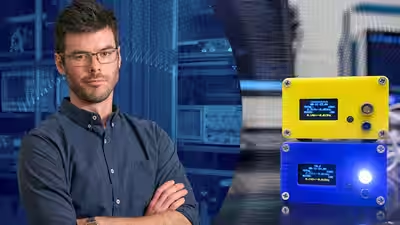
A student built a particle detector for just $100; the pocket-sized device can track invisible particles raining down from space at light’s speed; it is now being used in high-altitude balloon missions and major physics experiments

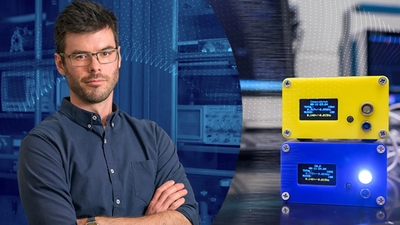
A device that can detect particles arriving from space does not necessarily require a multimillion-dollar laboratory. A compact detector developed by physicist Spencer Axani began as a low-cost student project and has since grown into a tool used for particle-physics research, education and high-altitude experiments. The University of Delaware detailed its latest developments in September, while earlier accounts in Physics Today and Fermilab/SLAC’s Symmetry documented how the project evolved from Axani’s work at MIT into the CosmicWatch programme.The device, called CosmicWatch, detects muons, short-lived subatomic particles produced when high-energy cosmic rays collide with atoms in Earth’s atmosphere. Those collisions generate cascades of secondary particles, some of which reach the ground and pass through buildings, rock and even the human body. Muons travel extremely close to the speed of light, making them useful messengers of what happens when cosmic radiation interacts with Earth’s atmosphere. Unlike ordinary light, however, they cannot be seen directly. A detector such as CosmicWatch converts their passage into measurable electrical signals.
How a $100 device detects particles from space
CosmicWatch is small enough to be handheld and costs about $100 in components. Its design combines a plastic scintillator with a silicon photomultiplier, electronics that process the tiny flashes of light produced when a muon deposits energy in the detector. The latest v3X design can record events to a microSD card or stream measurements through USB, while also logging information such as temperature, pressure and acceleration.The affordability is significant because traditional particle detectors can involve much larger and more expensive equipment. The original CosmicWatch research paper described the detector as a self-contained, portable instrument that students could build and use themselves, with a first build taking a novice roughly four hours.That approach also makes the detector useful outside conventional laboratories. Students can assemble one, collect measurements and then investigate how the number of detected muons changes with altitude, shielding or other environmental conditions.From an MIT project to a research toolAxani started developing the detector while he was a graduate student at MIT. The initial motivation was more closely tied to large-scale neutrino research, where detecting atmospheric muons can help researchers distinguish them from the neutrinos they are actually trying to study.The idea gradually moved in a different direction: instead of building another expensive instrument for a specialised facility, Axani and his collaborators developed a version that could be made cheaply enough for students and small research projects.The project became CosmicWatch and has continued to evolve. Its current v3X version adds environmental sensors, improved data collection and coincidence capabilities, allowing multiple detectors to be used together to reduce background events.
Why scientists care about muons
Muons are more than proof that cosmic radiation is passing overhead. Because they are energetic and highly penetrating, researchers can use them to investigate both cosmic-ray processes and structures on Earth.Muon measurements can help scientists study the showers produced by cosmic rays and understand the properties of the particles that initiated them. The same basic principle has also been used in muography, a technique that creates images by measuring how many muons pass through an object.That has applications ranging from archaeology to geology. The ability of muons to travel through substantial amounts of material makes them particularly useful when conventional imaging methods cannot easily penetrate a structure.
The detector can go where laboratories cannot
One of CosmicWatch’s most interesting advantages is its portability. Similar detectors have already been incorporated into high-altitude balloon experiments, where researchers can observe how cosmic-ray activity changes as the payload climbs through the atmosphere. Independent balloon experiments have previously carried CosmicWatch detectors to altitudes exceeding 60,000 feet.The University of Delaware has also described a more recent balloon experiment in which a modified detector was taken to around 100,000 feet. At those altitudes, the changing atmospheric environment provides an opportunity to study how cosmic-ray particle rates vary with elevation.The technology is also being used in research settings, including detector experiments studying rare particles and dark matter. A future version is being explored for measuring primary cosmic rays in rockets and spacecraft.
A pocket detector with a much bigger ambition
The project has also opened the possibility of creating a distributed network of inexpensive cosmic-ray detectors. Instead of measurements coming from a handful of specialised facilities, detectors placed in different locations could potentially contribute observations to a shared database.That would turn what began as an inexpensive teaching instrument into something closer to a citizen-science network, allowing students and researchers in different parts of the world to compare cosmic-ray measurements.CosmicWatch’s significance, then, is not simply that it makes particle detection cheaper. Its compact design lowers the barrier to experimenting with a part of physics that normally feels inaccessible, giving students a way to detect particles from cosmic-ray interactions with equipment small enough to sit on a desk.