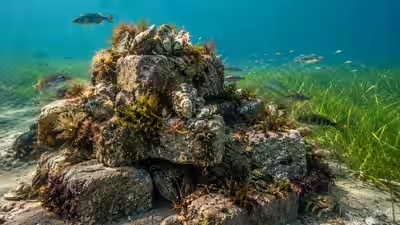
In 2021, researchers began placing concrete-block oyster reefs in bare eelgrass patches on Prince Edward Island; within two years biomass was about 45 times higher and 45 taxa had colonised the structures

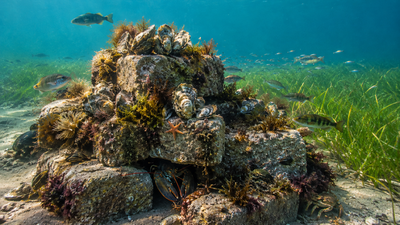
What started as piles of concrete blocks on the seafloor off Prince Edward Island soon became a magnet for marine life. Researchers began installing the artificial oyster reefs in 2021 to test whether they could provide some of the ecological functions lost from areas where eelgrass no longer grew. Within two years, the structures had been colonised by 45 taxa, while biomass was about 45 times higher on two-year-old reefs than on newly installed ones. The findings, published in Ecosphere, show how a simple structure can provide a new foothold for marine life in a fragmented coastal habitat.
Turning bare seabed into new habitat
The work took place on the eastern end of Lennox Island, Prince Edward Island, where eelgrass (Zostera marina) meadows are broken up by patches of bare sediment. Instead of trying to plant eelgrass directly into those empty areas, researchers tested another idea. They built small artificial reefs from ordinary concrete blocks and placed them in the bare patches.The first 18 reefs went into the water in July 2021. Another 16 were added in 2022, followed by eight more in 2023. Each reef was made from eight to 10 concrete blocks arranged into a mound, creating several levels and surfaces above the seabed. The blocks gave oysters and other organisms something that bare sediment could not: a hard surface to settle on and grow. That was important because oyster reefs are more than collections of oysters. As they develop, they can create three-dimensional habitat that other marine organisms can use for shelter, feeding and attachment.
Life quickly began to gather
The structures did not remain bare for long. Researchers recorded 45 taxa across 11 phyla on the artificial reefs. They included plants, invertebrates and fish, with 29 of the taxa identified to species level. Oyster spat, or newly settled oysters, were among the first organisms to establish themselves. As the reefs aged, the community became more developed. The difference in biomass was particularly striking. Reefs that were less than a year old had an average biomass of about 35 grams. That increased to roughly 318 grams on one-year-old reefs.By the time the reefs were two years old, average biomass had reached about 1,577 grams. That was around five times the biomass recorded on one-year-old reefs and roughly 45 times the amount found on the newly installed structures. Much of that increase came from oysters growing on the reefs. The number of different taxa also changed as the structures matured. One-year-old reefs had an average of about 19 taxa, compared with roughly seven on the newest reefs.
Fish began using the reefs too
The structures were not simply places for oysters and other organisms to attach themselves. Researchers also observed fish using the older reefs for feeding and shelter. Fish diversity and evenness generally increased with reef age, although the fish observations were analysed descriptively because sample sizes were limited. Measurements also showed differences in several water-quality conditions around the reefs compared with nearby bare areas. Compared with nearby bare areas, the reef sites had lower temperatures and turbidity, higher dissolved oxygen and lower pH in the measurements recorded by the researchers. In other words, the reefs were beginning to affect their surroundings as well as provide a physical surface for marine life. That matters because one of the problems with fragmented coastal habitats is that losing a habitat-forming species can affect many other organisms that depend on it. Creating another type of structure may help fill at least some of that gap.
The reefs are not a replacement for eelgrass
The researchers do not suggest that concrete oyster reefs can simply replace eelgrass meadows. The project explored whether artificial reefs could provide some of the ecological functions of eelgrass habitat in areas where eelgrass was already absent. That distinction is important. Restoring eelgrass can be difficult when the environmental conditions responsible for its decline have not changed. Simply planting more eelgrass may not solve the underlying problem.An oyster reef offers a different approach. Rather than recreating the lost habitat exactly, it introduces another type of habitat that can support marine life under the existing conditions. The researchers describe this as ecological facilitation, with different habitat-forming species potentially providing complementary benefits.
Connecting restoration with the local community
The project was carried out in collaboration with the Lennox Island First Nation. The researchers note that oyster beds have historical ecological, cultural and food-security importance in the area and that many have since disappeared.The artificial reefs therefore offered a way to create new habitat while also supporting the return of oysters and other organisms. The researchers recorded species including lobster and forage fish using the developing structures. The approach is relatively simple, too. Concrete blocks are inexpensive, readily available and can be placed using a small boat, making the method potentially useful for smaller restoration projects.
What happens next
The results are encouraging, but the researchers point out that the reefs will need to be watched for longer to understand how their communities develop and how they interact with nearby eelgrass. A two-year-old reef is still relatively young, and the ecological effects could change as oysters continue to grow and more organisms arrive. Still, the experiment offers an interesting lesson in habitat restoration. Sometimes restoring a damaged ecosystem may not mean trying to recreate exactly what was there before. In fragmented coastal areas, creating new structures that give marine life somewhere to settle, feed and shelter could provide another way to rebuild some of the functions that have been lost.On Prince Edward Island, a collection of concrete blocks has already become a small but growing marine community, showing how quickly life can make use of a new piece of habitat.