

Meet Ameya Kharade, the 17-year-old Nashua student whose $1,800 brain-reading system aims to turn brain activity into speech at implant-like speeds without surgery

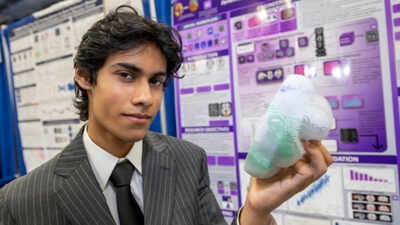
For someone who can speak, putting a thought into words is almost effortless. For millions of people living with conditions such as ALS, severe stroke or paralysis, that simple act can become impossible even when the mind remains fully active. At 17, Nashua, New Hampshire, student Ameya Kharade is working on a way to close that gap without putting a device inside the brain. According to a report by Newsnet Los Angeles, his project, called HALO-Vox, is a brain-computer interface designed to translate brain activity into speech far more quickly than conventional non-invasive systems. What makes the project particularly striking is its price. Kharade developed and tested the system using about $1,800 worth of consumer electroencephalography hardware rather than an expensive surgical implant. Scroll down to read the details.
A personal learning
According to Barron Prize Winners website data, Ameya’s work is rooted in his close family member’s loss of speech following a stroke when Ameya was seven. He could see in his relative’s eyes that his mind was intact, but his voice was gone. Refusing to accept that, Ameya applied the neuroscience research he’s done since age 13 to solving the speech problem. Working alone in his garage for more than six hours each day for a year, he taught himself the mathematics of information theory, developed a sixty-page theory paper, created the algorithms, wrote the code, and ran the human trials. He discovered that for decades, the entire field working to restore speech had been trying to decode letters when they should have been decoding “intent” itself. In over 100 human trial sessions, HALO-Vox’s built-in safety system has never put unintended words in a speaker’s mouth. Ameya has open-sourced his system so anyone can use it and has filed a patent to protect its accessibility. Ameya is now bringing this technology to the whole world. He co-founded Lucen to put brain-computer interfaces within reach of anyone, without millions of dollars and without brain surgery. Extending HALO-Vox, he and his team are building the foundational technology and physics to make that possible. “I’ve learned that persistence isn’t about confidence,” says Ameya. “It’s about being committed enough that giving up isn’t something you can live with.”
A different way to read intent
Current non-invasive brain-computer interfaces can be painfully slow, with conventional systems often requiring users to construct messages letter by letter. Surgical implants can deliver much faster communication, but they involve brain surgery and can cost well over $100,000. According to Society for Science data, Kharade took a different approach. Instead of treating communication as a process of spelling out individual characters, HALO-Vox attempts to identify the underlying intent of a person’s brain activity.In testing involving 111 randomized, counterbalanced trials, the system reached 65 words per minute, compared with 3 words per minute for a conventional speller using the same hardware. The results represented a roughly 20-fold improvement in speed. The system also reduced the time required to produce a message, with testing showing an average of 10.7 seconds compared with 242.2 seconds for the conventional approach.
Focusing on meaning, not sentence length
Kharade’s research points toward a different measure of communication efficiency. His system appeared to respond more strongly to ambiguity in a person’s intended message than to the length of the sentence itself. That distinction led him to develop what he calls the Six Laws of Intent Resolution, a framework based on information theory that describes how communication systems can extract more meaning from limited signals. The idea could extend beyond speech. Kharade argues that the same principle could eventually improve other bandwidth-limited technologies, including prosthetics and existing brain-computer interfaces.
A project with a wider purpose
As per the Newsnet Los Angeles report, Kharade’s work has also earned recognition beyond the laboratory. He is among the 2026 winners of the Gloria Barron Prize for Young Heroes, which honors 25 young people between the ages of 8 and 18 for significant contributions to people and the planet. For Kharade, the technology is ultimately aimed at a basic human need: giving people who cannot physically speak another way to communicate. If HALO-Vox can continue to demonstrate its early results, the project could offer a glimpse of a future where sophisticated brain-computer communication does not necessarily require a surgeon, a six-figure price tag or years of specialized equipment.Image Courtesy: Barron Prize Winners