
DOWN THE RABBIT HOLE: Is Donald Trump’s Greenland deal crucial to counter Russia and China in the Arctic Circle? | World News

There are shows that age well, and then there is Yes, Minister, which, in its plots, contains almost everything you need to learn about bureaucracy, democracy, the civil service, inter-departmental committees and even life itself. The BBC show was deemed so realistic that Margaret Thatcher was a huge fan and even appeared alongside Paul Eddington and Nigel Hawthorne in a special sketch. Now, anyone who has watched the show knows that Sir Humphrey Appleby doesn’t goof up often, but when he does, it is usually a doozy.And Yes, Minister, like the works of Franz Kafka, often feels less like satire of its own time and more like an unnervingly accurate portrait of the future.Take, for example, the plot of The Skeleton in the Cupboard, where it emerges that, in the years after the Second World War, a junior civil servant had bungled the lease of a Scottish island on which the Ministry of Defence had built a military base and associated installations. Thirty years later, the lease expired and the government discovered that, thanks to the original agreement, the entire lot would revert to the owner unless Whitehall coughed up around £40 million.The junior civil servant, of course, turns out to have been Sir Humphrey Appleby, who is reduced to a blubbering idiot shouting about “foreign powers”, MI5 and MI6 before giving perhaps the most loquaciously verbose admission of guilt ever committed to television.
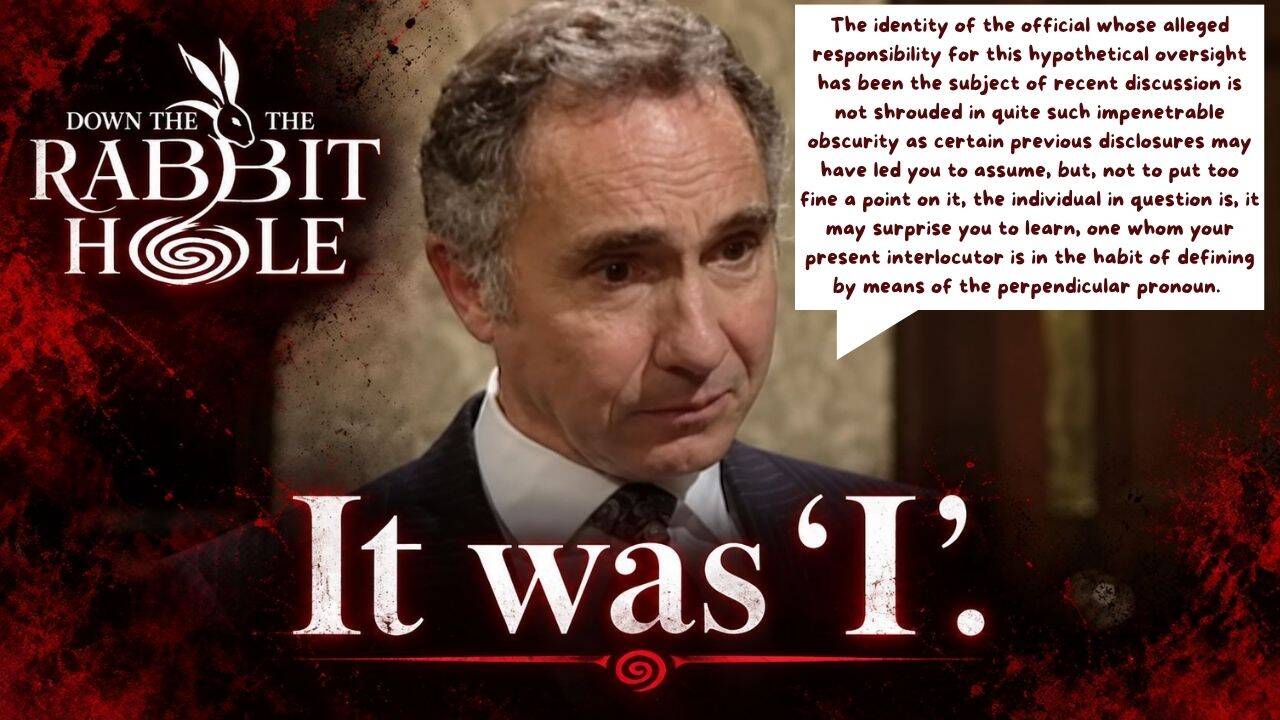
Sir Humphrey Appleby in Yes, Minister
And while that might seem like an amusing bureaucratic obscurity from an old BBC sitcom, reality has a way of becoming a Yes, Minister re-run. The recent talk of Scotland, Northern Ireland and Wales potentially ‘leaving’ the United Kingdom — coupled with the new Greenland deal between Denmark and the United States — makes the episode look almost accidentally prophetic.But to understand why all of this matters without reading a thousand think-tank pieces in gobbledygook, one needs to understand a few things, starting with a rather innocuous-sounding acronym: GIUK.Mind the GIUK gapThe acronym stands for the Greenland-Iceland-United Kingdom Gap, which might sound like an obscure inter-departmental committee but refers to particular geography. As this map below shows, it refers to the empty spaces between Greenland, Iceland and the United Kingdom. Now, Moscow’s Northern Fleet is concentrated on Russia’s Kola Peninsula, ergo any Russian submarine coming out of the Arctic and Norwegian seas would have to negotiate a series of passages formed by Greenland, Iceland and the UK before it can operate in the wider North Atlantic.
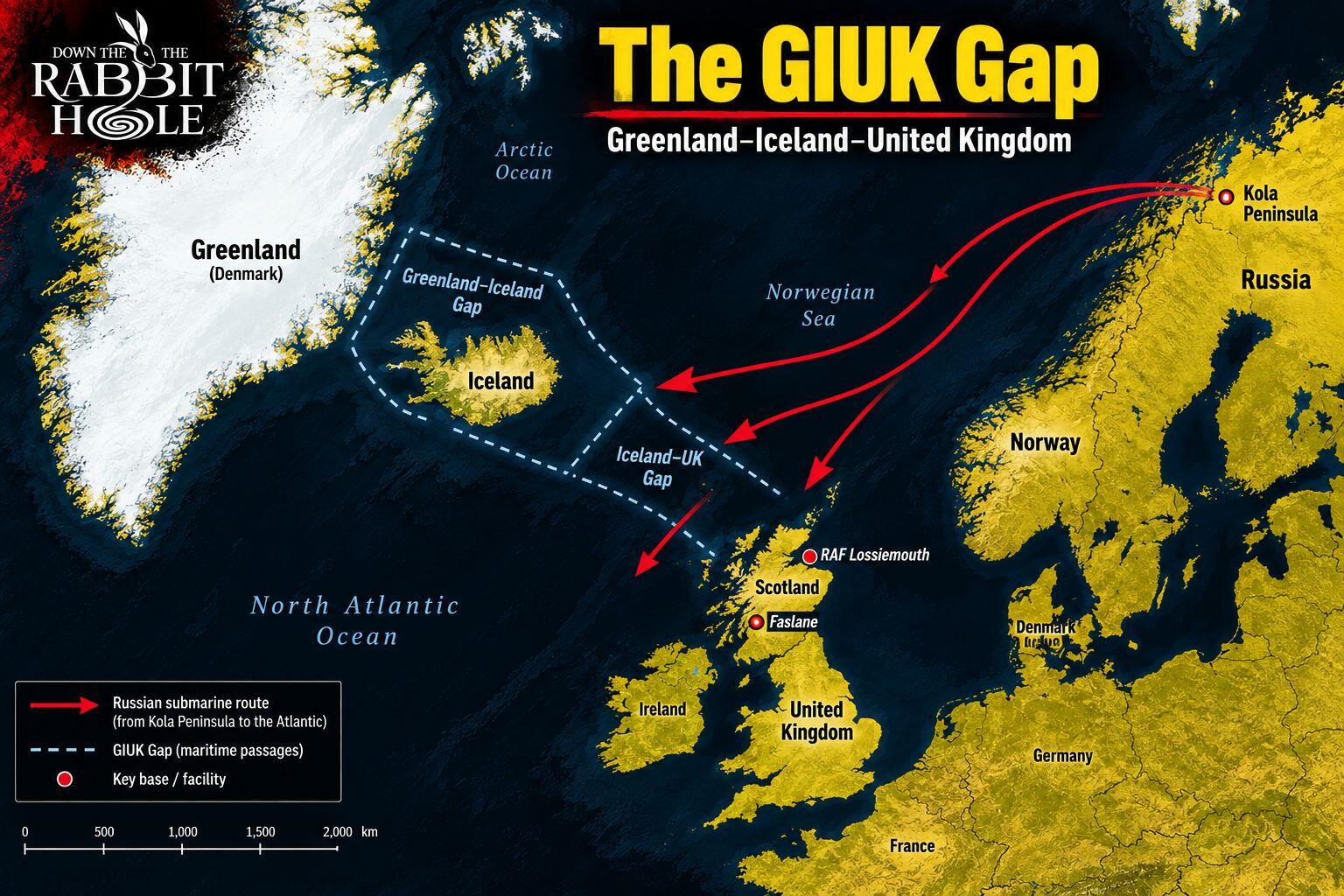
The GIUK Gap: the maritime passages between Greenland, Iceland and the United Kingdom that connect Russia’s northern approaches to the wider North Atlanti
Ergo, the GIUK gap is a gateway that Nato has spent decades watching. During the Cold War, detecting Soviet submarines was one of the West’s favourite maritime obsessions, and while the Soviet Union eventually disappeared, that obsession and Russia’s submarines didn’t.At the end of the day, Nato is fundamentally a transatlantic alliance.In the event of a hypothetical war in Europe, the US would have to move men, ammunition and other bits and pieces of its great military complex to reinforce the continent. Ergo, any opponent of America or Europe would do well to make those sea lanes as hazardous as possible, while Nato wouldn’t want any Russian subs lurking around and making a dash into the Atlantic.The British also control the port of Gibraltar that leads to the Mediterranean, creating a scenario where only the navies of Spain, France and Portugal from continental Europe possess direct access to the Atlantic Ocean that cannot be blocked by the UK’s navy. All this makes the GIUK gap, free access to the North Atlantic and Scotland’s geography essential to any Nato defence plans.
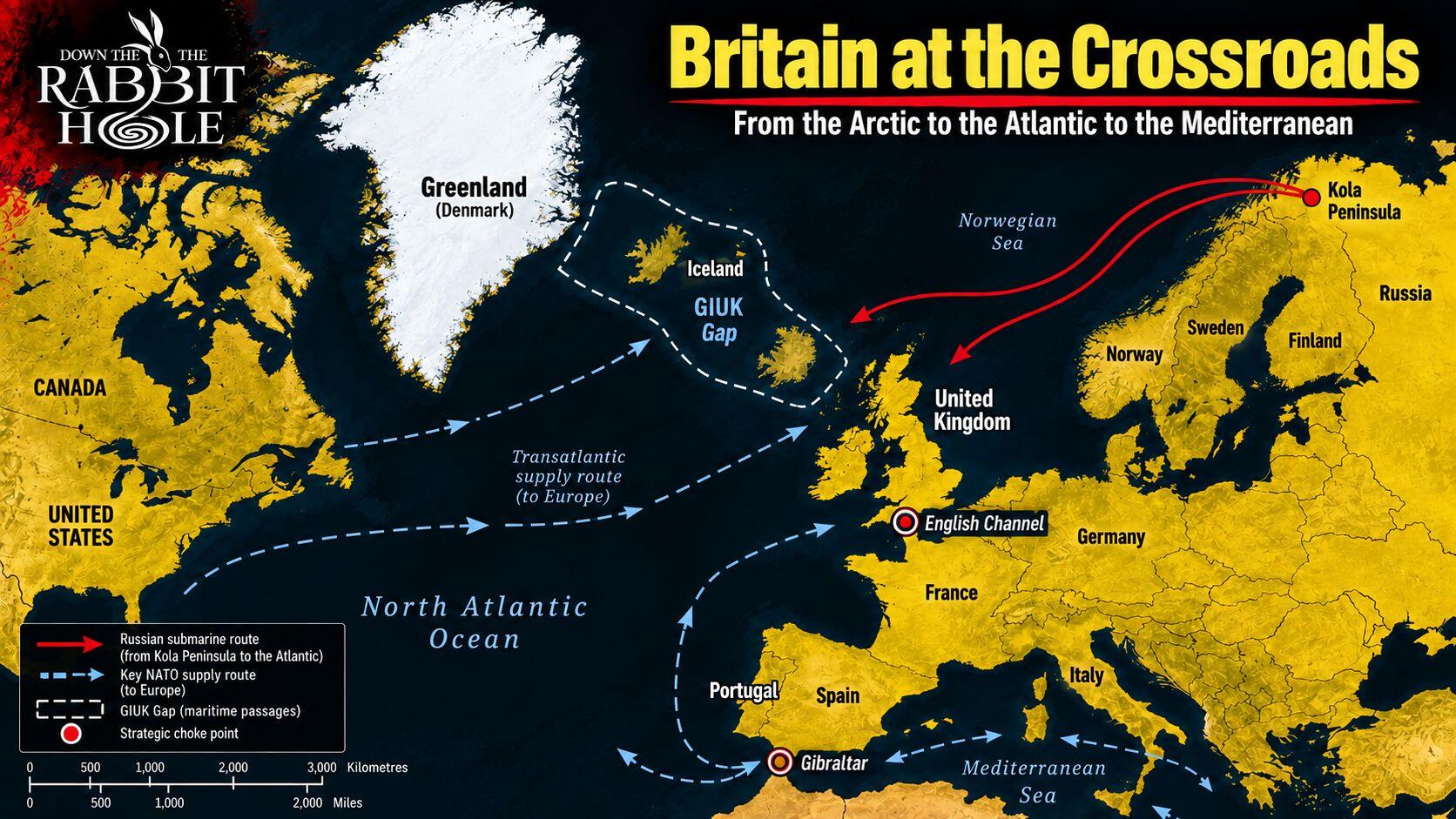
From the GIUK Gap to Gibraltar, Britain’s geography gives it an unusually important position along NATO’s Atlantic and European sea routes.
From Russia-China with loveNow come the antagonists: a rejuvenated Russia under Putin, certainly more so than at any point since the fall of the USSR, and a boisterous China.Russia is already a great Arctic power with a powerful military. The Kola Peninsula is the heart of Russia’s Northern Fleet, which protects Moscow’s strategic nuclear forces. It’s also the base from where Russian submarines can approach the GIUK gap and, in case of any conflict involving Europe, would be a hotbed of activity.Nato argues that Moscow has increased military activity in that region and that the Arctic Sentry multi-domain military activity is in response to that growing presence.Ergo, Russia’s problem is navigating the gap to reach the North Atlantic, while Nato’s is to detect and contain it.Now, Beijing isn’t in the same boat, literally or proverbially.While China might call itself a “near-Arctic state”, Beijing’s influence is more monetary than military, and it’s an important region for shipping, minerals and infra.In 2018, Beijing talked of a Polar Silk Road, encouraging Chinese companies to invest in infrastructure for Arctic shipping routes. Greenland, too, is very rich in minerals, while Beijing — much to the chagrin of America and Europe — is remarkably adept at rare-earth refining.In 2024, US and Danish officials had to pressure the developer of Greenland’s huge Tanbreez rare-earth project not to sell to China-linked buyers.Both China and Russia present different problems for the US and Europe in the area: Moscow wants to break out in case of a war, while China wants to get in to make more moolah, have more influence and ensure that, in case of a war, it doesn’t get locked out. And Greenland is essential to all the would-be belligerents.The Greenland situationGreenland was a Danish colony from 1721 to 1953 before being incorporated into the Kingdom of Denmark. Over time, Greenlanders wanted more independence, so Home Rule arrived in 1979, giving Nuuk a lot more say, which increased with 2009’s Greenland Self-Government Act.And now the Uncle Sam bit. When Nazi Germany occupied Denmark in 1940, a year later, the USA reached an agreement with the Danish ambassador to allow Washington to use Greenland as a military base while formally recognising Danish sovereignty.
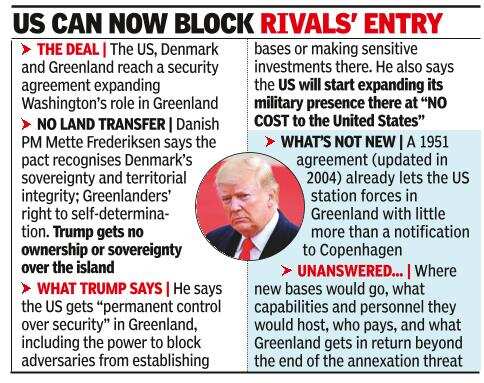
Long before Trump arrived on the scene, the US even considered the most Trumpian of solutions: buying it in 1946–47 before settling for using it as a long-term military base. The Americans ultimately settled for something more practical than buying Greenland: making sure they could use it.The 1951 US-Denmark Defence Agreement gave Washington long-term military access, while today Pituffik Space Base, formerly Thule Air Base, remains a crucial American missile-warning and space-surveillance outpost in the Arctic.The 2026 agreement reportedly gives the US permanent access, basing and overflight rights, prevents non-Nato countries from establishing military bases and restricts sensitive investments from potential adversaries. Most importantly, it is designed to remain in force even if Greenland eventually becomes independent from Denmark.The full treaty obviously isn’t public, but that’s the gist: Washington wants its military position insulated irrespective of whether Greenland is independent or remains with Denmark.And that brings us to the Scottish side of the problem.The Divided Kingdom problemNow we come to the other part of the GIUK gap and why some brows are furrowed. Scotland isn’t Greenland, and the UK in particular is not a single indivisible block, but the emergence of political parties that want to consider independence from the UK, like Sinn Féin in Northern Ireland, the Scottish National Party in Scotland and Plaid Cymru in Wales, does cause a little consternation. Even Trump stoked the fire, saying he would “love” to see a united Ireland, later reiterating that he would like it to happen sooner rather than later, while declining to discuss Scottish independence “yet”.This doesn’t mean the UK just becomes England next Tuesday, but it does create a slight problem because Scotland is crucial to the British realm’s defence and any talk of Scottish freedom makes Westminster queasy.RAF Lossiemouth in north-east Scotland hosts Britain’s P-8 Poseidon maritime patrol aircraft, which are specialised planes that hunt and track submarines. Faslane, on the Clyde near Glasgow, is also the main base for the Royal Navy’s submarine fleet.
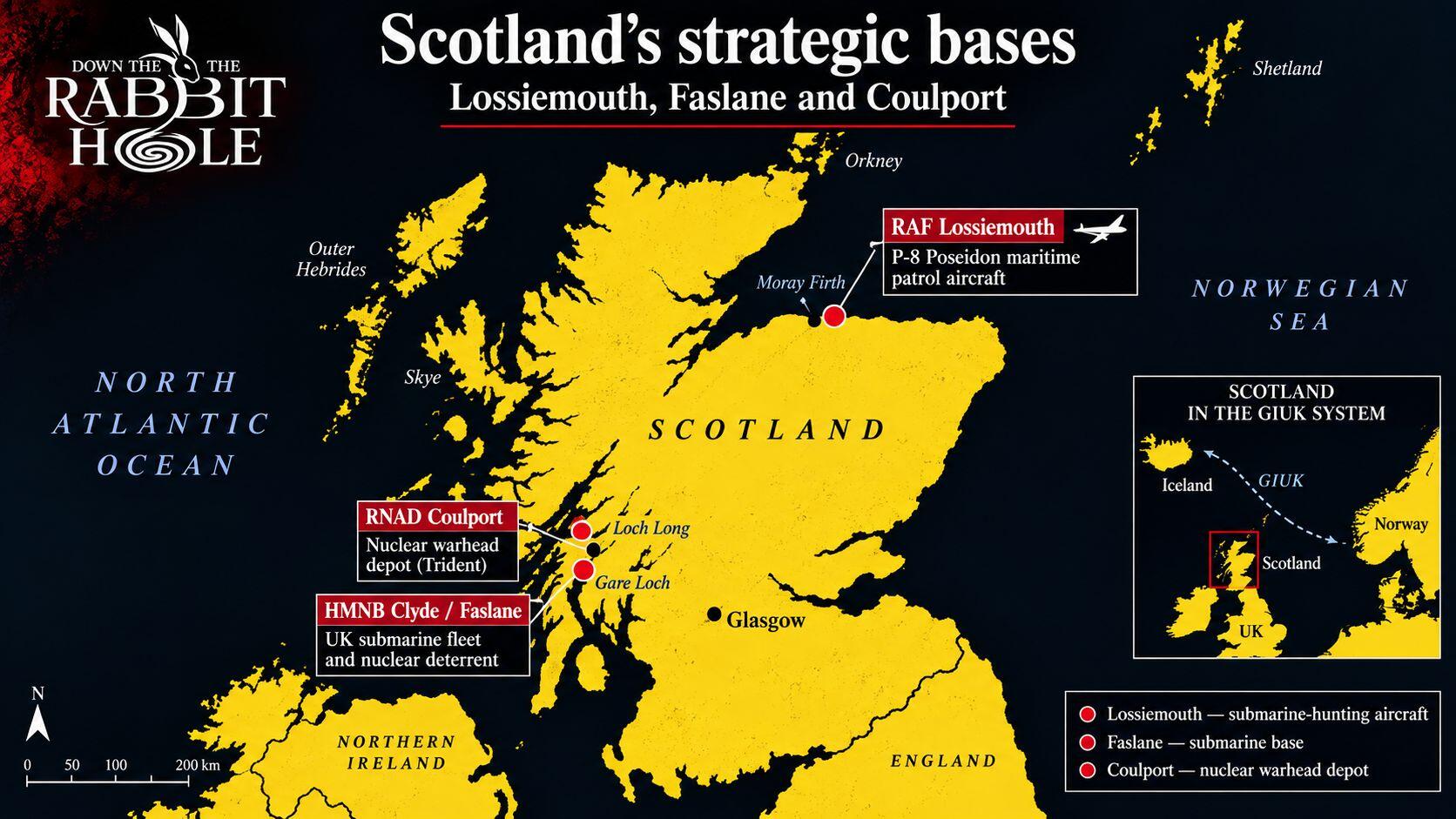
: Why Scotland matters: Lossiemouth helps monitor submarines in the North Atlantic, while Faslane and Coulport sit at the heart of Britain’s submarine and nuclear-deterrent infrastructure.
Together, Lossiemouth and Faslane are the core of Britain’s current ability to police its end of the GIUK gap. A House of Commons report stated that Britain’s ability to project military assets into the North Atlantic and High North is based primarily on those two assets, making them essential to both Britain and Nato.In a hypothetical scenario, take Scotland out of the defence map and both start to look vulnerable.And then there is Trident, a name anyone who has seen Yes, Prime Minister will be familiar with — something that (now) PM Jim Hacker didn’t cancel so he could get a cook at 10 Downing Street.Now, Faslane is also home to Britain’s Vanguard-class ballistic-missile submarines that carry the Trident II D5 missiles armed with British nuclear warheads.Ergo, Trident is the UK’s sea-based nuclear deterrent: since 1969, Britain has had a policy of keeping at least one nuclear-armed ballistic-missile submarine at sea at all times, giving it the option to retaliate in case the UK is attacked. Nearby Coulport hosts the nuclear warheads that are loaded into the Trident missile system, and together Faslane and Coulport underpin Britain’s at-sea nuclear deterrent.All that could be lost at sea, proverbially at least, in the space of some hypothetical Scottish bid for independence. The Scottish Government says an independent Scotland would seek Nato membership and maintain strong relations with the rest of the UK, but it also wants to remove nuclear weapons from Scottish soil as quickly and safely as possible.Now, hypothetically, that means Scotland can remain pro-Nato, pro-American and pro-West, and Edinburgh could still allow allied aircraft, ships and submarines to use Scottish facilities and continue helping Nato monitor the North Atlantic, but with one caveat: on its own terms.London could no longer automatically exercise sovereign control over the territory that contains its most important military infrastructure. That doesn’t mean the Royal Navy gets an eviction notice overnight, but there would suddenly be lots of things to discuss between London, Edinburgh and Nato. Scotland’s own proposals envisage Faslane as a conventional naval base but explicitly exclude nuclear weapons.In the past, Moscow has tried to influence the region, with credible open-source commentary suggesting Russia undertook campaigns during the 2014 independence referendum. In simpler terms, Moscow might not be making Mel Gibson shout freedom, but will certainly enjoy anything that complicates Britain’s nuclear arrangements or roils Nato’s current access at one end of the GIUK gap.In a situation like this, the Greenland pact is crucial: the more uncertainty Nato faces at the British end of the GIUK gap, the more certainty America would want in Greenland. No Western force wants two strategically important pieces of geography to become politically complicated.And that brings us to the most important question: is it entirely coincidental that Washington moved with such alacrity to sign a deal with Denmark and Greenland to future-proof its military position in Greenland when another part of the GIUK gap looks more vulnerable than ever?No causality can be drawn, and, as history shows from Afghanistan to Vietnam to Korea, strategic geography lasts much longer than political arrangements.The irony here — and Trump has truly dismantled the post-WWII world order — is that while America is trying to make US access in Greenland survive constitutional change, its President is cheerfully prodding the constitutional integrity of another Nato ally by openly supporting Irish reunification and not closing the door when asked about Scotland. None of that means America wants revenge on its former colonial overlord, but it does make for an odd juxtaposition: Washington is planning for borders to matter less militarily while its President keeps reminding everybody how politically movable they can be.The Sir Humphrey problemThere’s also the small bureaucratic oversight that started this entire piece. In Yes, Minister, the junior bureaucrat fails to realise that the base will be governed by Scottish law, not English law.In real life, we have the 1978 Vienna Convention on state succession, which protects territorial treaty obligations after a change of sovereignty but specifically excludes agreements relating to foreign military bases. Neither Denmark nor the US is a party to that Convention, but the underlying principle remains that a commitment by a sovereign state isn’t like Salman Khan’s: it can change.

Unlike certain cinematic commitments, agreements between sovereign states are not necessarily permanent
Perhaps the Greenland pact is simply an attempt to ensure the least disruption. At the moment, policing this end of the GIUK gap lies more heavily with Britain — Faslane and Coulport underpin Britain’s nuclear deterrent — and any constitutional rupture would create two specific problems: continuity of Nato operations and Britain’s nuclear posture.Since the Cold War, Nato has slept peacefully knowing that Denmark included Greenland and Britain had Scotland. But recent developments raise a question: what if that reality changed tomorrow?And that perhaps explains why Washington is so keen to ensure that Greenland is wired in properly, because it cannot guarantee Europe’s political borders but can try to ensure that constitutional uncertainty doesn’t become a strategic opening for Russia or China.
Borders, governments and constitutional arrangements can change. Strategic geography usually does not.
Perhaps that is the real lesson of the Greenland pact. Those who fail to learn from history are condemned to repeat it. Humphrey’s mistake was forgetting that distinction until the lease ran out. Washington appears determined not to make the same mistake. After all, as Littlefinger pointed out: chaos is a ladder, and Washington is hellbent on ensuring Russia or China doesn’t get a foot on that ladder.