
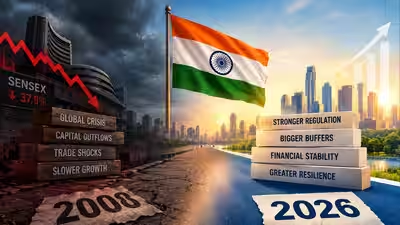

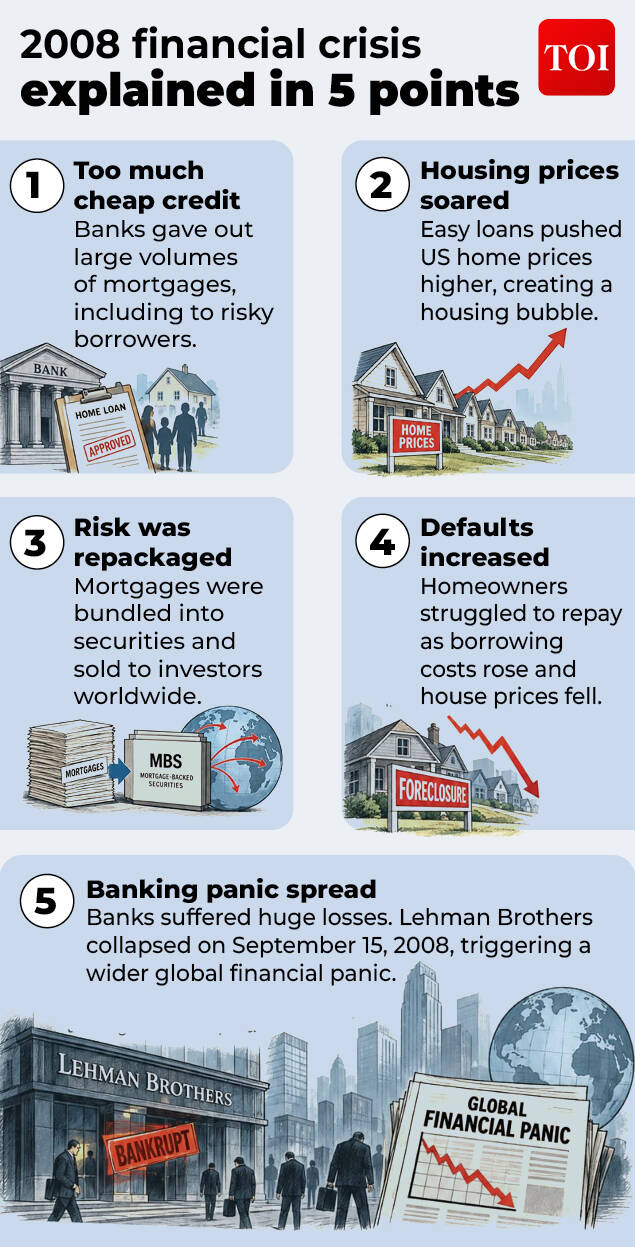
September 19, 2008: A world wrapped in uncertaintyThe global financial crisis erupted from the US housing market, where easy credit, rising home prices and risky mortgages had fuelled a massive boom. As borrowers defaulted and mortgage-linked assets collapsed, losses spread across banks and financial institutions.Lehman Brothers’ collapse on September 15 intensified the panic, sending markets tumbling and turning a US housing crisis into a global financial shock.
How the crisis emerged
India was hit too. The Sensex crashed, foreign capital fled, overseas financing tightened and economic growth slowed. But the country’s banking system largely held its ground.Nearly 18 years later, the question is not just how India survived 2008. It is what the crisis changed about the country’s approach to financial stability, regulation and institutional failure, and whether those lessons remain relevant as another investment boom, this time around artificial intelligence, gathers pace.
How much shock did India take?
India’s exposure to the global crisis came through capital flows, trade, external financing and market sentiment. The Sensex fell 37.9 per cent in 2008, while real GDP growth slowed to 6.7 per cent in 2008-09 from an average 8.8 per cent during 2003-08.Yet India did not experience the banking-sector collapse seen in several Western economies. Indian banks had limited exposure to the complex mortgage-linked assets at the centre of the crisis, while capital-account restrictions and prudential safeguards helped contain contagion.Vivek Iyer, Partner and Financial Services Risk Advisory Leader at Grant Thornton Bharat, said India’s cautious financial integration was an important factor. “When the global financial crisis hit the world, India was ring fenced from it substantially because of the simple fact that rupee was a partially convertible currency. That limited the exposure that the Indian financial system had with the global economy,” Iyer said.The RBI also moved quickly. Between October 2008 and April 2009, it cut the repo rate from 9 per cent to 4.75 per cent and the cash reserve ratio from 9 per cent to 5 per cent. The central bank also deployed refinance facilities and open-market operations. Its measures released potential primary liquidity of around Rs 5.85 lakh crore between mid-September 2008 and October 2009.The government responded with fiscal measures including tax relief and higher public expenditure.“The crisis actually validated India’s cautious approach to global integration given the contagion risks that the country was always wary of. While the world went in a frenzy building buffers for financial stability risks and fixing their plumbing, India adopted some of the best practices that suited it’s economy and continued to focus on financial stability,” Iyer added.Meanwhile, BFSI leader Abhay Johorey, managing director at business consulting Protiviti India, a business consulting and advisory firm, said India avoided a “structural economic meltdown” because of these buffers, including limited exposure to US subprime assets, cautious external borrowing rules and resilient remittances. Once the crisis deepened, policymakers responded with rate and CRR cuts, forex intervention and fiscal stimulus, he said.
India was better placed than many others
Thus, India had taken the shock. It had not allowed that shock to become a domestic banking crisis.
‘Too big to fail’ lesson
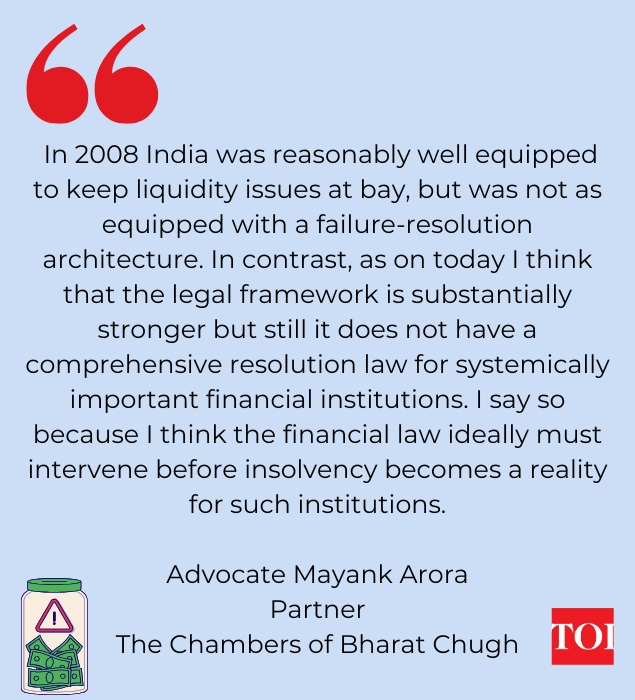
The crisis also brought the “too big to fail” problem into sharp focus. The concept predated 2008, but Lehman Brothers showed the consequences of a large, interconnected financial institution collapsing, while the rescue of other institutions raised concerns about moral hazard and the implicit safety net extended to systemically important firms.India did not have to deal with a Lehman-like failure in 2008. But from a legal perspective, the crisis exposed a different vulnerability: the country had tools to contain stress in banks, but no comprehensive framework to resolve a large financial institution if it actually failed.The Banking Regulation Act gave the RBI and the government powers relating to bank moratoriums, reconstruction and amalgamation. However, India had no Insolvency and Bankruptcy Code or time-bound corporate resolution mechanism, and no comprehensive resolution framework covering the financial sector.That architecture has changed substantially since then. The IBC, enacted in 2016, introduced a time-bound corporate insolvency process, while a 2019 framework brought notified categories of financial service providers under modified IBC procedures. The RBI’s Domestic Systemically Important Banks framework, introduced in 2014, also formally recognised that the failure of certain banks could have consequences far beyond their shareholders and depositors. SBI, HDFC Bank and ICICI Bank are currently classified as D-SIBs and face additional capital requirements because of their systemic importance.Deposit insurance has also been strengthened, with eligible deposits now covered up to Rs 5 lakh.However, advocate Mayank Arora, partner at The Chambers of Bharat Chugh, explained that a gap remains between the stronger legal framework India has built since 2008 and its ability to comprehensively resolve a systemically important financial institution if it fails.“In 2008 India was reasonably well equipped to keep liquidity issues at bay, but was not as equipped with a failure-resolution architecture,” he said, adding, “Today, the legal framework is substantially stronger, but still it does not have a comprehensive resolution law for systemically important financial institutions.”
How much was India prepared then
That distinction is crucial to the post-2008 meaning of “too big to fail”. The question is no longer only whether a large institution can be rescued. It is whether the legal and regulatory system can identify trouble early and intervene before its failure becomes a threat to the wider financial system.
Regulation changed after 2008
The crisis also altered the regulatory mindset.The RBI’s securitisation framework is one example. Rules governing the securitisation and sale of assets sought to build risk compartmentalisation and disclosure into the market, drawing on lessons from the US mortgage-backed securities collapse.A similar approach emerged with digital lending as the sector expanded rapidly. The RBI introduced rules around responsible lending, customer protection and the operations of digital lending platforms rather than waiting for the sector to develop into a larger systemic problem.Sebi has taken comparable steps in newer investment structures, including Alternative Investment Funds, REITs and InvITs, with disclosure, investor-protection and governance requirements built into their frameworks.Ashish Thekkekara, co-founder and managing director at Capital Stack, said the shift has been from monitoring risks as they emerge to asking what could go wrong before a new market becomes large enough to create systemic damage.“The real change is institutional mindset. Regulators now ask, ‘what could go wrong as this scales?’ before it becomes systemic. They are mapping credit exposure, monitoring cross-sector dependencies, and updating frameworks as new risks emerge. That proactive posture—staying ahead of emerging complexity—that is what separates India’s financial system today from pre-2008 dynamics. We have built institutional muscle memory around this. That positions us to scale new markets safely rather than manage crises after they hit,” he added.As Gautam Bhasin, founder & CEO, Prospurts Wealth and former HDFC Bank executive, said the bigger lesson from 2008 was the need to build buffers before a crisis and recognise losses once it passes.

The lesson
India rebuilt its buffers
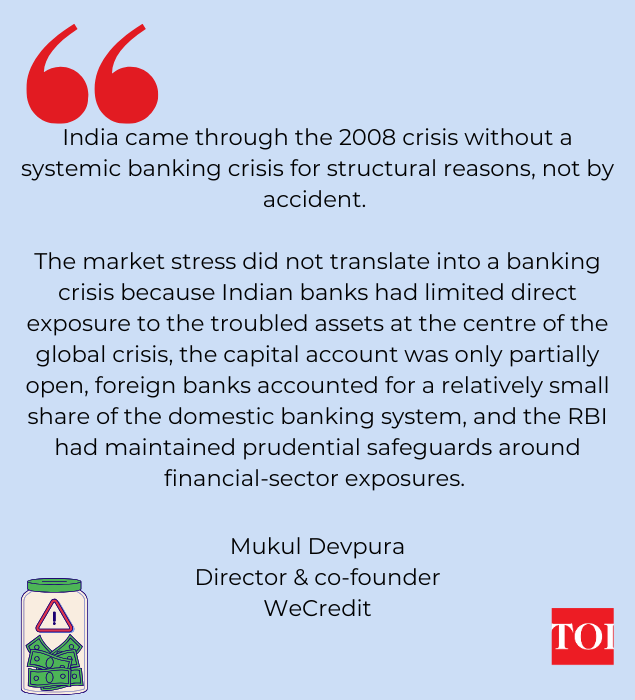
The immediate crisis was followed by a strong recovery. GDP growth rose to 8.6 per cent in 2009-10 and 8.9 per cent in 2010-11 under the national accounts estimates then in use.Mukul Devpura, director and co-founder of WeCredit, says India’s resilience was rooted in structural factors, including limited exposure to troubled US assets, a partially open capital account and prudential safeguards.
How India came through
The lesson, he argues, was not to retreat from global finance but to maintain buffers while opening progressively.India’s foreign-exchange reserves illustrate the scale of that buffer today. Reserves stood at about $300 billion around the 2008 crisis and reached a record $785.7 billion in the week ended September 4, 2026, according to RBI data.The RBI has also demonstrated a willingness to act when domestic risks rise. As unsecured consumer credit expanded rapidly, it raised risk weights on certain personal loans and credit-card exposures and strengthened supervisory requirements.The broader lesson from 2008, Devpura said, is to identify concentrations of risk early and intervene before market stress becomes financial-system stress.
September 19, 2026: An economy still strong
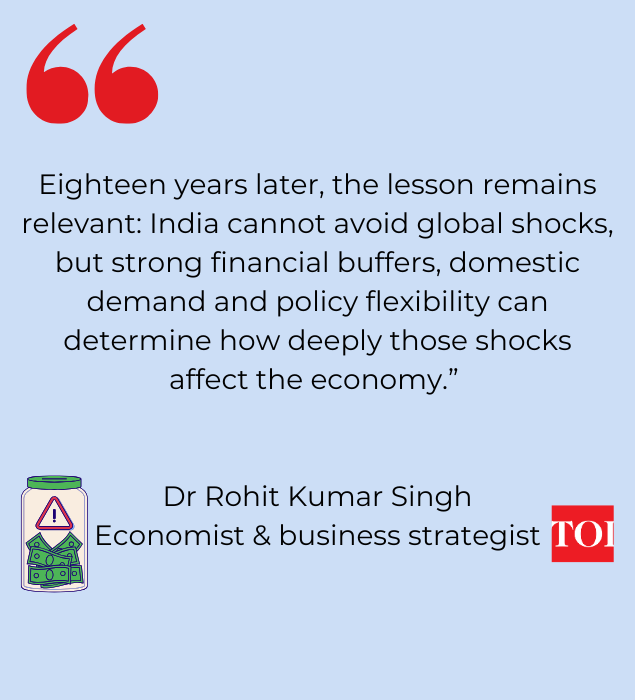
The India of 2026 is far removed from the economy that confronted the global crisis.Real GDP grew 7.8 per cent year-on-year in the April-June quarter of FY27, according to the latest government data. Financial markets are deeper, domestic capital pools are larger and Indian companies are more globally integrated.For economist and business strategist Dr Rohit Kumar Singh, the 2008 experience showed how much the outcome depends on policy flexibility.“India’s experience showed that the quality of the policy response can matter as much as the severity of the external shock,” Singh said.
The lesson
India’s growth still fell sharply during the crisis, from the 8.8 per cent average during 2003-08 to 6.7 per cent in 2008-09. But monetary and fiscal measures, domestic demand and external buffers helped prevent the global shock from turning into a prolonged financial-system crisis.The difference today is that India’s policy and financial buffers are substantially larger.That does not make the economy immune. Greater integration means global shocks can still arrive through capital flows, trade, currencies, commodities and confidence.But the country’s ability to absorb them has changed.And now we move to another investment boom.
AI boom: Another bubble?
Artificial intelligence is driving an investment cycle on a scale large enough to invite comparisons with previous bubbles.The technology is different from the housing market that triggered the 2008 crisis. AI promises genuine productivity gains, while spending is flowing into data centres, chips, computing capacity and infrastructure.Yet valuations have risen sharply, and the scale of investment has raised questions about whether expectations are moving faster than the underlying economics.The five largest global technology companies alone are expected to spend more than $1 trillion on AI-related capital expenditure across 2025 and 2026. Estimates cited by the Bank for International Settlements suggest global AI investment could rise from around $500 billion currently to $3-4 trillion by 2030.But a correction does not automatically mean another 2008.Paramdeep Singh, banking and financial services expert and founder of Long Tail Ventures, draws the distinction clearly. “Can there be an AI correction? Absolutely. Does that automatically become another 2008? I don’t think so,” he said.The key difference is leverage. In 2008, mortgage risk travelled through banks, securitisation and the wider financial system. When housing prices turned, an asset-price problem became a balance-sheet problem.AI investment, by contrast, has initially been driven largely by some of the world’s most profitable technology companies with strong balance sheets. That could change if the next phase of infrastructure investment increasingly relies on borrowing.“The number I would watch now is not the valuation multiple, but how much of the next leg of AI infrastructure gets financed with debt,” Singh added.That is where the 2008 lesson becomes relevant again. India did not need to own the toxic assets at the centre of the US crisis to feel the effects through markets, capital flows, trade and confidence. It may not need to be at the centre of an AI correction either.
The takeaway
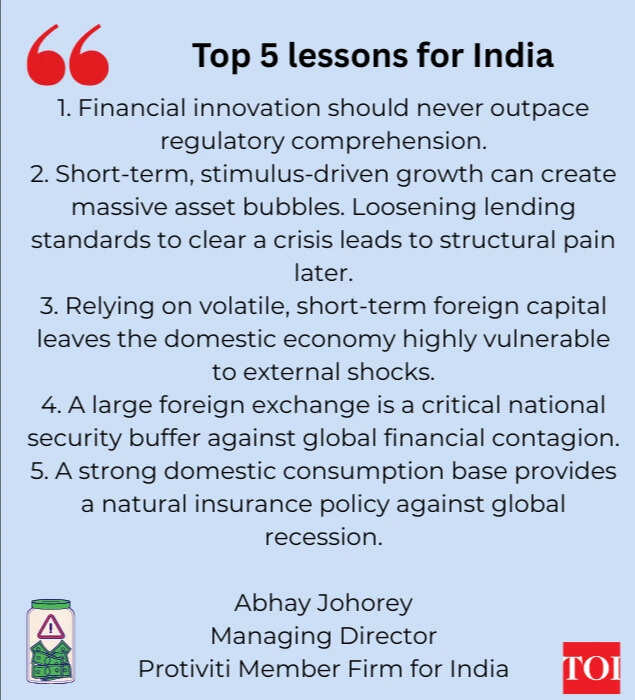
The biggest lesson from 2008 is not that India can avoid the next bubble, if there is one. It is that financial stability is built before a crisis arrives.The country entered 2008 with a relatively cautious financial system and limited exposure to the assets at the centre of the global crisis. Since then, it has added a stronger insolvency framework, formalised its treatment of systemically important banks, strengthened depositor protection, expanded external buffers and moved towards more proactive regulation.As Shristi Chaudhari, senior executive working in Regulatory intelligence and market research at Bureau Veritas, said the crisis offered India “three critical lessons” – strengthen domestic demand, create sustainable employment and build buffers against external shocks through adequate forex reserves, sound external borrowing and deeper domestic capital markets.The crisis also showed the dangers of excessive leverage, dependence on volatile short-term foreign capital and financial innovation moving faster than regulatory understanding.For businesses, the lesson is not to assume that capital will always remain cheap and available. For financial institutions, it is to monitor concentration, leverage, liquidity and interconnectedness, not just traditional credit risk. And for regulators, the challenge is to identify warning signs while they are still warning signs.India did not escape 2008. It absorbed the shock and rebuilt parts of its financial architecture in response. The economy is stronger today. The buffers are larger. The financial system is deeper.But the ultimate test of those lessons will come when the next shock arrives: whether one institution, one market or one investment boom can be prevented from becoming a crisis for the entire system.