
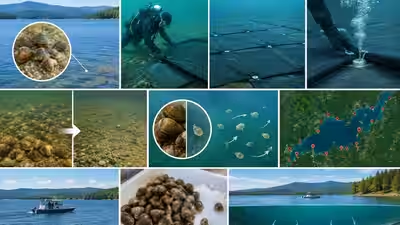
In 2011, New York covered five acres of Lake George with more than 700 mats to suffocate invasive Asian clams; 97% died, but the invader later spread to 27 locations

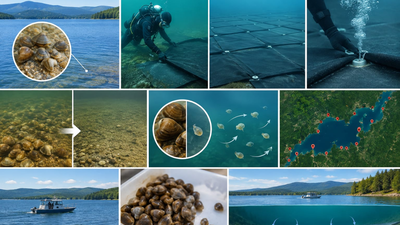
When invasive Asian clams were discovered in Lake George, New York, in 2010, researchers moved quickly to test whether covering the lakebed could stop the species from spreading. According to a final report by the Darrin Fresh Water Institute at Rensselaer Polytechnic Institute, published through the Lake Champlain Basin Program, a large-scale treatment was carried out in 2011 across five acres of infested lake bottom using benthic barrier mats. The treatment killed 97% of the Asian clams found in the treated area. But the result did not permanently eliminate the invasive species; subsequent surveys found Asian clams at 27 locations across Lake George, highlighting the difficulty of controlling an invasive species once it becomes established.
How the Asian clam arrived in Lake George
The Asian clam, scientifically known as Corbicula fluminea, was first discovered in Lake George in August 2010. Researchers initially documented densities of as many as 600 clams per square metre across an area of roughly 2.5 acres. The species is a small freshwater bivalve that can reproduce without a mate, allowing even a small number of individuals to establish a population.Asian clams prefer shallow, sandy or gravelly areas, which made parts of Lake George suitable for colonisation. The species can also occur in dense populations, raising concerns about its potential effects on water quality and native aquatic organisms. The discovery prompted the creation of the Lake George Asian Clam Rapid Response Task Force, bringing together organisations including the Lake George Association, Darrin Fresh Water Institute, Lake George Park Commission, New York State Department of Environmental Conservation and Lake Champlain Basin Program. The group began examining whether the newly detected population could still be controlled or eradicated.
The plan: cover the lakebed and cut off oxygen
One of the approaches tested was the use of benthic barriers. These are large mats placed directly over the lake bottom to isolate the clams from the surrounding water. The method was intended to reduce oxygen beneath the barriers and eventually suffocate the organisms. In 2011, the treatment expanded across five acres of the southern Lake George basin, between Pine Point and the English Brook Delta. More than 700 mats were placed over the affected lakebed. The mats were essentially heavy plastic barriers that had to remain in close contact with the bottom to prevent the clams from surviving underneath them.The treatment required considerable underwater maintenance. Waves and boat traffic shifted some of the mats, requiring divers to reposition and secure them. Lake Champlain Maritime Museum described how divers also had to “burp” the barriers by releasing gas that accumulated underneath them as organic material decomposed. Keeping the mats flat helped maintain the conditions needed for the treatment to work. Researchers also installed ports in more than 150 mats so divers could collect water samples from underneath the barriers. Those samples were analysed for dissolved oxygen and ammonia each week, allowing the treatment team to track changing conditions beneath the mats and use the results to guide maintenance.
97% of the clams were killed
The initial results appeared highly encouraging. After the spring 2011 treatment, mortality surveys found that 97% of the Asian clams in the treated area had died. The experiment demonstrated that benthic barriers could be highly effective at sharply reducing an established population when the affected area could be isolated and covered.But killing most of the clams in one area did not mean the species had been eliminated from Lake George. Later monitoring showed why. The Lake George Association’s surveys found that treated sites could become repopulated after initially successful treatments. According to the organisation’s lakewide survey reporting, microscopic and buoyant juvenile clams outside treated areas could move into previously cleared locations. Even sites where no clams were detected the year after treatment could contain small populations again the following year.
From one infestation to 27 locations
The problem gradually became much larger than the original infestation. A 2019 lakewide survey identified three additional Asian clam sites, bringing the total number of known locations to 27 across Lake George. Most were concentrated in the southern basin, particularly along the more developed western shoreline where sandy habitat is available. The spread demonstrated one of the central challenges of invasive-species control: a treatment can be extremely effective within a defined area while still failing to prevent recolonisation from populations elsewhere in the same waterbody.Lake George’s experience also showed why eradication becomes increasingly difficult and expensive as an invasive species expands. The lakewide survey reported that barrier treatments generally produced 96% to 100% mortality at treated sites, but populations often rebounded when even a small number of clams survived or when clams moved back into treated areas. By 2016, the task force halted barrier treatments after concluding that continued lakewide control was not a practical solution with the methods then available.
What the Lake George experiment revealed
The Asian clam response in Lake George became an example of both the potential and limitations of rapid invasive-species control. Covering five acres with more than 700 benthic mats produced a striking short-term result, killing 97% of the clams in the treated area. But the species’ ability to reproduce rapidly and recolonise treated sites meant that the treatment could not deliver permanent eradication across the lake.Today, Lake George continues to be monitored through lakewide surveys. The focus has shifted from attempting to eliminate every population with benthic barriers towards understanding the species, tracking its distribution and assessing its potential effects on the lake. The experience also underscores why early detection and preventing the movement of aquatic invasive species remain important parts of protecting freshwater ecosystems.