
Nasa Food Innovation: In 2026, NASA backed scientists make ‘microbites’ cookies from plastic bottles in vanilla flavour using baker’s yeast that could feed astronauts on Mars

Plastic waste keeps piling up in oceans, landfills, and cities, while millions of people around the world still don’t have enough to eat. It’s easy to think of these as two separate crises needing two separate solutions. But what if the same tiny organism could help tackle both at once?Even though this might sound nearly impossible, a group of researchers decided to step away from the ordinary. Instead of treating plastic as just trash, they started wondering if its basic building blocks could be built into something the human body could actually use, and surprisingly even eat.So, are you now wondering how one can eat plastic?Let’s dig in to find out what this is exactly about
NASA-backed project scientists produce food from plastic
Plastic bottles and cookies don’t usually belong in the same shelf, but a team of researchers has found an unexpected way to connect the two. By genetically engineering yeast, scientists have built a system that can convert compounds from plastic and farm waste into edible proteins, vitamins, and flavour compounds, mainly by turning trash into food ingredients.The project, led by Associate Professor Lahiru Jayakody at Southern Illinois University (SIU) Carbondale, came out of NASA’s Deep Space Food Challenge, a competition that was designed to find ways to feed astronauts on long missions where regular supply runs from Earth aren’t possible.According to the American Chemical Society (ACS), where the team presented its findings at its fall 2026 meeting, the researchers explained their thinking simply: “We were trying to develop technologies for plastic upcycling to make more valuable products. We thought, why not focus on making food? Because plastic is carbon and food is carbon.”
The main target is to make judicious use of plastic bottles
The main target is PET (polyethylene terephthalate), the plastic used in most soda and water bottles. Since PET is carbon-rich, its molecules can theoretically be broken down and rebuilt into other carbon-based compounds, including the building blocks of protein.Rather than depending completely on chemical processing, the team used microbes, which naturally handle complex chemical transformations. As Jayakody said, according to ACS, “Microbes are very clever. So, we are using their traits to solve the problems we created.”
Microbes turn plastic to edible vanilla-flavoured ‘microbites’
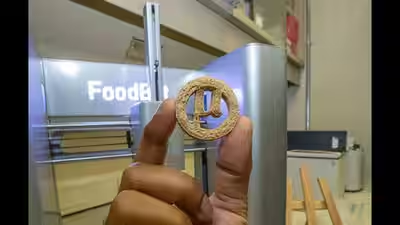
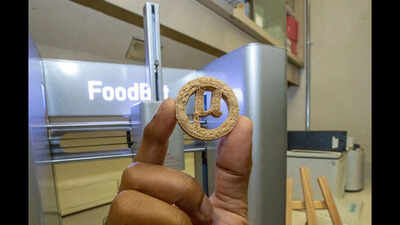
Before yeast can use the waste, though, it has to be broken down into simpler molecules. The researchers use a method called oxidative hydrothermal dissolution, developed by SIU geology professor Ken Anderson, which combines water, oxygen, high heat, and pressure to break apart tough materials like PET and leftover corn stalks.Once broken down, these molecules are fed to engineered yeast strains, including ordinary baker’s yeast, which convert them into proteins, fats, and other useful compounds. Graduate student Sandhya Jayasekara played a key role in this part of the work, even engineering yeast strains that produce vanilla flavouring and beta-carotene (a source of vitamin A) directly from waste-derived compounds.The final product, nicknamed µBites, or “microbites”, is made by mixing these yeast-derived ingredients with fiber, starch, and sweetener, then running the mixture through a 3D food printer to give it shape in the form of small cookies.
Safe to eat, but what about the taste?
According to ACS, early evaluations suggest µBites are safe to eat, though formal taste testing is still pending institutional approval. For now, people have judged the cookies mainly by smell, and most said they’d be willing to eat them in situations where food was scarce. The team is also working on making the cookies more appealing for everyday use, not just emergencies.Jayakody hopes µBites could be ready for real-world use within a few years, with possible applications ranging from submarines and disaster relief zones to future settlements on the Moon or Mars. Looking at the bigger picture, he added, according to ACS, “Global food demand is expected to rise 35–56% by the year 2050, and about 30% of the world population will be at risk of hunger in the future. The way to address that, I believe, is by using microbes.“