
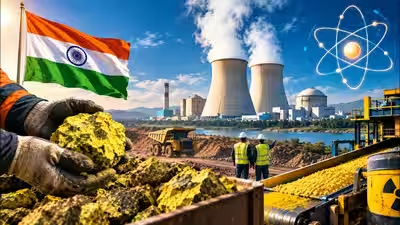
India Nuclear Ambitions: The Uranium rush: Inside India’s scramble to fuel its nuclear ambitions | India News

Last month, when Prime Minister Narendra Modi arrived in Tashkent, the headline takeaway was diplomatic. India and Uzbekistan agreed to elevate their ties to a Comprehensive Strategic Partnership and set a target of $5 billion in annual bilateral trade by 2030.But tucked into the joint statement was a line that could matter far more to India’s power planners than the trade target: the two countries agreed to work towards a long-term framework for uranium supplies.PM Modi had told delegates in Tashkent that India would “establish a long-term arrangement for the supply of uranium”, describing it as the next step in the two countries’ energy cooperation.It is easy to overlook why a single line on uranium in a joint statement matters. But it is perhaps the clearest sign yet of a scramble that has been building quietly across three continents, from Central Asia to Australia and North America, as India moves to secure the fuel needed for what could become one of the most ambitious nuclear expansion programmes of this century.
India’s nuclear math
Currently, the country operates 24 nuclear reactors with a combined capacity of about 8.78 gigawatts (GW).
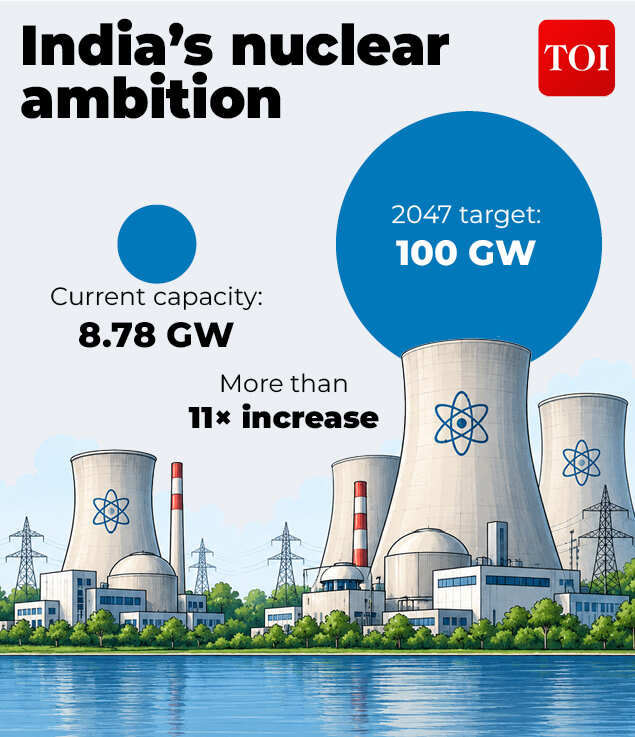
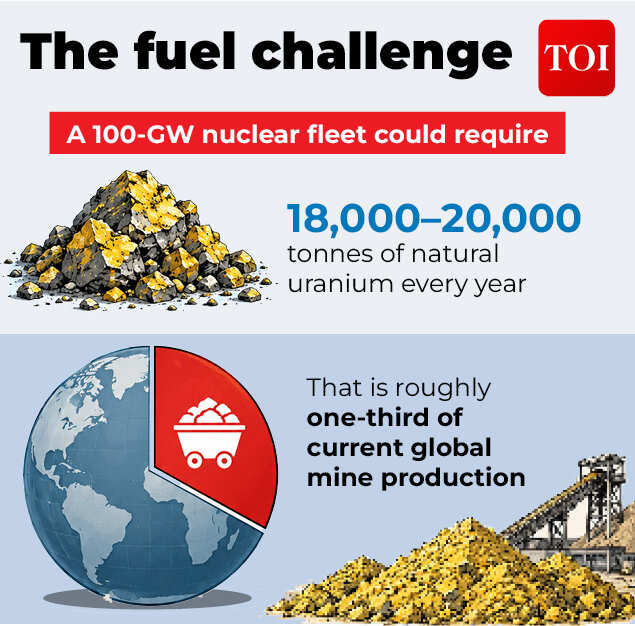
Centre’s Nuclear Energy Mission, announced in the Union Budget for 2025-26, sets a target of 100 GW by 2047, more than an eleven-fold jump, with an intermediate goal of roughly 22 GW by 2031-32.That target, however, comes with a fuel problem.Industry estimates suggest a 100-GW fleet would require somewhere in the range of 18,000 to 20,000 tonnes of natural uranium a year, roughly a third of current global mine production. India’s own uranium reserves, concentrated in Jharkhand, Andhra Pradesh and Meghalaya, are comparatively thin and have historically constrained, not enabled, the country’s civil nuclear programme.For decades, that shortfall was managed quietly through a handful of government-to-government contracts.
Now, with the expansion target locked in, it has become the organising logic behind a wave of overlapping diplomatic and commercial deals, of which the Uzbekistan framework is only the latest.
Central Asia
India’s relationship with Uzbekistan on uranium is not new. The two countries signed a contract back in January 2019 under which Uzbekistan’s state-owned Navoi Mining and Metallurgical Company agreed to supply 1,100 metric tonnes of natural uranium concentrate to India through 2026.Parliamentary records show India had received about 600 metric tonnes of that contracted volume as of March 2025, meaning the current arrangement was always going to need renewing, with expiry or no expiry.What changed in Tashkent was the structure.Rather than negotiate a one-off follow-on contract, the two sides are now working toward a long-term arrangement meant to outlast the transactional cycle of the 2019 deal.
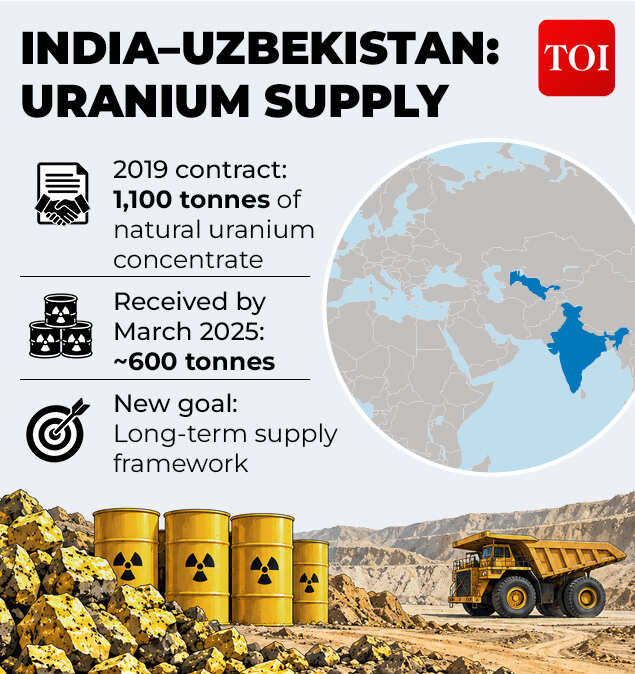
Siby George, secretary (west) in the ministry of external affairs, was quoted by news agency PTI as saying that “positive discussions have happened” on a long-term uranium supply arrangement, and that the two governments were “closing in” on signing it.No new uranium-specific pact was among the eleven agreements formally signed during the visit, the framework itself is still being finalised, but both governments used the summit to signal that Uzbekistan, one of the world’s largest uranium producers, will remain a fixture of India’s fuel-security plan rather than a legacy supplier being phased out.
Australia and Canada too on India’s nuclear framework
Earlier in July, India finalised the Administrative Arrangement with Australia under their 2014 Civil Nuclear Cooperation Agreement.The arrangement, sealed at the Third India-Australia Annual Summit in Melbourne, operationalises a pact that paves the way for long-term Australian uranium exports to India under IAEA safeguards.Australia holds more than a third of the world’s known uranium resources, by far the largest reserve base of any country, which makes the arrangement one of the more consequential fuel-security wins in India’s recent diplomatic calendar.On the other side of the globe, India signed its most commercially concrete uranium deal yet, a nine-year, roughly $2.6-billion agreement between Canada’s Saskatchewan-based Cameco Corporation and India’s Department of Atomic Energy, for the supply of close to 22 million pounds of uranium ore concentrate between 2027 and 2035.The deal, signed earlier in March, was struck during a visit by Canadian Prime Minister Mark Carney and both governments described it as a cornerstone of a new India-Canada strategic energy partnership.Separately, NTPC Ltd, India’s largest power producer, tasked with building roughly 30 GW of the country’s 100-GW nuclear target, has issued a tender to appoint consultants who will help identify uranium mining assets it could invest in overseas, in countries including Canada, Australia, Kazakhstan and South Africa.
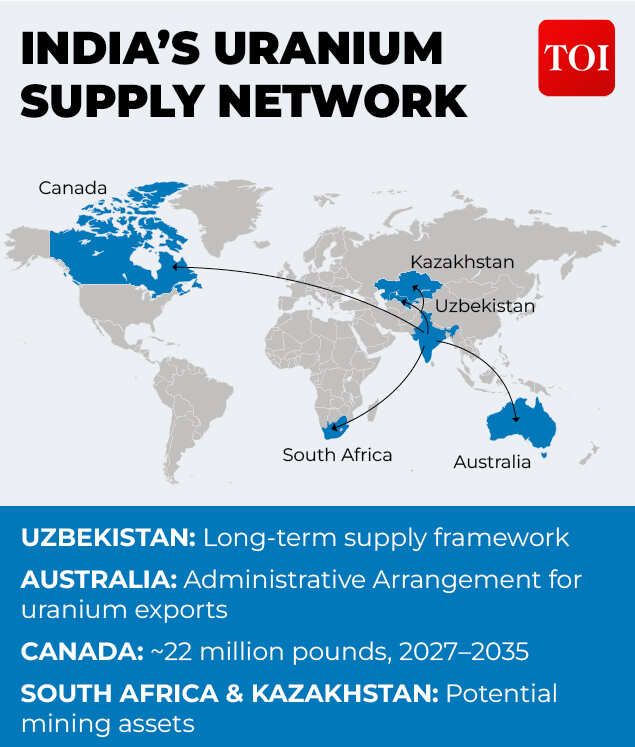
It is a telling move as state-run India is no longer content to simply buy uranium on long-term contracts. It wants equity exposure to the mines themselves.Together, the Uzbekistan, Australia and Canada threads are not three separate stories, but rather a larger picture of a nation that spent decades under-investing in fuel security and is now compensating for lost time on every continent that has the mineral.
Need for fuel
The external hunt for fuel has a mirror image at home: a domestic policy shift that is arguably even more consequential for India’s energy sector.In December 2025, Parliament passed the Sustainable Harnessing and Advancement of Nuclear Energy for Transforming India (SHANTI) Act, ending a six-decade-old state monopoly over civil nuclear power generation.Under the new law, private companies can, for the first time, build, own and operate nuclear power plants, while the government retains control over the most sensitive parts of the chain — uranium enrichment, heavy-water production, and long-term spent-fuel management.The response from India Inc. has been immediate. A tender floated by state-run Nuclear Power Corporation of India for co-developing 220 MWe “Bharat Small Reactors” has drawn interest from Reliance Industries, Adani Power, Tata Power, Hindalco Industries, Jindal Steel and Power, and JSW Energy, a roll call of India’s largest industrial conglomerates, each looking to secure captive, round-the-clock power for steel, cement and data-centre operations that a coal-fired grid increasingly cannot deliver cheaply or cleanly.Tata Power has gone furthest, publicly targeting 2032-33 for commissioning what would be India’s first privately built nuclear plant, with construction beginning as early as 2028 across sites being scouted in Madhya Pradesh, Odisha and Gujarat.The SHANTI Act creates the demand; Tashkent, Melbourne and Saskatchewan are where the supply is being lined up.
Thorium bet is the longer game
There is another reason India’s uranium scramble needs to be viewed as part of a much longer nuclear strategy.India has for decades pursued a three-stage nuclear programme designed ultimately to make greater use of its large thorium resources.The key transition is from today’s uranium-fuelled reactors to fast breeder reactors and, eventually, reactors using uranium-233 produced from thorium.The Department of Atomic Energy describes thorium-232 as the material that can be converted into fissile uranium-233 for the third stage of the programme.That strategy reached an important milestone this year when the 500 MWe Prototype Fast Breeder Reactor (PFBR) at Kalpakkam in Tamil Nadu attained first criticality.The DAE describes the PFBR as the flagship of the second stage of India’s three-stage nuclear programme and says thorium-232 can be converted into uranium-233 through transmutation, providing the fuel for the third stage.But the technology does not offer India an immediate escape from its uranium problem. The PFBR itself is part of a transition, while the large-scale nuclear expansion envisaged for 2047 still requires conventional reactors and therefore reliable access to uranium fuel.That explains the apparent contradiction at the heart of India’s nuclear strategy: the country is rushing across the world for uranium today even as it develops technologies intended to make its nuclear fuel cycle more self-reliant tomorrow.The distinction matters because thorium is not a shortcut to the 100-GW target as it is a longer-term bet on the architecture of India’s nuclear programme, while imported and domestically mined uranium will remain critical to the expansion now being planned.
Share your thoughts in the comments
Be respectful · TOI community guidelines
What’s next for India
None of the deals struck so far, not Uzbekistan, not Australia, not Canada, comes close to closing the fuel gap that 100 GW by 2047 implies on its own.Each is best understood as one card in a hand India is still assembling: diversify suppliers, avoid dependence on any single country or company, and buy time for domestic reforms, the SHANTI Act, the Bharat Small Reactor programme, and a longer-term bet on thorium, of which India holds one of the world’s largest reserves, to mature into an actual generation fleet.The Tashkent uranium framework, when it is finally signed, will not by itself power a single reactor.But it is a useful marker of how far India has travelled in eighteen months: from a country that mined and imported uranium exclusively through the state, to one running parallel negotiations with Central Asian suppliers, Australian miners and Canadian producers, while a queue of its largest private conglomerates waits for its first nuclear licence.The rush is real.Whether the fuel arrives fast enough to match India’s reactor-building ambitions is the question the next few Budget cycles will have to answer.