

Plugging gap: Why 67,000 EV charging points aren’t enough for India’s electric dreams | India News

When Siddharth Das, a Delhi-NCR based working professional and long-time motor enthusiast, traded in his petrol sedan for a brand-new electric SUV, he wasn’t just buying a new car. He was also trying to make his daily commute what he describes as “future-ready”.But switching to an electric vehicle brought a different kind of calculation.“My previous petrol car cost me 10 to 12 rupees a kilometre. With an EV, even if I use commercial chargers at 15 to 21 rupees per unit, my running cost is just 3 to 3.50 rupees a kilometre. If I could charge at domestic home rates of 8 rupees a unit, it would drop to 1 rupee per kilometre.”However, Das faces a problem even before he leaves his residential building.“I live in an apartment complex where parking is in the basement, and the society isn’t allowing home chargers due to safety protocol concerns,” he explains.His experience shows one of the bigger challenges in India’s shift to electric vehicles. The cars are improving quickly, but the charging system around them is still developing and can be difficult to access.
67,000 plugs down, 13 lakhs to go
According to a landmark study by Rubix Data Sciences released in September 2026, citing baseline projections from the Confederation of Indian Industry (CII), India will need 13.2 lakh EV charging points by 2030 to support the growing number of electric vehicles.But how far is India from that target?Data from the Ministry of Heavy Industries shows that, as of August 2026, India had 67,657 public charging points across the country including 1,139 battery-swapping station interfaces. This is in comparison to only 5,000 public chargers in early 2022 and 29,151 in December 2025.But even after this growth, the current network is only about 5 percent of the 13.2 lakh charging points expected to be needed by 2030.In simple terms, India still needs to add more than 1.25 million to reach the projected requirement. This gap matters because the number of EVs on the road is also increasing, meaning charging infrastructure has to grow fast enough to keep up with vehicle sales.There is also a major geographical imbalance. The Rubix analysis says the top 10 states, led by Karnataka, Maharashtra and Uttar Pradesh, account for 78 per cent of all public chargers in India.
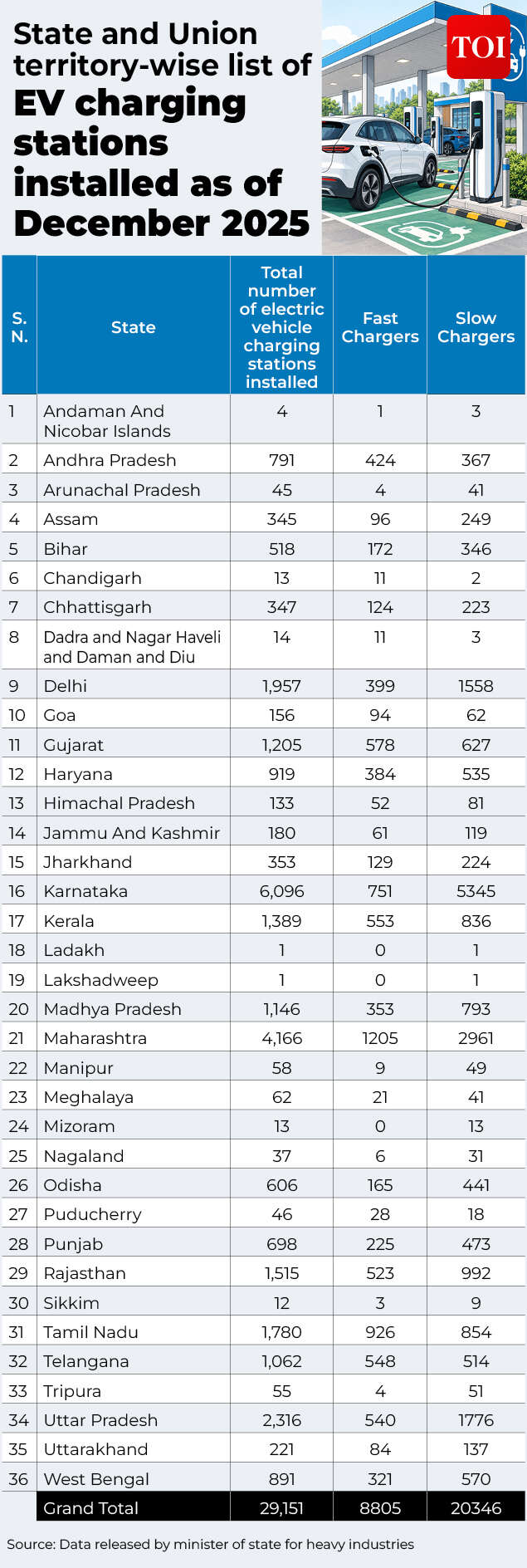
As of August 2026, India had 67,657 public charging points across the country including 1,139 battery-swapping station interfaces. This is in comparison to only 5,000 public chargers in early 2022 and 29,151 in December 2025.
That means nearly four out of every five public chargers are concentrated in just 10 states. For EV users in other parts of the country, especially smaller towns and less-developed regions, finding a public charger can therefore be much harder.
Power disconnect: Built for scooters, not long-haul trips
The problem is not only the number of chargers. It is also how much power those chargers can provide.Out of the 66,518 non-swapping fixed chargers installed across the country as of August 2026, most are on the slower side:
- 48,709 chargers, or about 73 percent, are rated below 30 kW.
- 15,753 chargers are in the 30–60 kW range.
- 1,513 chargers offer 61–120 kW fast charging.
- Only 534 chargers provide 121–240 kW, while just nine chargers offer more than 240 kW nationwide.
These figures are important because a charger’s power rating affects how quickly an EV can be charged. A large network may therefore look impressive on paper, but if most chargers are low-power units, drivers travelling long distances may still have to spend considerable time charging.The current charging mix also reflects the kinds of electric vehicles being sold in India. Federation of Automobile Dealers Associations (FADA) figures cited in the study show that the switch to electric vehicles is currently strongest among three-wheelers, where EVs have a 60.77 per cent market penetration, and two-wheelers, at 8.88 per cent.Electric four-wheeler passenger cars have a much lower penetration of 5.70 percent.This helps explain why India has a large number of lower-powered chargers.Low-power AC chargers can work well for e-rickshaws, electric two-wheelers and vehicles used mainly for short city trips. But the same infrastructure is less suitable for electric cars travelling long distances or for heavy commercial vehicles that need to cover hundreds of kilometres.
Divide in driver experience: Home charging vs range anxiety
For EV owners who have private parking and can install a home charger, everyday use can be relatively simple. Bishwajeet Kumar Seth, who bought his electric SUV in April 2026, relies entirely on home charging.“I have a 7.2 kW charger installed at home,” Seth says. “My car has a real-world range of around 550 km with the AC on. When I drove from Delhi to Mathura, I didn’t even need to plug in on the road. At home, it costs me 7 to 8 rupees a unit. At a highway fast charger, they were charging 19 rupees per unit. I thought, why bear double the cost when I don’t need to?”But the experience can be very different for people who do not own an EV or who rent one occasionally. For them, “range anxiety” remains a major concern.Mohammad Sarim, who rented an EV during a trip to Kerala, came away hesitant.“I had the car for 12 hours to cover 150 km, but the display showed a total range of 200 km,” he shares. “Being in the outskirts, I didn’t spot a single charger. The anxiety of the battery running down made it feel less convenient than a petrol car”Saad Abbasi, a commuter in the NCR region, also says the lack of infrastructure affects buying decisions. “Unless you live in Central or South Delhi, NCR has limited infrastructure. It’s fine for home-to-office daily commuting if you can charge at home, but the moment you travel away from major cities, it becomes an issue.”
Operator crisis: Empty stations in tier-2, tier-3 towns
While EV buyers worry about finding a charger, charging operators face almost the opposite problem: their chargers often do not get enough customers.Data from the Rubix Data Sciences report shows that public chargers across India currently have a utilisation rate of only 1 to 5 per cent.This means that, for much of the time, many public chargers are sitting unused. That creates a difficult business case, particularly for operators in smaller cities and towns. They have to spend a large amount of money upfront, but may not have enough vehicles using the chargers to recover that investment quickly.Amit Kumar Sahu, a fuel station owner who operates a public EV charging setup in Giridih, Jharkhand, explains the financial challenge faced by local businesses.“In private dealer-owned fuel stations, the entire investment falls on the dealer,” Sahu says. “Setting up a 60 kW DC charger costs around 8.5 to 9 lakh rupees for the machine alone. On top of that, buying a dedicated 63 kVA transformer takes another 5.5 to 6 lakh rupees in deposits and grid connection expenses. You end up spending 15 to 16 lakh rupees.”“In small towns like Giridih, if only 2 to 4 vehicles show up a day, you can’t recover your costs,” Sahu adds. “That is why private pump dealers in Jharkhand and Bihar avoid installing them. The vehicles aren’t there yet, and without footfall, nobody wants to lock in Rs 15 lakhs.”This creates a cycle that is difficult to break. EV owners need chargers before they feel confident buying electric cars, but operators are reluctant to invest in chargers until there are enough EVs using them.To deal with low utilisation, operators are now looking at other business models.According to the Rubix report, charge point operators (CPOs) are moving towards fleet leasing contracts, revenue-sharing arrangements with site owners and open-roaming networks. These models can help operators get more regular usage and reduce the risk of investing in chargers that remain empty.
Technical frameworks & heavy freight road ahead
India is also trying to reduce fragmentation in its charging system. Standard-setting bodies such as the Bureau of Indian Standards (BIS) and the Department of Science & Technology (DST) are working on charging standards and technologies that can make charging more uniform and suitable for different types of EVs.
- LECCS (light electric vehicle combined charging system): Under standards such as IS 17017 Part-2 Sec-7 and IS 17017 Part-31, LECCS combines AC charging of up to 7 kW and low-voltage DC charging of up to 12 kW into one standard plug for two and three-wheelers. The aim is to make charging more consistent instead of having different systems for different vehicles.
- Universal Sockets: These are intended for destination charging at places such as urban parking complexes. They can support charging from 2 kW to 22 kW using a standard Type-2 socket with detachable smart cables. This can reduce dependence on different proprietary charging systems.
The bigger challenge will come with heavy commercial vehicles and long-distance transport. Chargers below 60 kW are generally not enough for trucks and other heavy vehicles that need to recharge quickly and get back on the road.DST frameworks therefore include much higher-powered charging systems. These include Split-Type DC chargers, which can dynamically distribute 40 kW to 240+ kW across several charging posts; Dual-Gun 500 kW systems; Overhead Pantographs offering up to 600 kW; and Megawatt Charging Systems (MCS), which can provide up to 3.75 MW of peak power for heavy logistics fleets.The difference in power is significant.A system designed for a scooter or a car used for city commuting cannot simply be used as the main charging solution for a fully loaded electric truck travelling long distances. As India’s electric vehicle market moves towards larger commercial vehicles, the charging network will therefore need to become not only bigger, but much more powerful.
Share your thoughts in the comments
Be respectful · TOI community guidelines
Bridging the divide
India’s transition to electric vehicles has moved beyond its early stage. As driver Siddharth Das prepares for his upcoming long-distance EV trip to Nepal, he is already planning his route around fast chargers, with charging stops mapped roughly every 150 km using route planners.Reaching the projected target of 13.2 lakhs by Rubix study by 2030 will require much more than simply adding chargers in existing EV hubs.The network will need to expand beyond major cities and states that already have a large share of the country’s chargers. At the same time, operators will need easier transformer and grid connections, charging standards will need to become more consistent, and fast chargers will need to become more widely available on national highways.For consumers, the difference could determine whether an EV remains mainly a city vehicle or becomes a practical option for longer journeys across India.