
Scientists used centuries-old aurora sightings to reconstruct 8 solar cycles from 1560 to 1640; their method placed solar minima within 2 years with more than 90% reliability

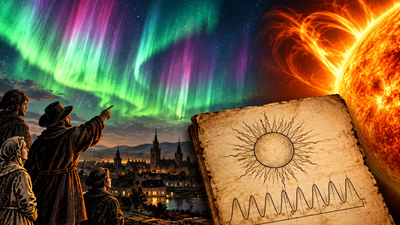
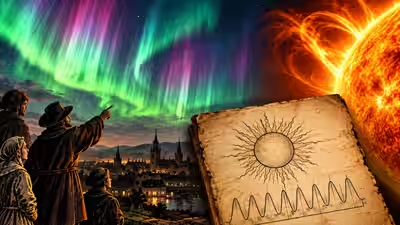
Centuries-old reports of strange lights in the night sky have helped scientists reconstruct a missing chapter in the Sun’s history. A study published in Scientific Reports by Kristof Petrovay, Laura G. Magyar and Hisashi Hayakawa has reconstructed eight solar activity cycles between 1560 and 1640 using historical records of aurorae, offering a way to trace solar behaviour from an era when systematic telescopic observations were only beginning.
When the sky became a record of the Sun
Before telescopes began producing regular observations of sunspots, scientists had few direct ways to determine how active the Sun was. One of the clues available to researchers today comes from historical accounts of aurorae, the glowing displays that occur when energetic particles associated with solar activity interact with Earth’s atmosphere.But aurora records are an imperfect proxy. Low-latitude aurorae are relatively rare and tend to capture some of the strongest space-weather events rather than providing a continuous measure of solar activity. Their occurrence also does not follow the sunspot cycle closely enough to simply use every auroral sighting as an indicator of a solar maximum or minimum. Petrovay, Magyar and Hayakawa therefore developed a statistical approach to extract information about the underlying solar cycles from these sparse observations.
More than 90% reliability for solar minima
The researchers used Monte Carlo simulations, repeatedly modelling large numbers of possible solar activity cycles, to determine how historical auroral observations could best be interpreted.Their analysis found that the method can identify the phase of a solar cycle with more than 90% reliability when the long-term average rate of major space-weather events producing low-latitude aurorae is around three events per year or higher.Under those conditions, more than 90% of the reconstructed solar minima fall within two years of the actual minimum. This is particularly useful because precisely identifying individual cycles in the period before systematic sunspot observations has been difficult.
Eight cycles reconstructed between 1560 and 1640
Using the method, the team reconstructed eight solar activity cycles, designated T−5 through T2, spanning roughly 1560 to 1640. The researchers introduce the term “telescopic era” for this sequence, with T0 referring to the solar cycle that was underway in 1610, around the beginning of the telescopic era of solar observation. They also found that cycles extending back to about 1540 could be reconstructed, although with lower reliability.The reconstructed sequence largely agrees with other independent evidence of past solar activity, including reconstructions based on cosmogenic radionuclides and available historical sunspot observations. That comparison is important because radionuclides such as carbon-14 and beryllium-10 provide another way of studying solar activity before the modern observational record. Their production in Earth’s environment is influenced by cosmic radiation, which in turn is affected by solar magnetic activity.
A window into the years before the Maunder Minimum
The period examined by the researchers falls within what they describe as the Early Modern Active Period, a century-long interval of broadly normal solar activity between the Spörer and Maunder Minima. The Maunder Minimum, beginning in the mid-17th century, is associated with an extended period of exceptionally low sunspot activity.The new reconstruction is therefore particularly useful for understanding what happened as the Sun approached that prolonged minimum. There is, however, an important caveat. While the reconstructed cycles show good overall agreement with radionuclide-based reconstructions and historical sunspot observations, the researchers found a notable discrepancy for the final cycle immediately preceding the Maunder Minimum.The study does not turn medieval and early-modern aurora sightings into a perfect historical sunspot record. Instead, it shows that even an incomplete collection of observations, recorded long before modern solar monitoring existed, can contain enough information to reconstruct the rhythm of the Sun with surprising precision. And in doing so, centuries-old descriptions of lights in the sky become more than historical curiosities: they become data points in the effort to understand how our star has changed over time.