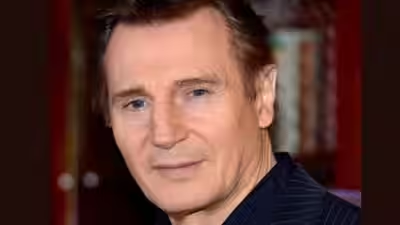
Liam Neeson says fatherhood changed even the way he ties his bootlaces: What happens inside the brain when becoming a parent quietly changes how you see, feel and move through everyday life


The image is almost comically ordinary: a father bending down to tie his shoelaces. But for Liam Neeson, even that tiny daily ritual became evidence that something fundamental had shifted. In a new interview with PEOPLE, the actor said fatherhood changed everything about him, down to “tying my bootlaces.”That may sound like an odd thing to remember about becoming a parent. But it captures something many parents eventually recognise: having a child does not simply add another responsibility to your day. It can quietly change the way you move through the entire day.
10 Sept 2026 | 12:19
What’s one thing you swore you’l never do as a parent now you find yourself doing?
“I’m a father. I have two boys, 30 and 31 years of age, Irish twins,” The Fix actor told PEOPLE. “I know my acting, forgive me for saying it, has improved by the fact that I’m a father. Everything, even tying my bootlaces has changed the day I became a father. Don’t ask me why, I do it the same way, but it’s changed in some way.”And neuroscience suggests Neeson may have been describing something more profound than a sentimental feeling.‘Everything’ suddenly looks differentNeeson became a father to sons Micheál and Daniel with his late wife, actress Natasha Richardson. Looking back on fatherhood, he has described the change as something that followed him everywhere.Neeson wasn’t necessarily saying that fatherhood literally changes the mechanics of tying a shoe. He was describing the way parenthood can alter the mental background against which ordinary actions happen. A parent may still make coffee the same way. Walk down the same street. Drive the same route. Tie the same shoelaces. But there is now another person constantly occupying part of the mental landscape.The brain doesn’t simply switch into ‘parent mode’Researchers have found evidence that becoming a father can involve changes in hormones, brain activity and neural networks involved in empathy, attention, motivation and emotional processing. A 2022 review of research on fatherhood found evidence of changes involving testosterone, oxytocin, prolactin and cortisol, alongside alterations in brain networks associated with empathy, emotional regulation and social understanding.That doesn’t mean every new father experiences the same transformation. But it does suggest that the transition into parenthood is biologically meaningful.Fatherhood can be a learning process, not a switchInterestingly, research suggests that fatherhood isn’t simply a biological event that happens once a baby arrives. Caregiving experiences appear to play a role.A study of fathers found that those who spent more time directly caring for their children showed stronger connectivity between parts of the brain involved in emotional response and social cognition.That makes Neeson’s description especially interesting.His point wasn’t that he woke up one morning with an entirely different personality. It was that fatherhood gradually became woven into ordinary behaviour.That is perhaps why his example is a shoelace rather than some dramatic life decision.Parenthood doesn’t always announce itself through a huge moment. Sometimes it appears in the smallest things.You start checking the back seat before leaving the car.You automatically look at the clock because someone needs to be home for dinner.You hear a child’s laugh in a crowded room and instinctively turn around.You become aware of which roads are dangerous, which foods might cause trouble, which films are too frightening and which jokes need explaining.Because the biggest change brought by children is rarely the dramatic announcement that your life has changed forever. It is the accumulation of thousands of tiny adjustments that eventually become automatic.The shoes are the same.The kettle is the same.The road is the same.But the person walking through all of it isn’t quite the same anymore.