
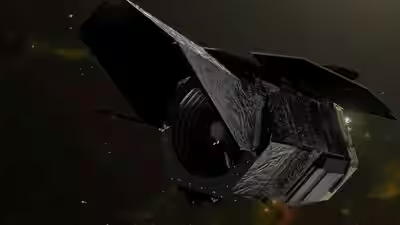

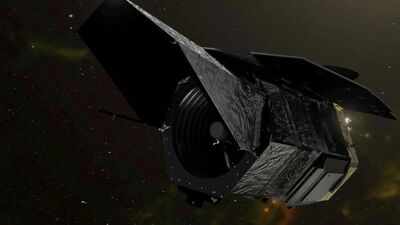
The story begins with an unexpected phone call. In Jan 2011, someone from the US’s highly secretive National Reconnaissance Office contacted a top Nasa official about a couple of curved mirrors, two metres wide, their spy satellite programme no longer needed.The offer immediately excited Nasa brass for two main reasons: the mirrors were Hubble-size, and they were getting them for free.Over the next decade, a thousand engineers went to work, packing millions of delicate components around one of the mirrors. Their creation was ready by 2024. And it was launched last month, as one of the most advanced space telescopes ever built.
“We’re now in the golden age of astronomical data,” says Sangeeta Malhotra, a Nasa astrophysicist who’s been with the Roman programme since 2017.
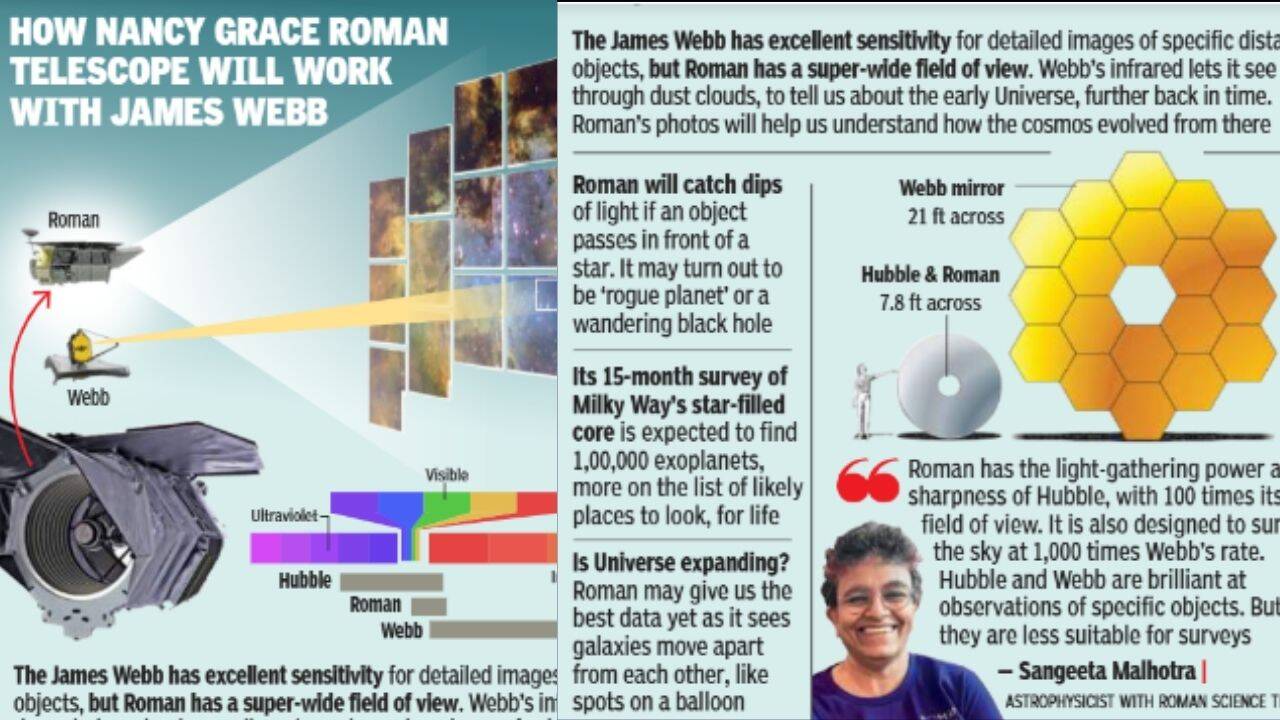
The Nancy Grace Roman is on its way to an observation point 1.5 million kilometres away. Once there, it will power up a 300-megapixel camera, for some the largest panoramic shots of the Universe ever taken by a space telescope.It’s named after Nancy Grace Roman, Nasa’s first chief of astronomy and its first woman executive, who in the early 1940s, was once asked why ‘a lady would prefer mathematics over Latin’. At Nasa, she was a strong advocate of space telescopes. Eight years after her demise at age 93, her namesake is set to revolutionise astronomy.Over its first five years of operations, Roman will survey 50 times the sky Hubble did in 30 years, beaming back 20 petabytes of data (roughly four billion songs), compared to Hubble’s 400Tb since 1990. During a single survey, lasting three weeks, this telescope, with a mirror donated by spies, will image an area equivalent to 3,455 full moons. To view the largest of these photos, one will theoretically need half-a-million 4K TVs — a screen size of nearly 250 acres, or the size of Delhi’s entire Red Fort complex.“We’re now in the golden age of astronomical data,” says Sangeeta Malhotra, a Nasa astrophysicist who’s been with the Roman programme since 2017. She was also part of the earliest scientific discussions, going as far back as 2005, that called for a wide-view tel-escope in space. Malhotra grew up in Karol Bagh in the 1980s, where she would wait for power cuts.“We slept on rooftops in the summers,” she says. “I would watch the sky pop with stars whenever the power went out.”She hung out with astronomers around the Nehru planetarium. And at 19, Malhotra ground a few mirrors, designed an assembly and made her first telescope. “I was an undergraduate studying physics at the time. I loved the theory and the maths, but amateur astronomy was the most fun we had. On the darkest nights, when lights were out, we would set up the telescope on the footpath, to give people a view of the Moon or Venus.”At 22, Malhotra left for the States and after a stint as a professor at Arizona State University, she joined Nasa, when she was “four Jupiter years” old. She’s with Roman’s science team, which works with engineers to execute research. She explains what sets apart this bus-sized space telescope from the two other famous ones — James Webb and Hubble.“Roman does this one thing very well,” Malhotra says, “which is survey large swaths of the sky. It has the light-gathering power and sharpness of Hubble, with 100 times its field of view. That is to say it images 100 times the patch of sky that Hubble or Webb would image during any pointing. It is also designed to survey the sky at 1,000 times Webb’s rate. Hubble and Webb are brilliant at detailed observations of specific objects. But they are less suitable for surveys.”Also aboard Roman is a coronagraph, designed to image exoplanets by cutting glare from host stars. A planet viewed without overwhelming starlight can throw up clues about its surface and even atmosphere. Roman’s coronagraph uses two mirrors whose surfaces can be adjusted in amounts smaller than the width of a DNA strand. It’s a tech demonstrator for future observatories, including Nasa’s proposed Habitable Worlds Observatory, which will look for a rock we could one day settle on.But the telescope Roman may work with quite perfectly is the Vera C Rubin Observatory on the ground in Chile, named after the woman whose groundbreaking research found the first clues to dark matter in galaxies.While Rubin will repeatedly photograph a much larger sky area in visible light, building a long time-lapse of changing stars and galaxies, Roman in space will see in near-infrared light through all the cosmic dust, separating objects that may blur or merge together in Rubin’s photos.Together, they offer one of our best shots at finding new planets, distant galaxies and massive black holes.“They were actually good friends, Vera Rubin and Nancy Grace Roman,” says Malhotra.“The two could be seen attending seminars together in the mid-2000s, asking hard questions. So it does seem fitting that data from telescopes named after them will one day be combined to give humanity the answers it seeks and the hard questions that must be asked.”